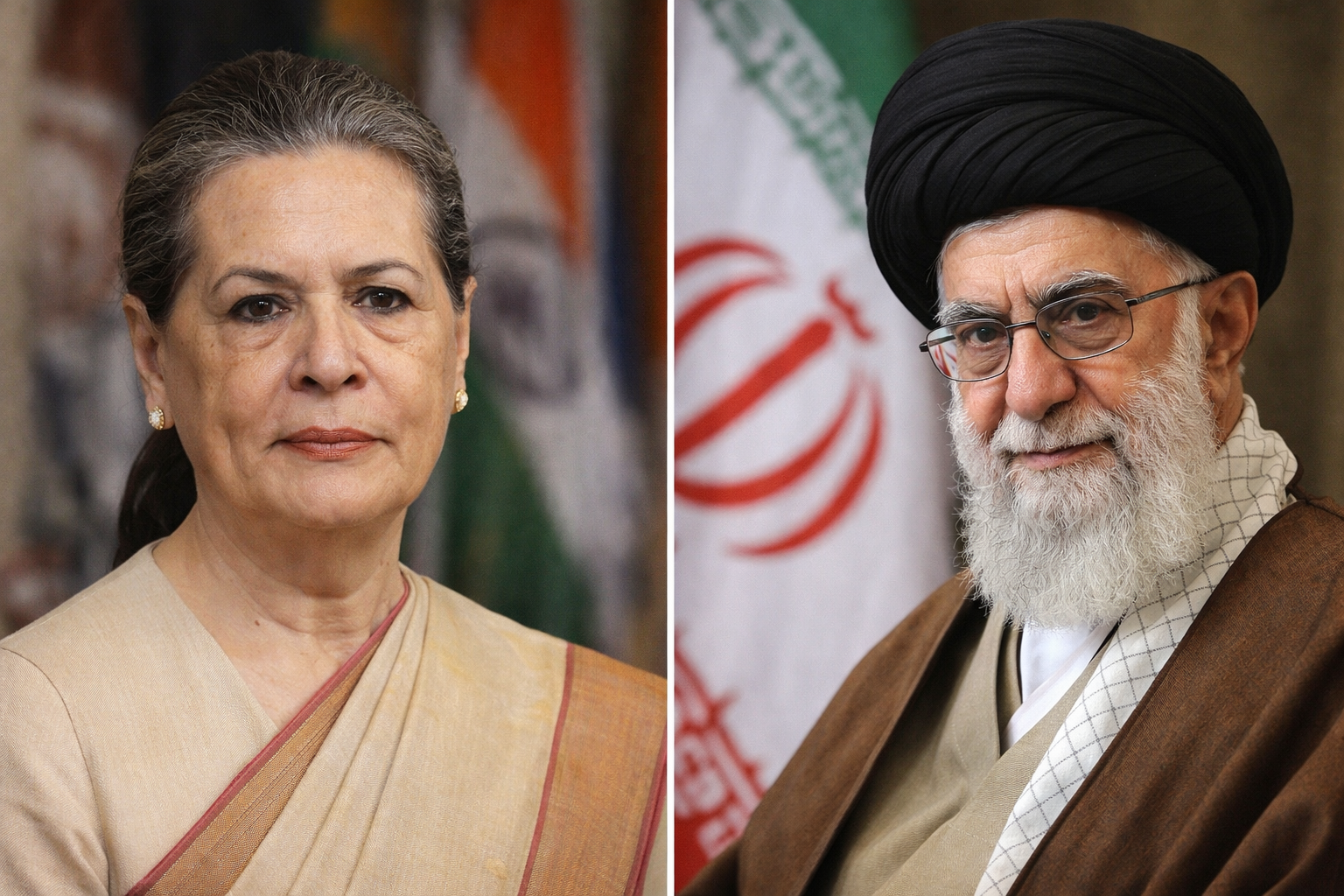
The Indian National Congress has once again discovered morality, loudly, theatrically, and conveniently from the opposition benches. Whenever political relevance begins to fade, outrage suddenly returns wrapped in the language of principle. This time, the trigger is an op-ed by Sonia Gandhi criticizing Prime Minister Narendra Modi for India’s restrained response following the reported killing of Iran’s Supreme Leader Ali Hosseini Khamenei. According to her, India’s silence represents not neutrality but an abdication of moral and strategic responsibility.
The accusation sounds weighty until one remembers that political memory in India extends beyond the latest newspaper column. Because if diplomatic restraint today amounts to abdication, then the Congress party must first explain its own remarkable silence when it governed India. In 2011, when Libyan ruler Muammar Gaddafi was violently overthrown and killed during NATO-backed military operations, the Congress-led UPA government did not issue sermons about sovereignty violations or moral collapse. There were no warnings that India’s credibility in the Global South was at stake. Strategic silence was then described as responsible diplomacy. The same conduct today is suddenly portrayed as ethical failure, not because doctrine has changed, but because political location has.
This selective outrage exposes the central contradiction of Sonia Gandhi’s argument. Foreign policy, when practiced by governments, demands calibration; when practiced by opposition parties, it becomes performance. India’s West Asia engagement today balances relations with mutually hostile actors while safeguarding energy interests, trade routes, and millions of Indian expatriates. Every official statement carries consequences. Silence in diplomacy is often deliberate communication, not weakness. Rebranding restraint as cowardice may generate headlines, but it does not constitute strategy.
More revealing, however, is the moral ground Congress appears willing to occupy. Ali Khamenei was not merely another international leader whose sovereignty deserved ritualistic defence. He presided over one of the world’s most rigid theocratic regimes – a system where dissent invited imprisonment, where women protesting compulsory religious codes faced brutal repression, and where opposition movements were crushed in the name of ideological purity. Thousands were executed over decades for challenging clerical authority. During the Iran-Iraq War, disturbing accounts emerged of Basij militia recruits, many barely adults, being deployed in human-wave assaults to clear minefields, lives expended as instruments of ideological warfare.
Yet India’s principal opposition party now appears morally aggrieved over insufficient condemnation following his death. The question therefore becomes unavoidable: is this truly about sovereignty, or about constructing a political narrative against the Modi government at any available opportunity? Because when outrage appears reserved for moments politically useful at home, moral language begins to look less like principle and more like positioning.
Sonia Gandhi’s op-eds rarely exist in isolation. In India’s contemporary political ecosystem, they function as signals. Each intervention – whether opposing development projects in Great Nicobar, environmental clearances in the Aravallis, or now foreign policy decisions, is followed by synchronized amplification across activist networks, commentators, and ideological allies. The sequence is familiar: publication, mobilisation, narrative escalation. The objective is not diplomatic correction but political momentum.
The aftermath of Khamenei’s killing illustrated this dynamic vividly. Demonstrations emerged across more than ninety locations in India, from parts of the Kashmir Valley to metropolitan centres such as Mumbai and Lucknow. Thousands gathered to mourn a foreign clerical authority thousands of kilometres away, a leader whose governance model fundamentally contradicts India’s constitutional framework. The spectacle revealed a profound sociological paradox: emotional mobilisation within a democratic republic for the head of a theocratic state that suppressed precisely the freedoms Indians exercise daily.
Congress choosing this moment to accuse India of moral abdication risks legitimizing these reactions as expressions of ethical solidarity rather than ideological alignment. It blurs the distinction between defending sovereignty as a diplomatic principle and appearing sympathetic to regimes built upon religious authoritarianism. For a party that claims ownership over India’s secular legacy, the optics are politically striking.
The deeper problem lies in consistency. When Congress governed, realism guided diplomacy. National interest justified caution. Silence was wisdom. Today, the same prudence is condemned because acknowledging its necessity would deny the opposition a convenient attack line. Foreign policy becomes another domestic battlefield, stripped of continuity and reduced to partisan accusation.
India’s credibility internationally has never depended on issuing emotional condemnations after every geopolitical upheaval. It rests on predictability, balance, and strategic autonomy, precisely the principles Sonia Gandhi invokes while simultaneously undermining. True autonomy allows India to choose when to speak and when restraint better serves national interest. Demanding performative outrage risks converting diplomacy into ideological signalling.
Ultimately, this controversy reveals less about Iran and more about the evolution of the Congress party itself. Increasingly detached from governance responsibility, it appears more comfortable engaging in narrative politics than strategic debate. The language of morality becomes a political instrument deployed selectively, activated whenever opposition requires mobilisation.
The real abdication, therefore, is not India’s diplomatic silence. It is the abandonment of consistency by those who once shaped the very foreign policy traditions they now criticize. When principles shift depending on who occupies power, morality ceases to guide politics, it becomes a weapon within it.
India does not weaken itself by exercising restraint in volatile geopolitical moments. But political credibility certainly weakens when outrage appears calibrated, memory becomes selective, and foreign tragedies are repurposed for domestic confrontation. At some point, the country must ask whether such interventions defend national interest or merely oppose Narendra Modi, even if doing so requires unexpected sympathy for regimes fundamentally opposed to the freedoms India represents.
Author – Uma Mhatre