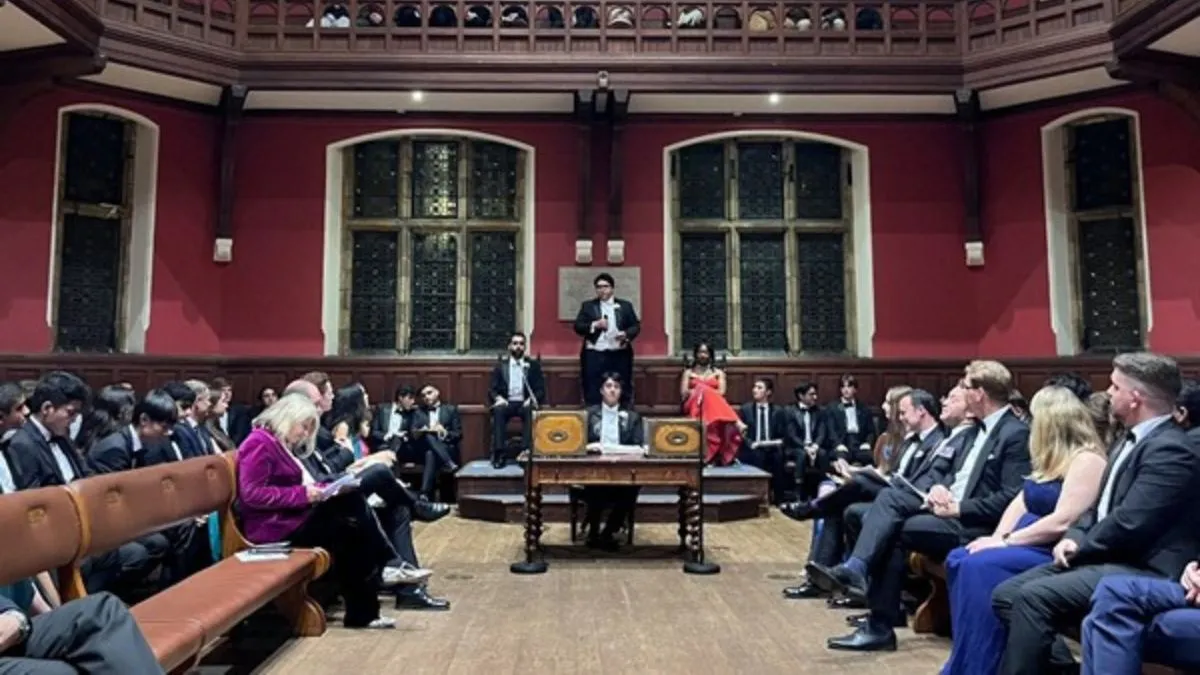
When the Oxford Union scheduled its November 27, 2025 debate, “This House Believes That India’s Response to Pakistan is a Populist Strategy Sold as Security Policy”, it was framed as another earnest attempt by one of the world’s oldest debating societies to probe a difficult geopolitical question. What happened instead exposed something more telling of how India’s intellectual class repeatedly enters forums structurally predisposed against them, and how Pakistan continues to set the terms of conversation within Western academia while the Indian diaspora remains largely reactive and disorganized.
The controversy unfolded with a familiar sense of déjà vu. Senior advocate J. Sai Deepak, invited months earlier, travelled to Oxford prepared to speak. Yet the Pakistani delegation though physically present in Oxford simply did not attend. They later claimed a walkover, asserting that Indian speakers like General M.M. Naravane, Subramanian Swamy, and Sachin Pilot had backed out. Sai Deepak publicly challenged this version with documented evidence, emails, call logs, and internal communications clearly showing that he was present and ready, and that Pakistani representatives had disengaged without explanation. Instead of meaningful debate, the event became a study in how narrative manipulation thrives when intellectual oversight collapses.
The episode may appear trivial compared to the larger security issues India confronts, but it illuminates a recurring pattern, that of India’s intellectual elite continues to walk into debates where the ground has already been prepared to disadvantage or discredit them.
The Indian intelligentsia and the persistent need for western validation
What stands out most starkly is the contradictory behaviour of India’s intellectual establishment. Many among them regularly argue at home that “terror and talks cannot coexist,” particularly after every violent terror incident that Pakistan perpetrates against India. They often advocate an uncompromising national security posture and often criticize attempts at engagement as naïve or politically motivated. Yet the same intelligentsia are remarkably eager to debate Pakistan in Western academic settings.
This inconsistency reveals more than just a tactical misstep; it reflects a deeper psychological dynamic. For decades, India’s intellectual class has attached disproportionate value to recognition by Western institutions like Oxford, Cambridge, Harvard, or the LSE. This post-colonial reflex still casts Western platforms as global arbiters of legitimacy, though in today’s date and age, any of them are far from it. In the past decade most of these institutions have become a bulwark for radical Islamist ideologues to legitimize acts of global terrorism and also provide intellectual heft to the most regressive societal issues that currently plague large part of the globe. In this pursuit, Indian speakers overlook the structural constraints of these debates. The choice of topics, moderators, framing of questions, and selection of panellists almost always aligns with entrenched academic biases against India.
The desire for validation undermines the coherence of India’s own political messaging. If India asserts that formal dialogue with Pakistan must be conditional on the cessation of terrorism, then choosing to engage the same adversary in collective Western spaces, without any conditions, weakens that principle. It inadvertently elevates Pakistan to a moral parity it definitely does not deserve.
Why granting Pakistan space in academic debates is problematic
What appears on the surface to be an exercise in free speech or scholarly exchange often masks a much deeper imbalance, that is Pakistan’s deliberate use of global academic forums to reshape narratives, manufacture moral equivalence, and challenge India’s legal and legitimate grounded position on Jammu and Kashmir.
This is not a new phenomenon. Historically, Pakistan has understood the soft-power value of elite debating platforms far better than India. Over decades, it has cultivated networks within Western universities, student bodies, South Asian and Western societies, ensuring that its framing of geopolitical messages concerning India are marked as a dispute of identity, justice, and Muslim victimhood, that finds sympathetic ears. The Indian intelligentsia, by contrast, enters these debates with the assumption that rational argument alone will suffice, that facts will win on their own, and that Western audiences will naturally approach the issue with neutrality. This misreading of the ecosystem is precisely what allows Pakistan to dominate the conversation long before the debate begins.
For Pakistan, participation in these debates serves a highly calibrated strategic purpose. It allows Islamabad to repackage an illegal territorial occupation into an intellectual argument about a “disputed identity,” “so-called self-determination,” or “regional justice.” More dangerously, it gives Pakistan an opportunity to present itself as the self-appointed messiah of South Asian Muslims, projecting an image of moral stewardship that stands in stark contrast to its own domestic record. Through these curated forums, Pakistan further positions Indian Muslims as oppressed, constructs the narrative of India as a rising “fascist” state, and inserts itself as the moral guardian of regional Muslim interests. This narrative-building conveniently obscures the reality that Pakistan is the region’s principal exporter of terrorism and one of the most repressive military-controlled regimes, the one that has crushed democracy, silenced dissent, and disenfranchised its own ethnic minorities for decades.
When Indian intellectuals step into these debates without recognizing how structurally tilted, they are, they end up giving Pakistan the legitimacy that it validates to seek. The problem is not the debate per se; it is debate conducted on Pakistan’s terms, where the very structure of the conversation or in this particular case a pure theatrical optics lets Pakistan walk away with moral grandstanding. Moreover, these forums are not neutral, they are arenas where Pakistan’s narrative machinery has been embedded for years, ready to channel any discussion or spin any argument back into its preferred framing.
The Indian diaspora in the United Kingdom must also share responsibility for this recurring trap. Despite having the numbers, resources, and influence to build independent platforms that allow Indian thinkers to articulate their positions on equal footing, diaspora groups remain surprisingly passive. They continue to outsource intellectual engagement to institutions like the Pakistani dominated Oxford Union, which are neither insulated from adversarial political capture nor designed to safeguard narrative balance. The absence of strong Indian-backed forums has meant that Pakistan-backed or Pakistan-leaning groups continue to dominate South Asia discourse within British universities. The result is predictable, as the debates that begin with the illusion of equality but end up reinforcing Pakistan’s agenda.
This is where the controversy surrounding Sai Deepak becomes a broader case study rather than a one-off event. The outrage, the theatrics, and the posturing around who is presenting the truth reflect a deeper intellectual insecurity within the Indian elite, a belief that legitimacy is still bestowed by old Western institutions, not by the strength of India’s own academic and strategic ecosystem. Meanwhile, Pakistan capitalizes on every opportunity, using even minor debates or optics around it to amplify its disinformation strategy, internationalize Kashmir, and create the illusion of parity with India.
For India, the lesson is not to retreat from debate or an event, but to recognize the architecture of the planned engagement itself and deal with it in an effective manner. Pakistan’s strategy is built around narrative engineering, diaspora leverage, and student-body influence, an ecosystem India has been far too slow to understand, let alone counter. If Indian intellectuals continue to approach these forums with the assumption that good arguments alone suffice, they will continue walking into the same traps, inadvertently reinforcing Pakistan’s geopolitical messaging rather than challenging it.
Pakistan’s deepening influence on UK campus narratives
Events like the Oxford Union fiasco are not isolated incidents. Pakistan has spent years cultivating networks within British universities, particularly through student bodies such as the Oxford Pakistan Society and allied groups in London, Manchester, and Birmingham. These organizations often play influential roles in amplifying the Pakistani narratives by shaping campus debates, hosting events, and influencing administrative decisions about speakers and topics.
This influence is well crafted strategic tool that Pakistan mostly uses to its advantage. Pakistan has understood that narrative dominance in academic spaces eventually filters into policymaking circles, media ecosystems, and activist networks. The slow accumulation of influence through student elections, event committees, and alliances with sympathetic faculty has allowed Pakistan to present itself in forums like Oxford as a nation wronged by India rather than as an aggressor and a terror exporter violating international mandates.
The outcome is predictable, as these debates become carefully curated environments where India is compelled to defend itself in a hostile setting, and Pakistan is treated as an equal, even when the facts suggest otherwise.
The Indian diaspora’s structural weakness: Loud protests, weak institutions
While Pakistan actively shapes academic discourse, the Indian diaspora continues to rely predominantly on protests, petitions, and reactive outrage. These actions may express collective sentiment but rarely influence institutional power.
Diaspora organizations hesitate to take the next big step. They have been painstakingly slow in creating multiple robust, sustainable platforms capable of hosting academic discussions, funding research, supporting scholars, or nurturing student leadership. Instead of building long-term structures at universities, chairs, lecture series, conferences, or student alliances, they largely depend on mobilizing crowds only after damage has been done.
Protests outside Oxford or Cambridge do little to counteract the framing inside the rooms where the debates actually happen.
If India wants its perspective to carry weight in Western academic spaces, diaspora organizations must invest in institutional presence, not just emotional expression. That requires funding, professional leadership, and long-term strategy and not episodic activism.
A more productive strategy: Engage the rest
The Oxford controversy should serve as a moment of reckoning. It highlights the urgent need for India’s intellectual class to rethink where and how it engages globally. Instead of repeatedly stepping into debates that inherently diminish India’s positional advantage, policymakers, scholars, and public thinkers should pivot toward platforms where the discussion is grounded in law, policy, and contemporary geopolitics.
Engaging with European think tanks, American policy centres, global security institutions, and Western academic departments and student lobbies is far more effective. These forums can amplify India’s global message, its counterterrorism doctrine, pluralism, economic transformation, and regional diplomacy in ways that shape international opinion more constructively. Debating Pakistan does not change minds but influencing Western intelligentsia in academic and policy ecosystems does.
The Oxford Union debacle is also emblematic of a larger structural problem. India’s intelligentsia continues to engage in debates that offer prestige without strategic value, while the diaspora remains unprepared to challenge Pakistan’s growing influence within Western academic institutions. If India wishes to shape global understanding of its policies and principles, it must strengthen its intellectual presence, choose its platforms wisely, and resist the temptation to validate Pakistan through reactive engagement.
Ultimately, India has far more to gain from articulating its story on its own terms or at the least on equal terms than from performing in debates that are designed to produce more heat than understanding. Debating with Pakistan delegates at their chosen platforms is akin to wrestling with the pig where both get dirty, but the Pig actually enjoys it. Oxford event fiasco therefore should be treated not as an embarrassment but as a lesson and perhaps a turning point.
Note: The article is written by Raja Muneeb, independent journalist and geopolitics expert. He can be reached on X at @rajamuneeb.