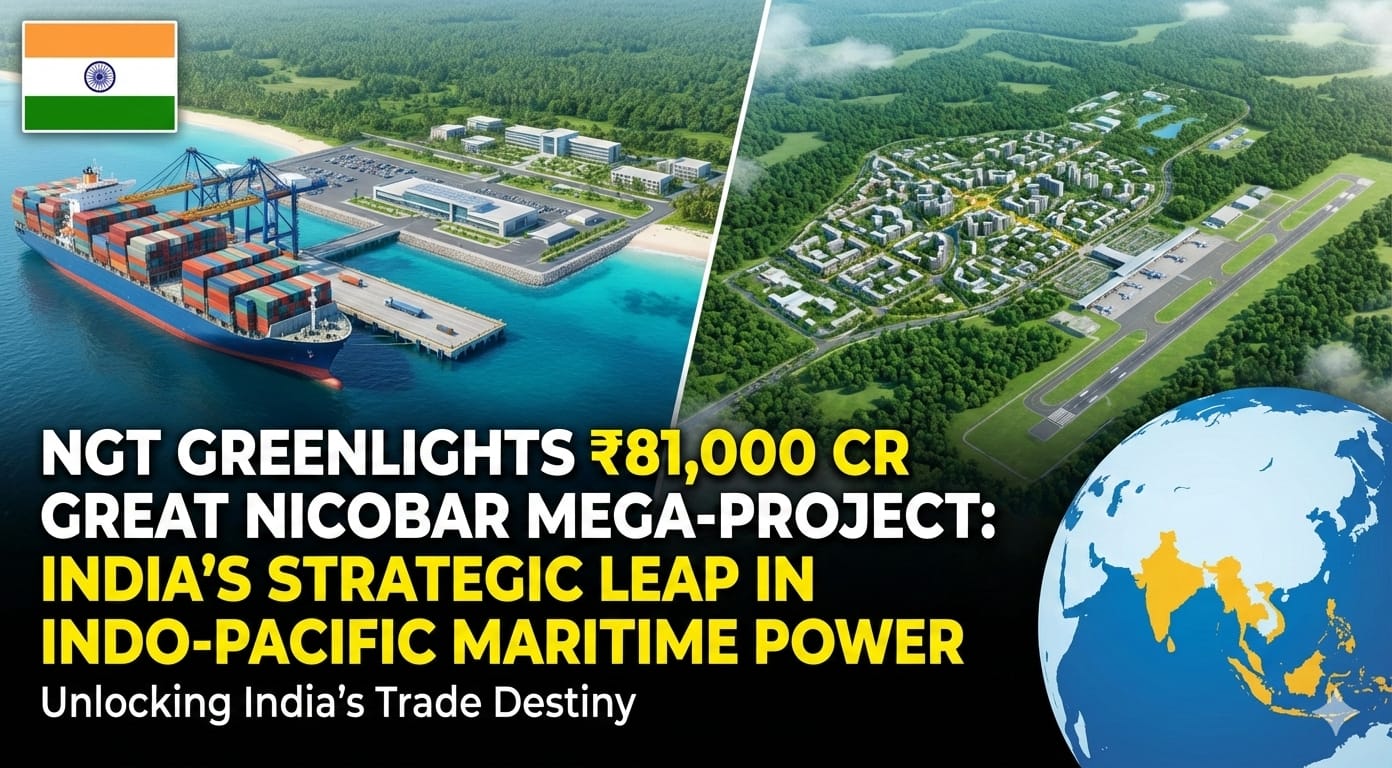
In a landmark decision that propels one of India’s most ambitious infrastructure ventures forward, the National Green Tribunal (NGT) has approved the ₹81,000 crore Great Nicobar Island Holistic Development Project. The tribunal citied the project’s overriding strategic importance while mandating strict environmental compliance.
This mega-initiative, encompassing an international container transshipment terminal at Galathea Bay, a greenfield international airport, a power plant, and an integrated township across 166 sq km—including pristine forests and tribal lands—had faced intense scrutiny and legal challenges for over two years.
The NGT’s six-member bench dismissed petitions alleging ecological devastation and violations of coastal regulation zones, stating there are “no good grounds to interfere” as adequate safeguards are embedded in the clearances, though it directed authorities to enforce them rigorously.
This clearance marks a pivotal victory for India’s maritime ambitions, transforming the southernmost Nicobar Island into a bustling hub overlooking critical global sea lanes near the critical Malacca Strait, through which $3.5 trillion in annual trade flows.
The project’s core thrust lies in its transshipment port, designed to handle up to 16 million TEUs (twenty-foot equivalent units) annually in four phases at a cost of around ₹43,796 crore, positioning Great Nicobar as India’s answer to foreign-dominated hubs like Singapore, Colombo, and Port Klang.
Currently, 75% of India’s transshipped cargo—worth billions—relies on these overseas ports, incurring hefty fees and delays that inflate logistics costs by $70-75 billion yearly. By capturing 20-30% of regional traffic, the deep-sea port with its natural depths for mega-vessels will slash these expenses by ₹4-5 trillion annually, enhance supply chain reliability, and prioritize Indian EXIM cargo, directly fueling the nation’s export-driven growth story.
India’s diversified export basket—from agriculture and services to burgeoning manufacturing, especially precision auto components vital for Europe’s industry—stands to gain immensely, reducing dependency and amplifying competitiveness in a $5 trillion economy push. The airport and township will further catalyze tourism, FDI, and 2-2.5 lakh jobs in construction, logistics, and services, creating a self-sustaining economic ecosystem over the next 50 years.
Strategically, Great Nicobar embodies India’s forward-thinking vision in the Indo-Pacific, securing chokepoints like the Six Degree Channel against rising naval activities and Chinese influence, while enabling rapid Navy deployments and maritime surveillance. Its equidistant location from key Asian ports makes it ideal for rerouting trade to emerging markets, including direct access to Russia and Ukraine via optimized northern corridors, bypassing congested routes and foreign bottlenecks.
This aligns with Sagarmala and broader initiatives like the India-Middle East-Europe Economic Corridor, strengthening BIMSTEC ties and ASEAN partnerships for regional dominance. Completion in phases through 2047 will not only handle ultra-large vessels but also integrate defense infrastructure, turning the island into India’s “Jebel Ali of the East”—a commerce-security powerhouse.
Yet, the path to this green signal was fraught with activism aimed at derailing economic progress. Petitions highlighted risks to corals, rainforests, and indigenous Shompen and Nicobarese tribes, amplified by Congress leaders like Jairam Ramesh, who decried it as an “ecological disaster” flouting laws, and Sonia Gandhi, who labeled it a “planned misadventure” threatening tribal survival.
European and American church-backed NGOs, alongside foreign-funded campaigns, mounted a relentless two-year assault via op-eds in international media and local protests, echoing tactics seen in Tamil Nadu’s copper project and nuclear plant delays—where external lobbies sought to stall India’s rise.
Survival International and others pressured for scrapping, questioning tribal consents and cost escalations from $1 billion to over $10 billion. These efforts, often traced to geopolitical rivals wary of a resurgent India, underscore activism as a modern weapon against development, but the NGT’s ruling reaffirms national priorities with ecological balance.
As shovels hit the ground, the government faces the challenge of navigating compliance amid watchful eyes, ensuring tribal welfare and zero net biodiversity loss while delivering on promises. This project isn’t just infrastructure; it’s India’s declaration of maritime sovereignty, trade autonomy, and strategic autonomy in a multipolar world.
By taming foreign dependencies, Great Nicobar will propel exports, jobs, and influence, scripting the next chapter of Viksit Bharat amid global flux. The tribunal’s nod signals resilience against hurdles, proving that visionary execution trumps obstruction in building a $5 trillion powerhouse.