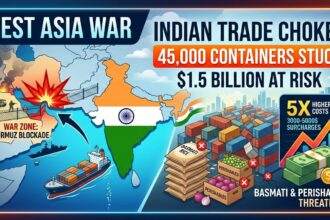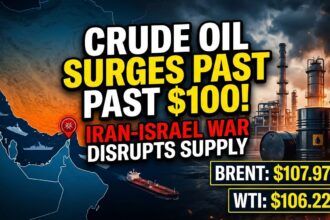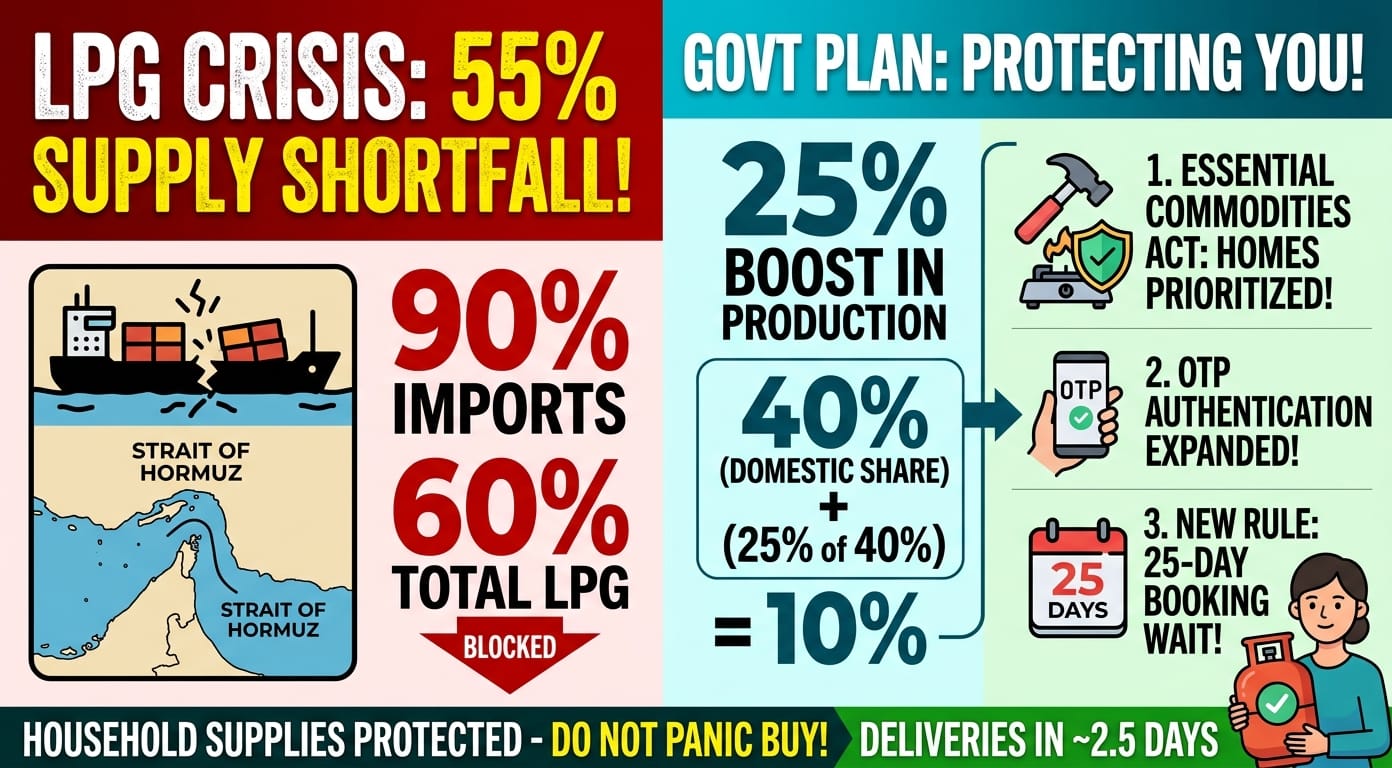
If you have been hearing worrying talk about cooking gas running out, here is what is actually happening. India imports about 60% of its liquefied petroleum gas (LPG) — the fuel that powers most household stoves across the country. Of those imports, a massive 90% travel through a narrow sea passage in the Middle East called the Strait of Hormuz. Due to the ongoing West Asia conflict, that passage has effectively shut down for shipping, which means roughly 55% of the cooking gas India normally consumes is currently unavailable from its usual sources.
That is a genuinely significant disruption — but it is not the full picture. The government has moved quickly to respond, and officials want households to know that they are the top priority when it comes to keeping supplies going.
To protect household consumers, the government has invoked a powerful law called the Essential Commodities Act, which legally forces suppliers to put homes before hotels, factories, and other commercial users. In practical terms, this means that if there is not enough cooking gas to go around, families get it first. As a direct result, hotels and restaurants are facing their own shortages — a separate panel has been set up to handle requests from these commercial users.
Alongside this legal move, the government has ordered oil refineries to produce as much LPG as possible and to redirect raw materials — such as propane and butane that would normally go into making plastics and chemicals — into producing cooking gas instead. These combined steps have already pushed domestic LPG production up by 25% compared to what was being produced before the conflict began.
At the same time, India is urgently hunting for alternative suppliers outside the Middle East. Some new supply cargoes have already been secured from distant regions such as Canada, though it takes longer for those shipments to arrive. Efforts are ongoing to plug as much of the gap as possible from these alternative sources.
Now the question is — does the 25% production increase solve the problem? Not entirely — and it is important to understand why. Before the crisis, India was producing only 40% of its LPG domestically. A 25% boost to that 40% share works out to roughly a 10% increase in overall national consumption. Given that around 55% of normal supply volumes are now cut off from import routes, a 10% production gain leaves a meaningful gap still to be filled. The government is trying to close that gap through alternative imports and strict prioritisation of household use, but it does mean supplies are genuinely tighter than usual.
Government officials are asking citizens not to panic. Sujata Sharma, Joint Secretary in the Ministry of Petroleum and Natural Gas, said on Wednesday that some households are panic-buying and hoarding cylinders based on misinformation, and that this behaviour is actually making things harder for everyone else. She confirmed that the normal delivery cycle — where your booked cylinder arrives within two-and-a-half days — is still being maintained. Panic booking creates an artificial shortage by pulling cylinders out of circulation faster than the system can refill them, which ends up hurting other households who genuinely need gas.
To discourage hoarding further, the government has also extended the minimum waiting period between cylinder bookings from 21 days to 25 days. This is designed to stop people from booking cylinders well before they actually need them.
Reports of black-marketing — where cylinders are being sold illegally at much higher prices — have emerged from various parts of the country. The government is responding on two fronts. First, the authentication system used when a cylinder is delivered (where a one-time password is needed to confirm receipt) is being rapidly expanded to cover 90% of all domestic LPG consumers. This makes it harder for distributors or delivery workers to divert cylinders to the black market. Second, oil marketing companies and enforcement teams are working together at the local level to clear backlogs at distribution points and ensure cylinders reach households as intended.
At the national level, the Union Home Secretary has held a meeting with the top administrative and police officials of every state and union territory, directing them to take strict action against hoarding of essential commodities and to maintain steady supplies. Each state has also been asked to designate an official spokesperson to give the public regular, reliable updates — a measure aimed at countering the spread of rumours and false information.
The disruption is real, and the government is not pretending otherwise. India’s usual cooking gas supply chain has been significantly hit by events beyond the country’s borders. However, the steps taken so far — production increases, legal protection of household supplies, alternative import sourcing, and anti-hoarding enforcement — are aimed squarely at making sure that families with home gas connections keep receiving their cylinders. If you have a domestic LPG connection and you book your cylinder at the regular time, officials say your delivery should arrive on schedule. The message from the government is clear: stay calm, book only when you need to, and trust that household supplies are being protected.