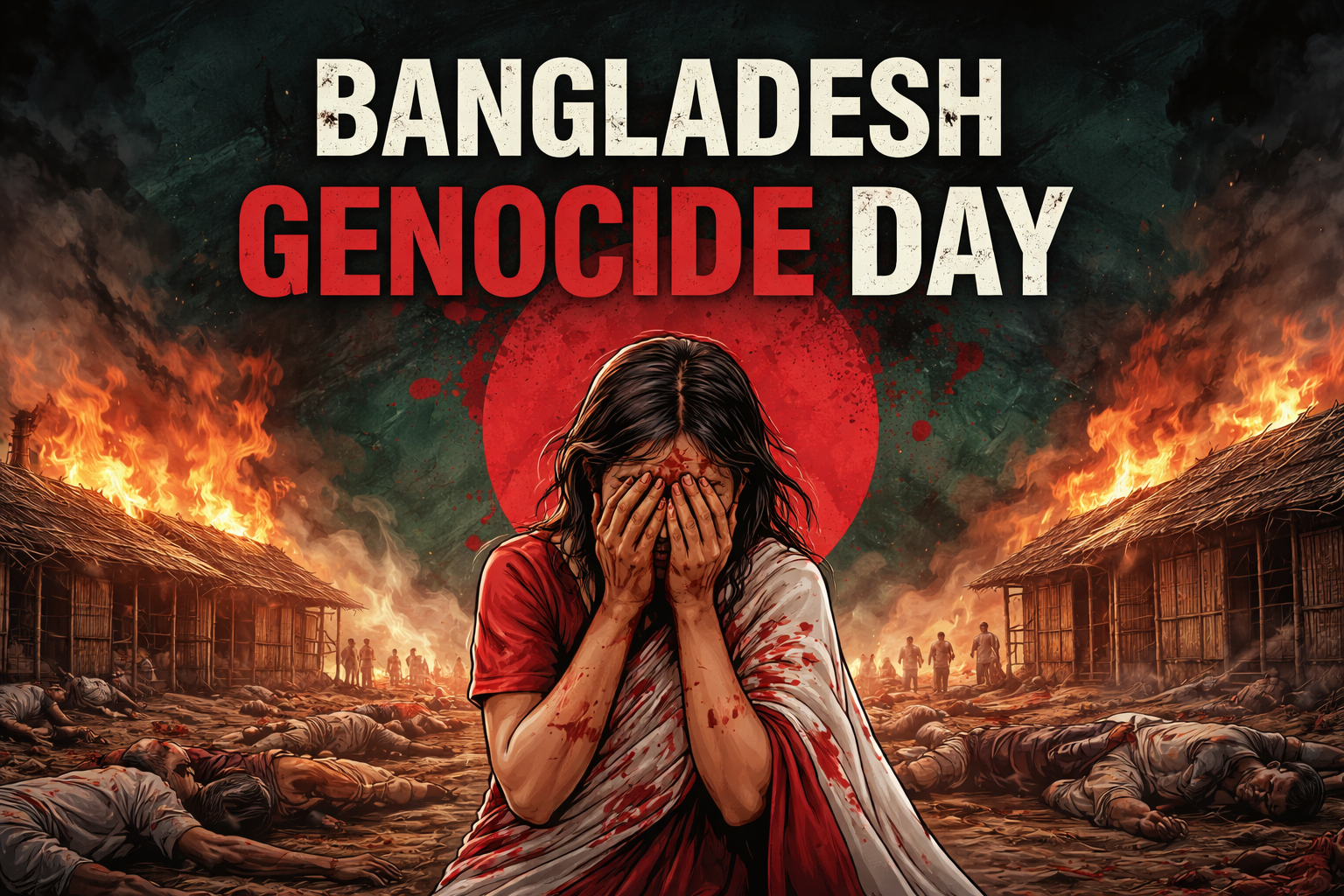
The observance of Genocide Day in Bangladesh is more than a solemn act of remembrance; it is a reaffirmation of historical truth in a region where memory is often contested. It is particularly significant that leaders across the political spectrum, including those from the Bangladesh Nationalist Party (BNP), have openly acknowledged and condemned the atrocities of Operation Searchlight. Such bipartisan recognition reflects a growing maturity in confronting the past an example that offers lessons well beyond Bangladesh’s borders.
Genocide Day marks March 25, 1971, when the Pakistani military launched Operation Searchlight in what was then East Pakistan. What followed was a systematic and brutal campaign aimed at crushing a democratic mandate. Universities were stormed, intellectuals targeted, and civilian neighborhoods subjected to indiscriminate violence. The scale and speed of the crackdown were staggering. Within days, thousands were killed; in the months that followed, the death toll rose dramatically, accompanied by mass displacement and grave human rights violations.
What makes this episode especially relevant today is the identity of its victims. The majority of those who suffered and died were Bengali Muslims. This reality challenges simplistic narratives that frame political conflicts solely in religious terms. In 1971, shared faith did not translate into protection or solidarity. Instead, state power, political calculations, and ethnic tensions dictated events. It serves as a sobering reminder that religion alone does not determine political conduct interests and power often do.
This contradiction becomes even more striking when viewed against Pakistan’s long-standing claim of being a defender of Muslim causes worldwide. From Kashmir to other international issues, Islamabad has frequently invoked the language of religious solidarity. Yet, the events of 1971 expose a clear gap between rhetoric and reality. Faced with dissent from its own citizens many of whom shared the same faith the Pakistani state chose repression over dialogue. In that moment, the notion of Muslim brotherhood gave way to the imperatives of control and authority.
For Indian Muslims, and indeed for Muslims globally, the lesson of 1971 is not one of alienation, but of awareness. It underscores the need to distinguish between faith as a spiritual bond and political narratives that may selectively invoke that bond for strategic purposes. True solidarity cannot be built on slogans alone; it must rest on justice, dignity, and respect for human life. When history is engaged with honestly, it empowers communities to approach contemporary challenges with clarity and independence.
Bangladesh’s continued observance of Genocide Day also highlights the importance of collective memory in nation-building. By acknowledging past atrocities including those committed by a state that once ruled it Bangladesh affirms its commitment to truth and accountability. The willingness of leaders, including those from the BNP, to support this narrative shows that historical justice can transcend present day political divisions. Some truths, after all, are too important to be politicized. In an era where geopolitical conflicts are increasingly framed through religious lenses, revisiting 1971 offers a necessary corrective. It reminds us that political actions cannot be reduced to religious identity, and that states regardless of their ideological claims are ultimately guided by strategic interests. For India, with its complex and diverse social fabric, this perspective is particularly important. Understanding the interplay between history, identity, and politics is essential to navigating present challenges.
The remembrance of Genocide Day, therefore, extends beyond Bangladesh. It is an opportunity for the wider region and the global community to reflect on the dangers of conflating faith with state power. It is also a call to uphold universal values of human rights and dignity that transcend borders and beliefs. More than five decades later, the events of 1971 continue to resonate not only as a tragedy, but as a lasting lesson. They remind us that the strength of any society lies in its ability to confront difficult truths, learn from them, and ensure that such chapters are neither forgotten nor repeated. In this sense, Genocide Day is not just a memorial it is a guidepost for a more honest and humane future.
Author Dr. Shujaat Ali Quadri is the National Convener of Muslim Youth Organisation of India MSO, he writes on a wide range of issues, including, Sufism, Public Policy, Geopolitics and Information Warfare.