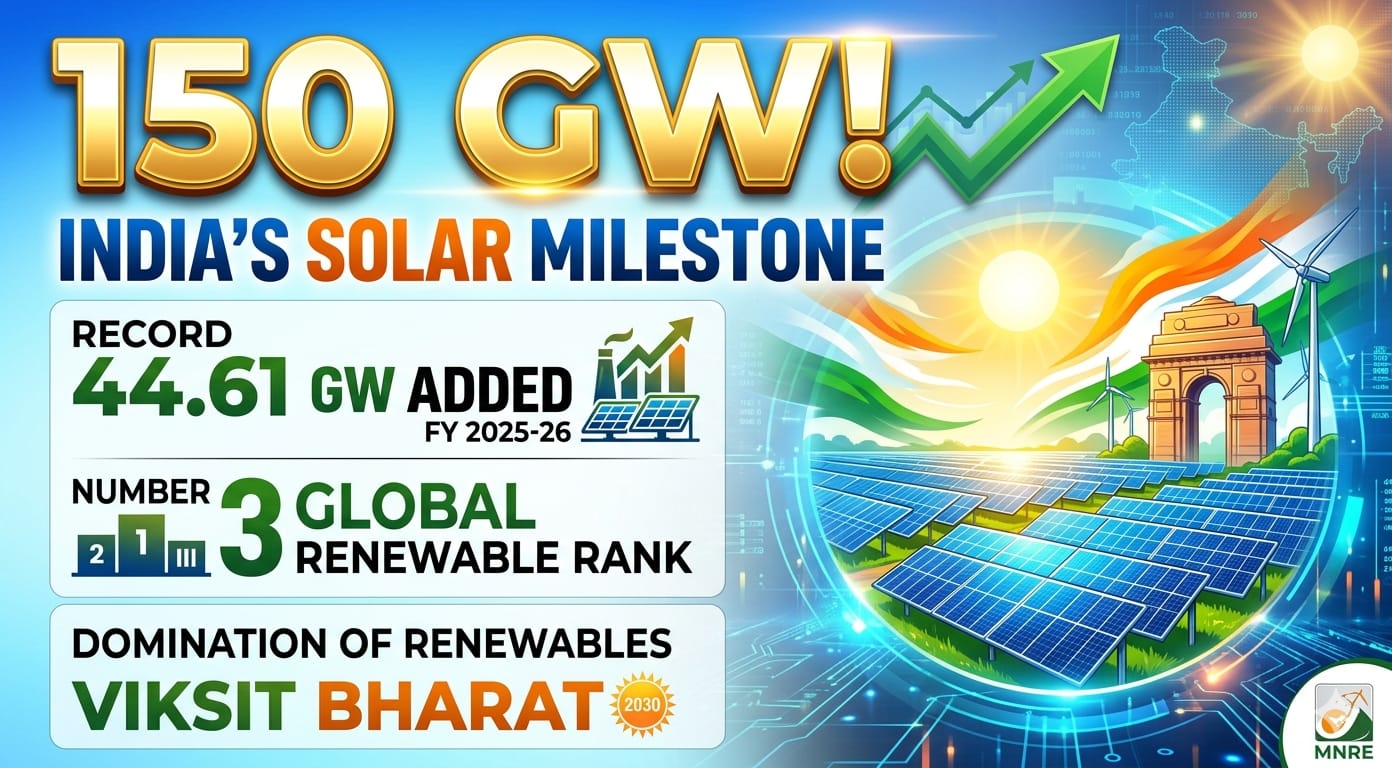
The transformation into the domination of renewable energy in India became the point in history in the fiscal year 2025-26 when its cumulative solar power capacity hit a record figure of 150 GW, a fact that was substantiated by the Ministry of New and Renewable Energy (MNRE) in its latest physical progress report as of March 31, 2026.
This milestone was accelerated with record amounts of installations during the year that started with a strong momentum after the earlier periods when the country had already established a solid foundation with over 100 GW of solar already completed and momentum towards 500 GW of non-fossil installed by 2030 spearheaded by Prime Minister Narendra Modi.
It culminated in the previous milestones, including surpassing 50 percent non-fossil share in total power generation by June 2025, five years earlier than the Paris Agreement NDC, and peaks of 51.5 percent of total demand met by renewable generation on July 29, 2025.
FY 2025-26 chronologically saw solar installations of an unprecedented 44.61 GW during the 12 months between April 1, 2025 and March 31, 2026, and the highest yearly addition to date of almost twice the 23 GW added the previous year. The surge was not only large contributions of distributed renewable energy (DRE), which contributed 16.3 GW or 36% of the yearly solar additions, but featured decentralized initiatives such as rooftop and off-grid projects.
In particular, under the PM KUSUM program, 7.6 GW was installed, enabling farmers with solar pumps and grid-connected plants, and rooftop solar capacity catapulted the segment beyond the 25 GW to reach 25.73 GW by the end of March, as the segment moved widely, both in households and commercial areas. There was a balanced portfolio with ground-mounted plants being the largest by a cumulative of 114.87 GW, hybrid projects coming in with the solar component of 3.86 GW and off-grid solar being 5.80 GW.
The peak of the year came in March 2026, when a record single-month addition of 6.656 GW of solar power – the biggest single monthly addition to date – was registered, to take the total solar power to exactly 150.261 GW according to MNRE records.
This total limit renewable energy (RE) excluding large hydro was at 223.273 GW, increased since past years in steady growth: wind energy 6.057 GW, biomass (bagasse) 9.821 GW, non-bagasse cogeneration 1.048 GW, waste-to-energy 0.324 GW plus off-grid With large hydro added (51.415 GW, including 7.176 GW of pumped storage), total RE was 274.688 GW, and non-fossil capacity (including 8.78 GW of nuclear) was 283.468 GW with FY additions reaching an all-time high 55.292 GW -ber.
These figures were announced by the Union Minister of New and Renewable Energy and Consumer Affairs, Food and Public Distribution, Pralhad Joshi on Wednesday, April 8, 2026 in an MNRE press release saying that India is currently the third largest installed capacity in renewable energy in the world. Joshi emphasized the solar dominance in the renewable industry, with wind contributing 6.05 GW (second highest ever single year wind record) after 6.9 GW but bested by solar 44.61 GW.
This international placement is similar to that of IRENA ranking India third in solar, fourth in wind and total RE as of late 2024, which is now even higher. The minister mentioned the rapid increase of non-fossil capacity to above 50% of all power, which strengthens energy security and Viksit Bharat targets in the face of twice the projected demand by 2032.
These trends are due to policy enablers such as ISTS charge waivers stimulating 22 GW RE additions in H1 FY26 alone (18.4 GW solar), policy PM Surya Ghar Yojana of 8.5 lakh rooftop installs, and the fall in tariff of 10.95 to 2.15 per unit since 2010- Since 75.52 GW RE in 2014 to 223.27 GW today–a 200 percentage-point growth–the pattern of India is set to become self-sufficient in clean energy dominance, with each GW of increase cumulatively pushing the country toward clean energy leadership.