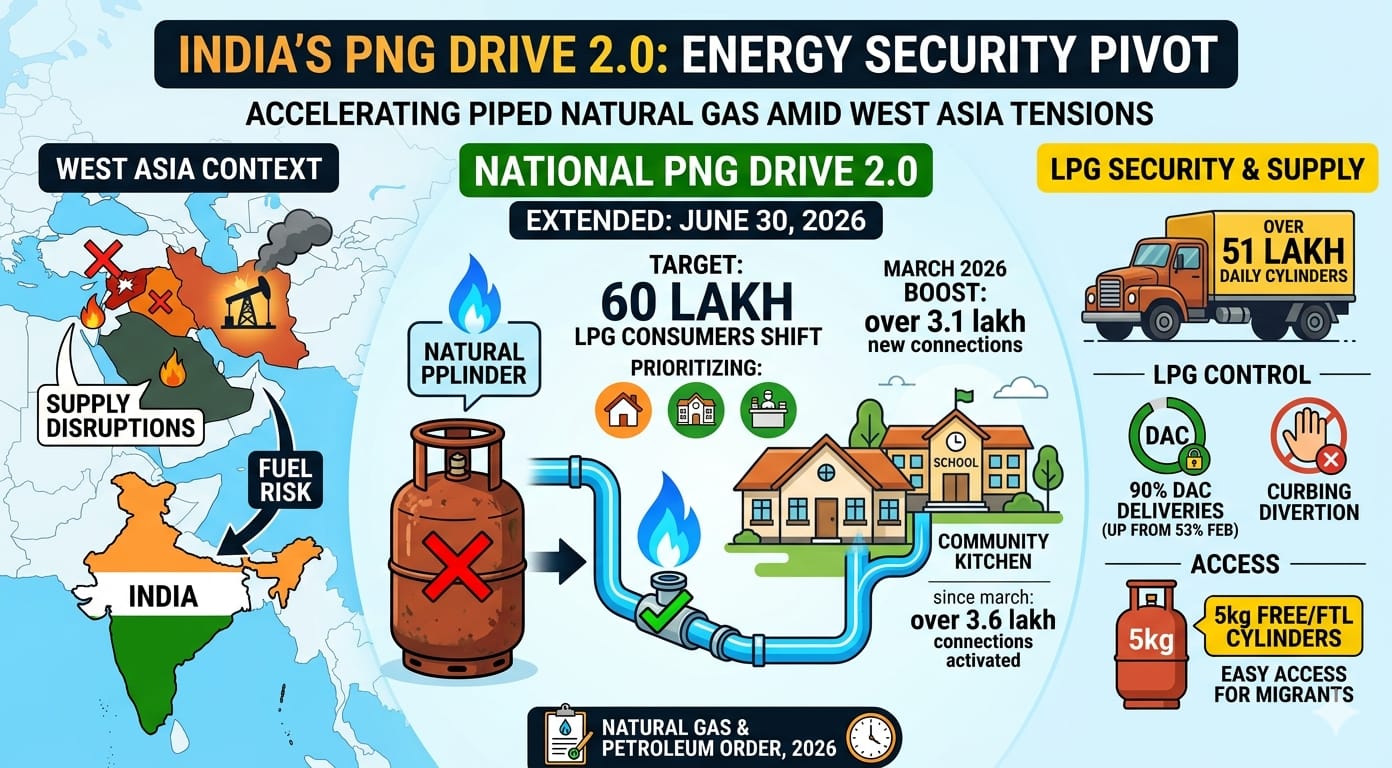
Amid simmering conflicts and supply disruptions in West Asia, India has significantly ramped up its push toward piped natural gas (PNG), turning geopolitical risk into a catalyst for a cleaner, more secure energy architecture.
In March 2026 alone, city gas distribution companies activated over 3.1 lakh new PNG connections across domestic homes, commercial establishments, hostels, messes and canteens, while processing more than 2.7 lakh fresh applications, underscoring a sharp uptick in consumer willingness to move away from LPG cylinders where pipeline infrastructure exists.
With the government already targeting a long‑term shift of around 60 lakh LPG‑dependent households and small businesses to PNG, this acceleration is seen as a strategic step to insulate India’s cooking‑fuel security from volatile global gas markets.
The centerpiece of this shift has been the National PNG Drive 2.0, launched by the Petroleum and Natural Gas Regulatory Board (PNGRB) on 1 January 2026 as a focused three‑month campaign to boost connectivity and usage of natural gas.Encouraged by the surge in new connections and registrations since March—over 3.6 lakh PNG connections gasified and more than 3.9 lakh fresh registrations recorded— the government has now extended PNG Drive 2.0 until 30 June 2026 to sustain momentum and institutionalize the transition.
Through this drive, CGD entities such as IGL, MGL, GAIL Gas and BPCL have been directed to fast‑track domestic PNG connections and to prioritize schools, colleges, hostels, community kitchens and Anganwadi facilities wherever pipelines are within striking distance, thereby protecting essential food‑service institutions from LPG shortages.
To support this structural move, the government has introduced a package of regulatory and financial incentives, including a new Natural Gas and Petroleum Products Distribution Order, 2026 under the Essential Commodities Act, which streamlines pipeline laying and expansion by cutting approval delays and easing land‑access bottlenecks.
States and Union Territories are also being offered additional commercial LPG allocations—up to 10 percent extra—on condition that they actively enable PNG expansion and help migrate eligible consumers away from cylinders. At the same time, defense, transport and coal ministries have been roped in to expedite approvals for CGD infrastructure, including in military housing and highways, reinforcing PNG as a cross‑sector priority rather than a mere urban utility.
On the LPG front, authorities are balancing crisis‑driven curbs with measures to maintain supply and prevent panic.Online cylinder bookings have risen to around 95 percent of total bookings, with delivery authentication code (DAC)‑based deliveries jumping from 53 percent in February to 90 percent by early April, sharply reducing the risk of diversion at the distributor level.
Over 51 lakh domestic LPG cylinders are being delivered daily on average, and more than 50,000 cylinders have been seized since March through coordinated raids aimed at curbing hoarding and black‑marketing.
The government has also scaled up 5 kg free‑of‑cost or FTL cylinders—over 90,000 sold in a single day, amounting to roughly 6.6 lakh since late March—while waiving address proof and requiring only valid ID, easing access for migrant workers and low‑income households.
Taken together, these measures signal a deliberate pivot from a cylinder‑centric model to a city‑gas‑driven cooking ecosystem, with PNG Drive 2.0 and the broader regulatory framework designed not only to manage short‑term disruptions from West Asia but also to lock in a more resilient, low‑carbon fuel base for India’s growing urban centres.