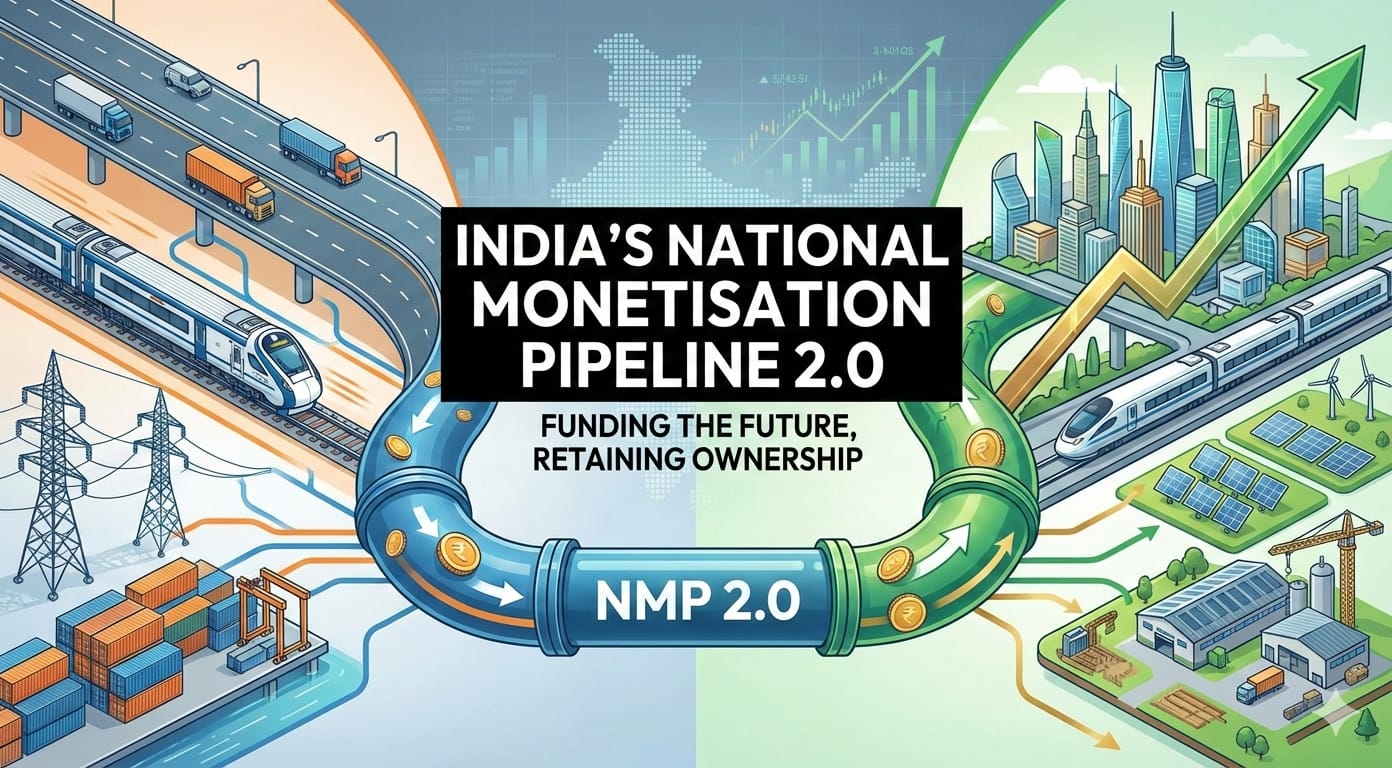
India needs money to build roads, railways, ports, and power lines at a speed that matches its growth ambitions. But building new infrastructure from scratch — what economists call greenfield projects — requires enormous capital upfront, while the returns from tolls and user charges come in slowly over many years. Borrowing more or raising taxes every time is not a sustainable answer. This gap between what the government needs and what it can spend gave rise to a financial strategy called the National Monetisation Pipeline, or NMP, which India first introduced in 2021 and has now relaunched in a much bigger form as NMP 2.0.
The core idea behind NMP is straightforward. The government already owns a large number of operational public assets — completed highways that collect toll, functioning railway stations, working power transmission lines, gas pipelines, and port terminals. These assets are not sitting idle; they generate steady, predictable cash flows every single year. The NMP strategy asks a simple question: instead of waiting for this income to arrive slowly over the next two decades, why not bring a large portion of that future value to the present by inviting private companies to operate these assets for a fixed period? In return, the private operator pays the government an upfront lump sum or a regular revenue share. The government takes that money and immediately uses it to build new infrastructure elsewhere. Ownership of the asset never leaves the government — only the right to operate and earn from it is temporarily transferred. This is what makes NMP fundamentally different from privatisation, where an asset is sold permanently.
To understand how NMP connects to older models, it helps to recall the Public-Private Partnership, or PPP, approach that India used widely for airports and highways. In classic PPP, a private company builds a new road, operates it, collects toll for a set number of years, and then hands the road back to the government. NMP reverses this logic. Here, the government has already done the hard work of building the asset. It now invites the private sector to step in at the operational stage, skipping the risky and expensive construction phase entirely. The assets in the NMP pipeline are called brownfield assets — meaning they are already built and running — which makes them far less risky for private investors compared to new greenfield projects where costs can overrun and timelines can slip.
NMP 1.0 was unveiled after the Union Budget of 2021 and ran from FY22 to FY25. NITI Aayog worked alongside multiple line ministries to identify central government assets that were operational and attractive enough for private investment. The pipeline covered sectors including highways, railways, power generation and transmission, oil and gas pipelines, telecom towers, and warehousing. The target was to unlock approximately ₹6 lakh crore through monetisation over four years. According to official reports, around ₹5.3 lakh crore was actually achieved — roughly 89 percent of the target. Coal blocks and mining leases, road projects, and power transmission assets turned out to be the biggest contributors. However, the experience was not without problems. Railways, for instance, fell significantly short of their targets, with actual monetisation a fraction of what was planned. Some ministries lacked the technical capacity to structure complex deals from scratch. Trade unions and opposition politicians raised concerns that public assets were being quietly handed over to corporations, creating public resistance and delays in several cases.
Learning from these challenges, Finance Minister Nirmala Sitharaman launched NMP 2.0 covering the five-year period from FY26 to FY30, with an indicative pipeline value of approximately ₹16.72 lakh crore — nearly two and a half times larger than the first phase. NITI Aayog and multiple infrastructure ministries together identified over 2,000 projects across 12 sectors. Highways, multimodal logistics parks, and ropeways alone account for around ₹4.4 lakh crore of this total, with railways, power, ports, oil and gas pipelines, and telecom making up much of the rest. The plan is to initiate monetisation transactions worth around ₹2.49 lakh crore in FY26 itself, so that fresh capital starts flowing into new projects from the very first year of the pipeline.
The money flowing through NMP 2.0 is expected to arrive through two main channels. In some cases, private companies pay a large upfront amount — for example, under the Toll-Operate-Transfer or TOT model, a company takes on a bundle of highway stretches for 20 years, pays thousands of crores to the government at the start, and then collects toll on its own for the duration of the contract. In other cases, the government retains a share of future cash flows, or assets are structured into Infrastructure Investment Trusts and Real Estate Investment Trusts — known as InvITs and REITs — whose units are sold to institutional investors. Combining all these approaches, the government estimates that NMP 2.0 will generate approximately ₹10.8 lakh crore in cash flows to government entities between FY26 and FY30, while attracting around ₹5.8 lakh crore in new private capital into these assets.
The benefits of this model are real for multiple parties. For the government, it gains access to relatively low-cost capital without adding to the fiscal deficit, since these deals are backed by existing, cash-generating assets that lenders consider quite safe. This allows the government to accelerate capital expenditure — building new roads, rail corridors, urban infrastructure, and ports — without waiting for tax revenues to catch up. For private investors, especially pension funds, sovereign wealth funds, and long-term infrastructure funds, brownfield assets with known traffic patterns and predictable revenue streams are highly attractive. They avoid the construction risk entirely and get a ready-made income-generating asset. For the economy as a whole, faster infrastructure spending typically translates into more construction jobs, lower logistics costs, and a boost to GDP growth over the medium term.
NMP 2.0 also addresses the structural weaknesses that slowed down the first phase. The government is focusing on standardised contract templates, faster regulatory approvals, and a common framework so that individual ministries do not have to design every deal from zero. Sitharaman has publicly stated that ministries should not merely meet their targets but actively try to exceed them, given that high-quality infrastructure is essential to India’s Viksit Bharat vision of becoming a developed nation by 2047.
The risks, however, are equally real and deserve attention. If assets are under-valued during the monetisation process, the public loses out on the true worth of what it collectively owns. If contracts are structured in ways that are not transparent, public trust erodes quickly — as seen during NMP 1.0. And if the money raised does not actually flow into new capital projects but instead gets absorbed into routine government spending, the entire logic of asset recycling breaks down. Governance quality, contract transparency, and political will to keep the reinvestment cycle honest are the three factors that will decide whether NMP 2.0 becomes a genuine engine of growth or a source of controversy.
In the end, NMP 2.0 represents India’s most ambitious attempt yet to use the value locked inside its existing public infrastructure to fund the infrastructure of tomorrow. Every toll paid on an expressway, every container moved through a port, every unit of electricity transmitted across a power line is part of a financial chain that the government is now trying to make work harder and faster. If executed well — with fair valuations, strong governance, and genuine reinvestment — it could prove to be one of the most powerful tools available to a developing economy that wants to grow quickly without drowning in debt.