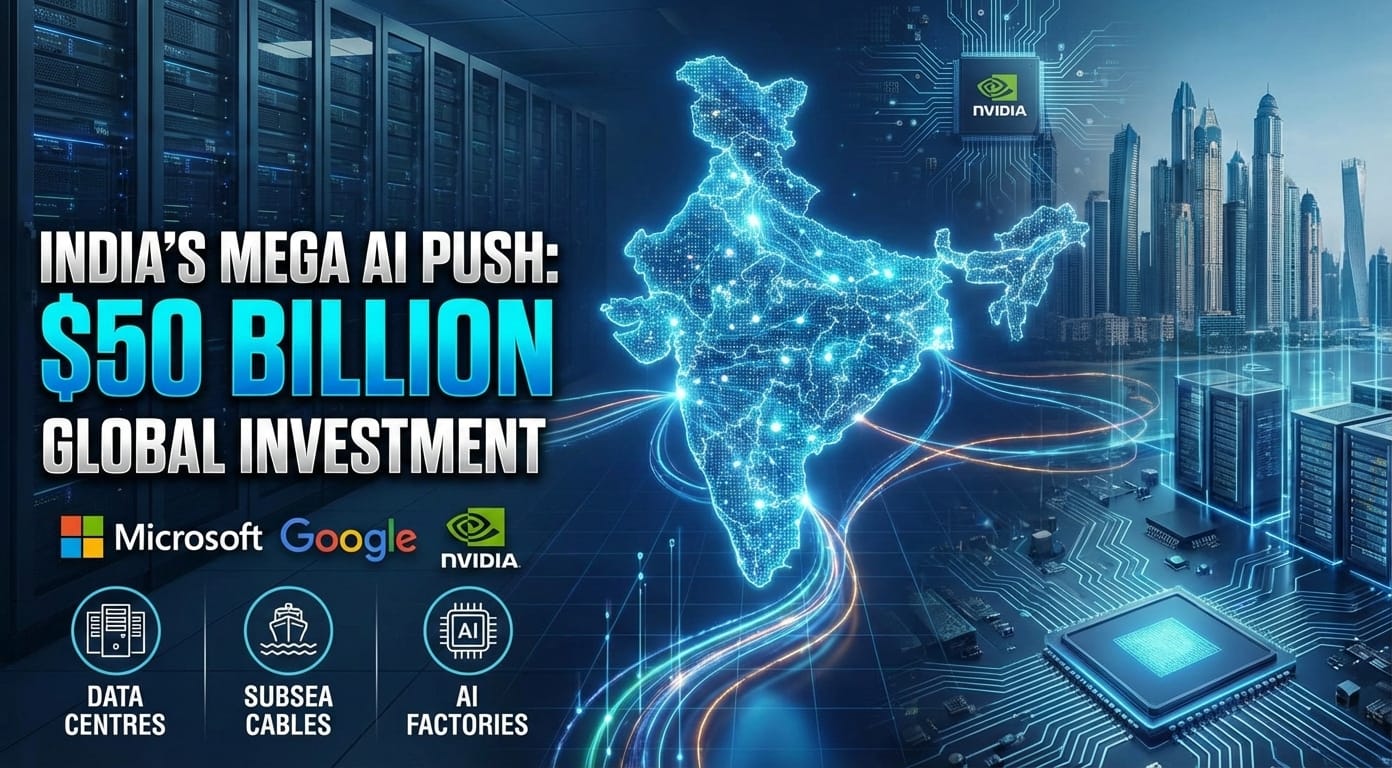
India’s ambition to become the epicenter of global artificial intelligence took a bold leap forward on Day 3 of the AI Impact Summit in New Delhi. The stage was not just about algorithms or innovation—it was about infrastructure, scale, and partnerships.
The world’s biggest technology companies—Microsoft, Google, and Nvidia—stood shoulder to shoulder, promising investments that could reshape India’s digital economy and the AI footprint of the entire Global South.
For India, this momentum is more than just about data centres or cables under the sea. It’s a statement of intent—a declaration that the country plans to lead the next wave of AI transformation by combining policy support, skilled talent, and global collaboration. The conversations at the summit carried both optimism and urgency: The AI race will be defined by who builds the strongest digital backbone first, and India clearly wants to be one of the frontrunners.
Microsoft’s vice-chair and president Brad Smith captured this vision vividly when he said that AI could help bridge the global inequality divide. His words echoed through the summit hall as he reaffirmed the tech giant’s $50 billion investment commitment for AI infrastructure across the Global South by the end of the decade.
Out of that ambitious plan, India stands to receive $17 billion—part of a roadmap aimed at expanding data centres, enhancing connectivity, and ensuring electricity availability to power large-scale AI operations. Smith called this a crucial step to help emerging economies catch up with advanced ones, describing the effort as a moral and economic responsibility tied to AI’s future.
If Microsoft’s message was about access and equity, Google’s was about connectivity and people. CEO Sundar Pichai, who met Prime Minister Narendra Modi earlier in the day, announced the India–America Connect initiative—a new subsea cable route that will strengthen AI data exchange between India, the United States, and other parts of the southern hemisphere. This cable, stretching across the ocean floor, will act as the digital bridge enabling faster, smarter, and more secure AI-driven data transmission across continents.
Pichai also used his address to spotlight the human side of AI advancement. He announced Google’s most ambitious skilling programme in India so far, including a new AI function certificate that trains people to use AI effectively at work. Google’s collaboration with Wadhwani AI will ensure students gain early exposure to these technologies, building a future-ready workforce capable of driving India’s digital transformation. Alongside that, the $30 million Google.org AI for Science Impact Challenge aims to push the boundaries of innovation and research, fuelling scientific breakthroughs in the region.
Meanwhile, Nvidia, partnered with India’s engineering powerhouse Larsen & Toubro (L&T), is building what could become one of the largest AI compute backbones in Asia—a gigawatt-scale AI factory. Though Nvidia CEO Jensen Huang had to cancel his trip to the summit at the last minute, his statement was full of conviction: “AI is driving the largest infrastructure buildout in human history—every company will be powered by it and every country will build it.” His words perfectly reflected India’s direction under the broader “India AI” vision.
This AI factory model, backed by Nvidia’s GPU clusters, will provide advanced computing capacity to cater to a wide range of industries from manufacturing to healthcare. With deployment already underway in Chennai and Mumbai, the facility will deliver enterprise-grade AI capabilities—reliable, secure, and scalable infrastructure designed to move businesses from experimentation to full production. For India Inc., this means faster, more predictable access to cutting-edge AI resources that can reshape operations, logistics, and service models.
Adding to the momentum, Indian data firm Yotta Data Services announced plans to invest another $4 billion this year to procure 40,000 Nvidia GPUs. The move not only strengthens India’s domestic compute capacity but also shows how private Indian players are aligning with the global AI supply chain. With every such investment, India’s role in the world’s AI network becomes stronger—not just as a consumer of technology, but as a producer and enabler.
Together, these announcements paint a clear picture: India is no longer on the sidelines of AI’s growth story. It’s right at the centre, crafting a narrative that blends infrastructure, leadership, and inclusivity. International players see India not only as a vast market but also as a strategic base for building the Global South’s digital future. With subsea cables connecting continents, AI factories powering industries, and billions in investments flowing in, the foundation for an AI-powered India is being built block by block.
The AI Impact Summit may have lasted a few days, but its implications will last for decades. The conversations and commitments announced in New Delhi this week are setting the stage for a new kind of global collaboration—one where India becomes the bridge between the developed and developing world through artificial intelligence.