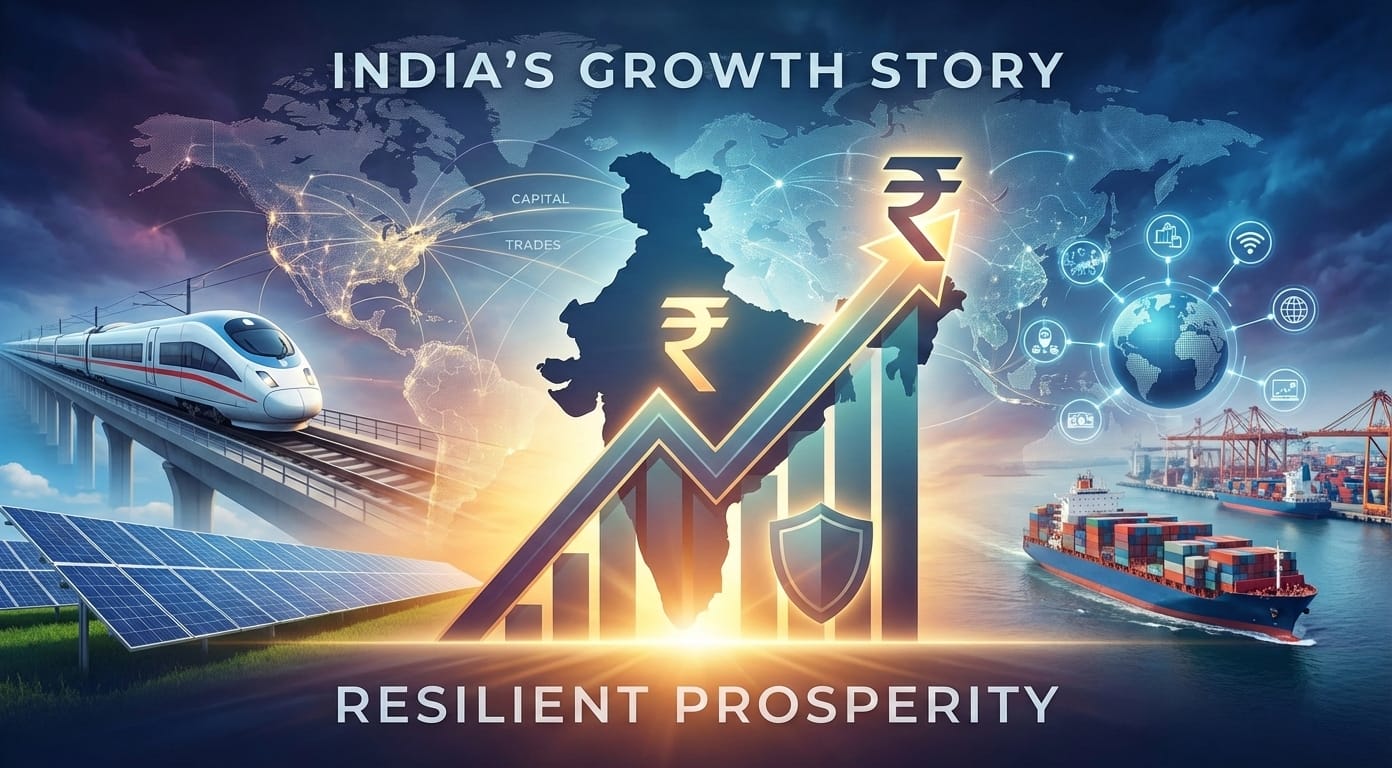
The Economic Survey 2025‑26 paints a world economy that has moved from occasional turbulence to a permanently fragile, politically‑driven order, where trade and finance are shaped less by efficiency and more by security, rivalry and coercion.
It outlines three possible global paths for 2026 — Managed Disorder, Disorderly Multipolar Breakdown, and a Systemic Shock Cascade — with India relatively better placed than many peers, yet exposed to one common vulnerability in all three: instability in cross‑border capital flows and the resulting stress on the rupee.
In this environment, India’s recent growth achievements, however impressive, cannot be viewed in isolation from a central question: will global investors — especially in the United States — continue to see India as a safe, profitable and politically acceptable destination for long‑term capital?
The Survey acknowledges that India’s macro fundamentals are strong: real GDP growth is estimated at 7.4 per cent in FY26, keeping India the fastest‑growing major economy for the fourth straight year, while medium‑term potential growth has been marked up from 6.5 per cent to 7 per cent thanks to reforms and higher investment.
What makes this growth politically and socially salient is that it is driven by the common man — household consumption grew 7.5 per cent in the first half of FY26, and private spending now accounts for about 61.5 per cent of GDP, the highest since 2011‑12, supported by a rare combination of rising incomes and sharply lower inflation.
Retail inflation averaged just 1.7 per cent in April–December FY26, with food prices even entering deep deflation at minus 5.02 per cent in October 2025, meaning purchasing power has tangibly improved for ordinary families. When people feel their monthly budgets are finally breathing again, the economic story ceases to be an abstract number and becomes a lived experience; that is precisely the political capital the government has built, and it is not a trivial achievement.
If the US has already used tariffs and geopolitics as tools, the next geopolitical weapon could be the flow of capital itself; and for India, the biggest medium‑term risk is not that its domestic growth engine fails, but that foreign direct investment and portfolio flows — especially from the US — become more volatile, conditional or weaponised, just when India needs them to sustain high investment and technology transfer.
This concern is not theoretical. The Survey notes that while global FDI flows fell by 11 per cent in 2024, the United States actually saw a near 19.7 per cent increase, largely because AI‑related investments and supply‑chain reconfiguration sucked capital into the US. At the same time, US growth is being driven disproportionately by AI investment rather than broad‑based, inclusive expansion, and is accompanied by higher unemployment and inflation that remains above the 2 per cent target; this combination can fuel political pressures for more inward‑looking, national‑security‑framed policies.
In such a world, capital — whether FDI, venture money or debt — can be directed or restricted not only by market returns but by strategic calculations: which countries are aligned, which supply chains are “trusted”, and which technologies are seen as too sensitive to share.
For an India that is pushing to become a manufacturing hub, AI power and green‑tech leader, this politicisation of capital matters as much as tariff wars did in the previous phase. At the same time, the Survey underlines that India has prepared a significant buffer against precisely this sort of volatility through a combination of fiscal consolidation, banking clean‑up and external‑sector strengthening.
On the fiscal side, the government has steadily reduced the central fiscal deficit from 9.2 per cent of GDP in FY21 to 4.8 per cent in FY25 and is on track for 4.4 per cent in FY26, a consolidation that has been rewarded with three separate sovereign rating upgrades in 2025 and a move to ‘BBB’ from S&P.
This has been achieved while tripling capital expenditure from around ₹3.4 lakh crore in FY20 to ₹10.5 lakh crore in FY25, and lifting the capex share in total spending from 12.5 per cent to 22.6 per cent, which directly builds long‑term productive assets instead of short‑lived populist schemes.
On the financial side, the legacy “twin balance sheet” problem has been largely resolved: gross NPAs of scheduled commercial banks are down to 2.2 per cent as of September 2025, recovery rates on bad loans have roughly doubled versus FY18, and profitability and return on assets have strengthened.
These achievements together form the first major “achievement of goals” of the government: anchoring growth in credible fiscal consolidation and a healthy banking system, while still funding a historic public investment push.
A second clear achievement lies in the deepening of financial inclusion and social protection while keeping leakages under control. The Jan Dhan programme has opened over 55 crore bank accounts, Mudra has disbursed more than ₹36.18 lakh crore across 55.45 crore loans (with over 10 crore first‑time borrowers), and schemes like PM SVANidhi have integrated street vendors into the formal credit system, with NPA ratios below 10 per cent and over 83 per cent of borrowers using digital payments in 2025.
Direct Benefit Transfers are estimated to have plugged leakages worth about ₹3.48 lakh crore over the past decade, meaning money that previously evaporated in middlemen now reaches actual beneficiaries.
In parallel, social security has expanded through the Atal Pension Yojana — which has grown at a compound annual rate of 43.7 per cent since 2016 — and the new Unified Pension Scheme that promises a minimum pension for government employees without blowing up the deficit.
This web of bank accounts, digital rails and targeted transfers is not just welfare — it is also a political insurance policy, making the economy more robust to external shocks by keeping demand from the bottom of the pyramid relatively stable when global headwinds hit.
A third notable achievement is in the external sector: India has moved from vulnerability to a position of cautious strength, even as the global trade regime becomes more weaponised. Between 2005 and 2024, India’s share in world merchandise exports has nearly doubled to 1.8 per cent, and its share in global commercial services exports has risen to 4.3 per cent, backed by strong IT and knowledge services.
Total exports of goods and services reached an all‑time high of USD 825.3 billion in FY25, growing 6.1 per cent despite global headwinds, and this momentum continued into FY26 with record export levels in the first three quarters.
Crucially, the Production Linked Incentive schemes and Make in India have begun to structurally shift sectors like telecom and electronics from import dependence to export capability: telecom exports grew modestly on average between FY21 and FY25 while imports fell 18.5 per cent, and electronic goods exports rose by 35.1 per cent in the first nine months of FY26.
These improvements are backed by a strong macro buffer: India’s current account deficit has moderated to about 0.8 per cent of GDP in the first half of FY26, and foreign exchange reserves of around USD 701.4 billion as of mid‑January 2026 cover nearly 11 months of imports, giving the Reserve Bank room to handle capital‑flow shocks.
A fourth achievement is the government’s use of trade diplomacy and free trade agreements as proactive tools to secure markets and diversify partners in a fracturing world order. The Survey notes that India has concluded strategic deals like the India–UK Comprehensive Economic and Trade Agreement, the India–Oman CEPA, and the India–EFTA Trade and Economic Partnership, while simultaneously negotiating with the EU and others.
The India–Oman CEPA alone offers duty‑free access to over 99 per cent of India’s exports, which is both a market opportunity and a hedge against excessive dependence on any single destination. New frameworks like the Export Promotion Mission and the Trade Connect e‑platform attempt to integrate scattered schemes, reduce transaction costs and ensure that smaller exporters also benefit from these deals.
When combined with India’s growing attractiveness — external assessments such as the Asia Power Index 2025 rank India third in Asia’s overall power, and note that India has overtaken China as the top destination for investment in Asia over a ten‑year period — these FTAs are not mere diplomatic trophies but instruments that can anchor long‑term, rule‑based capital and trade relationships.
A fifth and very visible achievement relates to infrastructure and basic services, which underpin both economic competitiveness and quality of life. The National Highways network has expanded by about 60 per cent since FY14, high‑speed corridors have gone from roughly 550 km in 2014 to over 5,300 km by late 2025, and the number of airports has more than doubled from 74 to 164, with passenger traffic on track to rise from 412 million in FY25 to 665 million by FY31. Railway electrification has reached over 99 per cent of the network, ports have seen a surge in PPP projects that expanded capacity by about 660 million tonnes per annum, and power shortages have effectively been eliminated, with the demand‑supply gap dropping from 4.2 per cent in FY14 to near‑zero by late 2025.
Social infrastructure has expanded as well: rural tap water coverage under Jal Jeevan Mission has jumped from about 17 per cent in 2019 to more than 81 per cent of rural households by late 2025, while urban sanitation and waste processing capacity have soared under Swachh Bharat, with waste processing capacity rising from about 16 per cent to roughly 80 per cent.
These investments are not only about comfort; they are what attract FDI into logistics, manufacturing and services, and they signal to investors that India is serious about reducing structural bottlenecks.
A sixth achievement lies in the climate and energy transition domain, which directly connects to the future direction of global capital. India has already crossed its target of sourcing 50 per cent of installed power capacity from non‑fossil fuel sources, reaching about 51.93 per cent by December 2025, while solar capacity has exploded roughly forty‑five times from 3 GW in 2014 to nearly 135.81 GW.
The government has launched missions such as the National Green Hydrogen Mission, PLI schemes for high‑efficiency solar modules, and the SHANTI Bill to advance nuclear power, alongside a National Critical Mineral Mission to secure key inputs for batteries and clean energy with a planned outlay of ₹16,300 crore.
In parallel, instruments like Sovereign Green Bonds and the RBI’s Green Deposit framework are creating a dedicated ecosystem for climate finance, aligning India’s needs with the priorities of global institutional investors increasingly constrained by ESG mandates.
If India can convincingly present itself as both a growth market and a climate leader, it can attract green capital even in a world where general risk appetite is falling, which directly addresses the concern about future capital flows being rationed or politicised.
Against this backdrop of achievements, it is essential to clarify the core risk being highlighted: India’s domestic growth engines — consumption, public capex, structural reforms — are strong, but they cannot fully substitute for stable, large‑scale foreign capital, particularly in high‑tech sectors, infrastructure and advanced manufacturing.
If geopolitical tensions intensify and the US deploys capital controls, sanctions‑like restrictions, or complex compliance threats on investors looking at certain countries or technologies, then India may face a scenario where FDI inflows slow, financing costs rise and the rupee faces episodic pressure — even if India’s own policies remain sound.
The Survey implicitly recognises this by underlining that, in all three global scenarios, disruption to capital flows and rupee volatility is the shared risk, differing only in duration and intensity.
In a “Managed Disorder” world, such shocks are temporary and manageable with buffers and policy credibility; in a “Disorderly Multipolar Breakdown”, capital could become segmented into rival blocs, forcing India into tough strategic choices; in a “Systemic Shock Cascade”, a major correction — for example in over‑leveraged AI infrastructure in the US — could trigger a liquidity crunch worse than 2008, pulling investment out of emerging markets wholesale.
In all three, India’s relative strength does not equal immunity; it merely buys time and bargaining power. This is why the Survey’s policy prescription is so focused on “stability of supply, creation of buffers, and diversification of routes and payment systems.”
On the macro side, that means maintaining low and predictable inflation, which the government has managed unusually well: India has seen one of the sharpest declines in inflation among major emerging markets, with global agencies like S&P noting that inflation expectations are better anchored than a decade ago.
On the fiscal and financial side, it means continuing credible consolidation, keeping debt dynamics sustainable — India’s general government debt‑to‑GDP ratio has fallen by about 7.1 percentage points since 2020 — even as public investment remains high. On the external front, it means deepening domestic capital markets, encouraging the dominance of domestic institutional investors (DIIs now own about 18.7 per cent of NSE‑listed equities), promoting rupee‑based or multi‑currency settlement systems through platforms like GIFT City and the Foreign Currency Settlement System, and leveraging FTAs that lock in rules and access.
All of this together reduces the probability that a single foreign decision — say, a sudden tightening of US capital outflow rules — can derail India’s entire development trajectory. India today is like a family that has cleaned up old debts, increased its income, built a better house, and started saving regularly; however, it still needs outside investors to help set up a modern factory in the backyard and connect it to global markets.
The Economic Survey shows that the “housekeeping” has been done well — macro stability, lower inflation, better banks, more infrastructure, expanded social protection — but also warns that the world outside the gate has become more unpredictable and politically charged. The one assumption is that after tariffs and overt geopolitical posturing, the next tool big powers will use is money itself: deciding where investment can go, at what speed, and with how many security strings attached.
If that assumption holds, then India’s real test is not only to keep growth high, but to ensure that global capital sees India as such a crucial, trusted and diversified partner — through credible policy, resilient institutions and smart FTAs — that any attempt to weaponise capital flows against India becomes costly and unattractive even for its rivals. In that sense, the Survey’s underlying political message is clear: India has moved from “managing crises” to “managing risks”, but the price of this new position is constant vigilance over how capital, technology and geopolitics are intertwined.