India is currently standing at a historic crossroads in its journey toward becoming a global infrastructure powerhouse. As of February 2026, the landscape of Indian transit has been fundamentally altered by the rapid rollout of Vande Bharat trains, the expansion of Metro networks across dozens of cities, and the looming arrival of the country’s first high-speed bullet train.
However, while the physical tracks are spreading faster than ever, something remains hidden in the balance sheets. India is in the middle of its biggest-ever rail buildout, yet its reliance on foreign technology for critical components remains a significant structural vulnerability.
According to recent trade data and official reports, India’s imports of railway and metro equipment reached over ₹6,100 crore in the 2025 fiscal year alone, following imports worth ₹6,434 crore in FY24 and ₹5,232 crore in FY23 . These figures tell a story of a nation that can build the “body” of its transport system but is still forced to purchase the “brain and heart” from overseas markets like Europe, Japan, and China.
The nature of these imports reveals a specific gap in India’s manufacturing capabilities. We are not just importing steel or simple hardware; the bill is dominated by high-value, precision-engineered components such as sophisticated bogies, specialized wheelsets, advanced braking systems, and the complex signaling technology required for the Regional Rapid Transit System (RRTS) and high-speed rail.
For instance, while Indian Railways has successfully increased the local content in its rolling stock, nearly 45% of the components for modern Metro and Rapid Rail systems are still sourced from international suppliers. This dependence is not merely a matter of cost; it is a matter of control. When the most vital parts of a multi-billion-dollar project are made elsewhere, India remains at the mercy of global supply chain disruptions, fluctuating exchange rates, and geopolitical shifts.
In an era where “strategic autonomy” is the buzzword for major economies, having the entire rail supply chain within domestic borders is no longer an option—it is a necessity for national security and economic stability.
To understand the scale of what India is attempting, one must look at the “China Exception.” Globally, massive infrastructure projects are almost synonymous with indefinite delays and staggering cost escalations. China, however, has been the sole exception to this rule, building a high-speed rail network of over 45,000 kilometers in record time. The primary reason for this efficiency is not just labor or capital, but the fact that China owns almost the entire domestic supply chain for building its transport infrastructure.
By controlling everything from the raw materials to the microchips in the signaling systems, they have removed the uncertainty that plagues other nations. India is the only other country in the world with the ambition to build at this “China-scale.” Whether it is the massive Vande Bharat rollout or the integration of RRTS across the National Capital Region, India’s goals are gargantuan. Yet, without a deeper push into indigenization, our progress will remain structurally constrained by the “import trap”.
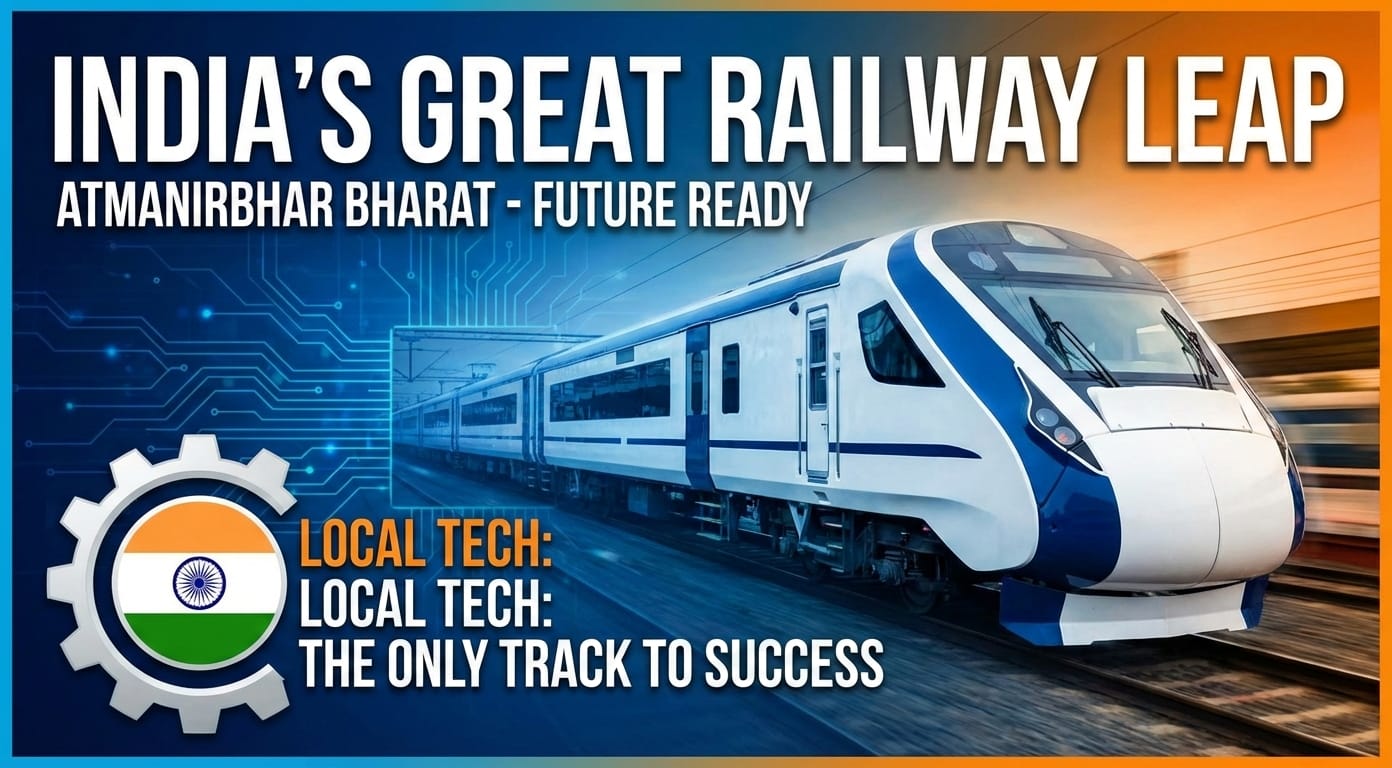
Historically, the Indian Railways was a legacy of the colonial era, designed more for extraction and basic connectivity than for technological leadership. For nearly a century, we relied on steam and then basic diesel technology, often trailing global standards by decades. The shift toward a high-tech, electrified, and high-speed future began in earnest only in the last few years, marked by the indigenous development of the Train 18 (Vande Bharat) platform.
This project proved that Indian engineers could deliver world-class products when given the right backing, achieving nearly 80% indigenization in its early phases. But moving from 80% to 100% is the hardest part of the journey. It requires mastering the “high-tech niches” where countries like Germany and Japan have spent decades refining their engineering . The Raebareli wheel plant and the new partnerships to manufacture thousands of high-quality wheels domestically are steps in the right direction, but they represent only one piece of a much larger puzzle.
The proposed Rail-Tech Policy 2026 is intended to be the catalyst for this final leap toward self-reliance. By providing partial funding, technical support, and access to advanced testing facilities, the government hopes to encourage local startups and established manufacturers to take on the challenge of “Gen-next” railway tech.
However, as industry experts point out, the current funding for this policy remains modest compared to the sheer scale of the challenge we face. For a sector that manages a capital expenditure of over ₹2.5 lakh crore, the investment in research and development for domestic components must be significantly more aggressive. We need a “moonshot” approach to railway technology where the focus is not just on assembling trains, but on inventing the systems that make them run.
Ultimately, the goal of “Atmanirbhar Bharat” in the rail sector is about ensuring execution certainty. When the domestic supply chain is robust, a project delay in a foreign factory doesn’t stop work on an Indian track. Local manufacturing also creates a massive “multiplier effect” for the economy, generating high-skilled jobs and fostering an ecosystem of MSMEs that can eventually export their technology to the world.
As we look toward the 2030s, the metric of our success should not just be how many kilometers of track we have laid, but how much of the technology riding on those tracks was “Designed and Developed in India” . Bridging the ₹6,000-crore import gap is not just about saving foreign exchange; it is about building a foundation for a nation that can move its people with speed, safety, and, most importantly, on its own terms.