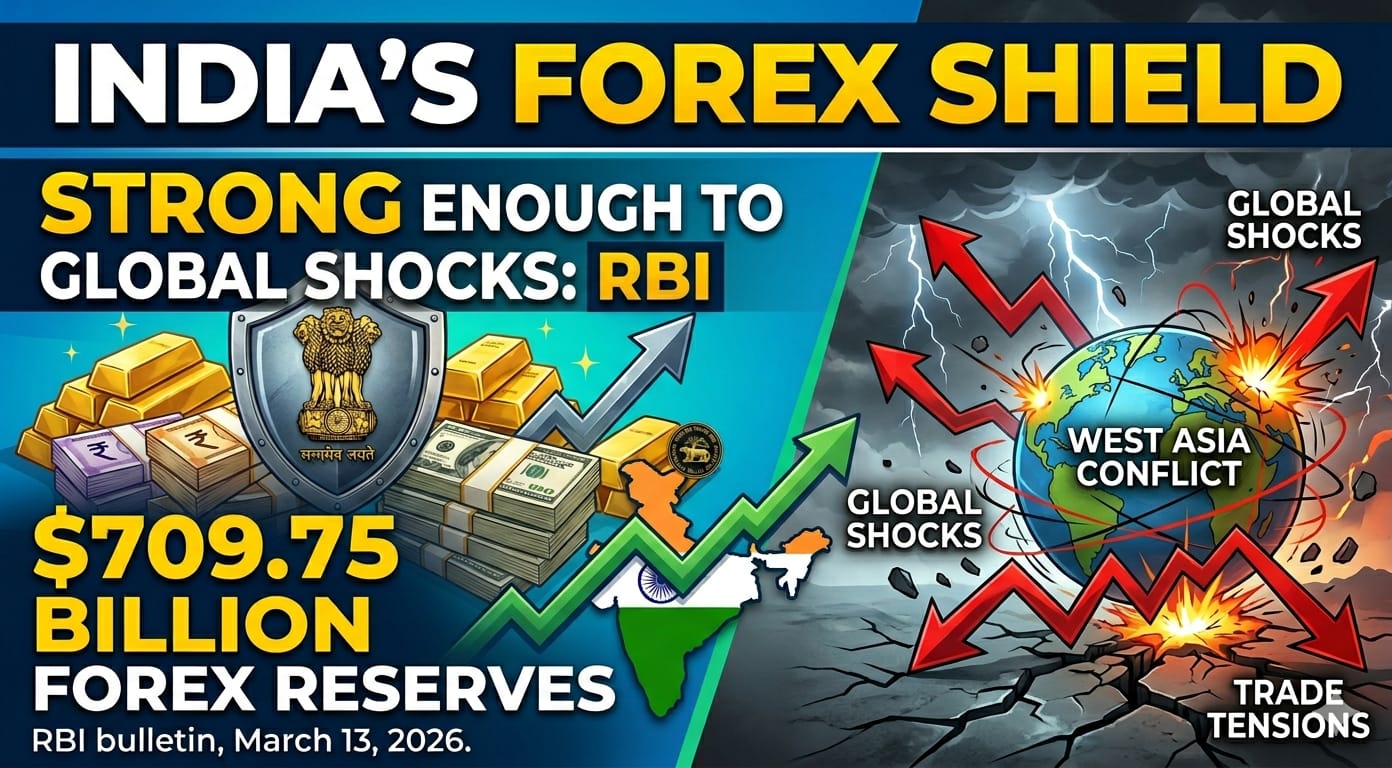
The foreign exchange reserves of India continue to act as a strong shield for the economy amid global turbulence. According to the Reserve Bank of India’s State of the Economy article published in its March 2026 bulletin, the country’s forex reserves stood at an impressive $709.75 billion as of March 13. The RBI said these reserves are adequate to cushion the country against external shocks such as geopolitical conflicts, trade tensions, or fluctuations in global commodity prices. The central bank stressed that while global uncertainties remain high, India’s overall macroeconomic foundation remains solid and resilient.
The RBI’s article highlighted that the recent escalation of conflict in West Asia and new U.S. trade investigations into key trading partners have created new challenges for global commerce and energy security. Such developments could increase market volatility, disrupt supply chains, and impact energy prices across the world. For India, which depends heavily on crude oil imports, this situation demands close monitoring and timely policy responses to minimise the risks of imported inflation and supply disruption.
Despite these global concerns, the article pointed out that India has significantly improved its ability to manage external shocks. The central bank noted that the economy’s resilience has strengthened over time, supported by strong growth, stable macroeconomic indicators, and efficient management of external sector buffers. Over the years, India has diversified its crude import sources and increased its domestic refining capacity, reducing its dependence on any single region. Several policy measures have been introduced to deal with disruptions in global fuel supply and make better use of local capacities when global supply chains are affected.
The RBI’s commentary also mentioned the government’s plan to create an Economic Stabilisation Fund, which would act as an additional financial buffer. This fund would give policymakers more room to respond to external shocks or sudden slowdowns without putting pressure on the fiscal deficit. By having such a safety net, India aims to sustain its growth momentum even in a volatile global environment.
On the domestic front, India’s economy has continued to display strong performance. The second advance estimates of GDP for 2025–26, based on the revised base year of 2022–23, show that real GDP grew by 7.6%, up from 7.1% in the previous year. The RBI attributed this robust growth to healthy domestic demand, steady consumption, and ongoing investment in key industries and infrastructure. Private consumption remained strong, while investment activity held up well despite weak global trade conditions. During the third quarter of FY26, India’s growth remained high at 7.8%, even as merchandise exports faced pressure from weaker demand and higher tariffs in the U.S.
The article also reported that high-frequency indicators suggested strong momentum in economic activity during February 2026. Fuel consumption, logistics movement, and trade volumes all showed improvement. Notably, e-way bill generation continued to record double-digit growth, driven by higher consumption and rationalisation of GST rates. Together, these indicators suggest that domestic economic activity remains vibrant, supported by consumer spending and government reforms.
In conclusion, while global events like the West Asia conflict and trade investigations by major economies pose risks to India’s external environment, the RBI’s assessment presents a reassuring picture. India’s large forex reserves, prudent macroeconomic management, and diversification efforts have built a strong economic foundation. These factors ensure that the country remains in a comfortable position to handle emerging global shocks and sustain its growth momentum in the years ahead.