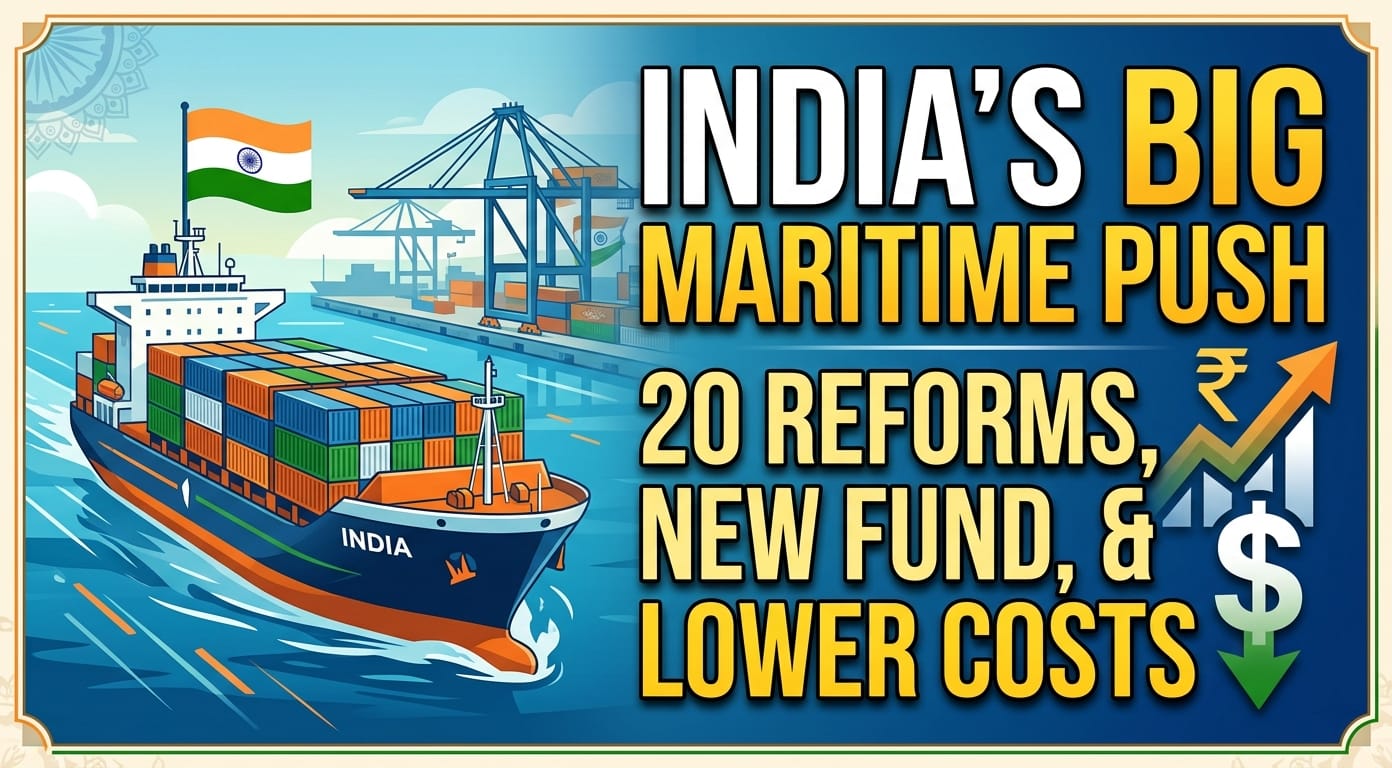
The government is preparing for one of its biggest shipping and port overhauls in recent years, with a plan to roll out around 20 maritime reforms in the first 90 days of FY27. The idea is simple but powerful: make cargo movement smoother, reduce dependence on foreign ships, and bring down the high cost of doing business in India. At the center of this effort is a proposed ₹25,000 crore Maritime Development Fund, which is expected to support shipbuilding, shipping capacity, and other long-term needs of the sector.
This move matters because India still depends heavily on foreign ships to carry its import and export cargo. According to the report, Indian ships carry less than 5% of EXIM cargo, which means most of India’s trade is transported by vessels owned or operated outside the country.
That dependence leads to a huge annual freight outflow of about $75 billion, money that effectively leaves the country instead of staying in the Indian shipping ecosystem. In simple terms, India is paying a massive bill every year to others for moving its own goods, and the new reforms are meant to change that.
The government’s larger goal is not just to reform ports on paper, but to make the whole logistics chain work better in real life. If ports become faster, paperwork becomes simpler, and ship movement becomes more efficient, businesses can save time and money. That helps exporters, importers, manufacturers, and even consumers, because transport cost is a hidden part of almost every product price. When logistics becomes cheaper, the economy becomes more competitive, especially for a country like India that wants to expand its trade footprint globally.
One of the most important long-term targets mentioned in the report is increasing the share of coastal shipping from 6% to 12% by 2047. Coastal shipping means moving goods by sea along India’s coastline instead of relying only on roads and railways. This is important because sea transport is often cheaper for bulk cargo and can ease pressure on highways and trains. If India can shift more cargo to coastal routes, it can reduce road congestion, lower fuel use, and make the overall logistics network more balanced.
The proposed Maritime Development Fund is also significant because the shipping industry needs large, steady investment. Ships are expensive, ports need continuous upgrades, and shipbuilding capacity takes time to develop. A dedicated fund can help create domestic strength in the sector rather than leaving India dependent on foreign capacity. Over time, this could also support more jobs, more Indian vessels, and a stronger maritime supply chain.
The broader message behind these reforms is that India wants its trade system to be faster, more self-reliant, and less costly. Maritime policy may sound technical, but its effect is very practical: cheaper transport can make Indian products more competitive, improve export earnings, and reduce the pressure on businesses that deal with long supply chains. For a country pushing growth, manufacturing, and export-led development, this kind of reform can have a wide impact beyond ports alone.
The challenge will be execution, because the real success of the plan will depend on how quickly the reforms are implemented and whether they actually reduce the friction that companies face every day.