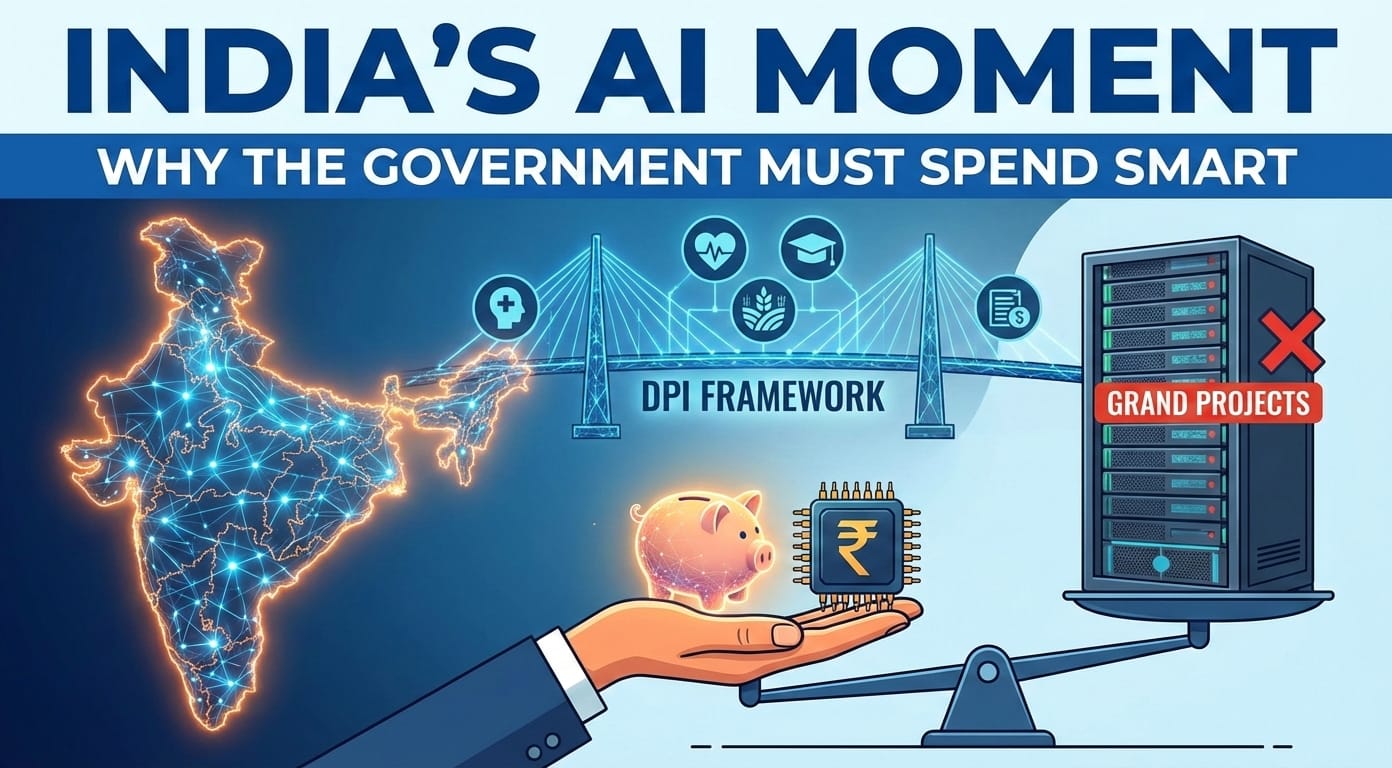
As Delhi hosts the Global AI Summit, the Digital Public Infrastructure (DPI) framework offers a tactical roadmap for funding public-interest technology without breaking the bank. When 35,000 people gather in Delhi this week for the fourth Global AI Summit, they will be wrestling with a question that affects taxpayers everywhere: How much should governments spend on artificial intelligence, and what exactly should they buy?
India has been promoting something called Digital Public Infrastructure, or DPI, as a model for how countries can build technology that serves everyone rather than just making profits for companies.
The DPI framework does offer valuable lessons, but governments should not treat it as a simple instruction manual. What exactly is DPI? Think of it like roads and bridges, but for the digital world. The World Bank calls it “digital plumbing” because it provides basic infrastructure that many different services can build upon. Just as a single highway system supports countless businesses from food delivery to ambulance services, digital infrastructure like payment systems or identity verification can support thousands of apps and services.
India’s DPI success — from UPI payments to Aadhaar and DigiLocker — proves that low-cost innovation can create high social value. But can that same approach work for AI? The answer is both yes and no. Yes, because the DPI principle of shared, open infrastructure fits AI perfectly. No, because not all AI technologies deserve public money. Consider this: does building huge data centers or domestic language models guarantee independence? Not really. The AI ecosystem is layered and complex — owning one layer, like compute, doesn’t mean controlling the entire chain of models, data, and applications. Governments may build local capacity but still depend on foreign chips, software, and frameworks. The result? Massive spending with limited autonomy.
So, where should governments put their money instead? The most powerful investments are often the simplest — like building high-quality datasets that developers, researchers, and startups can freely use. Think about it: AI systems are only as good as the data they’re trained on. Creating clean, representative datasets for agriculture, health, and education can unlock innovation for years. But this must come with strong privacy safeguards so that citizens’ data isn’t misused. Another smart area is shared AI layers such as Bhashini — India’s language translation platform. Just as roads and bridges connect people physically, these digital “plumbing systems” connect languages, services, and communities. They’re low-cost, reusable, and empower thousands of innovations downstream.
There’s also a question many countries face: should governments fund specific AI projects or leave that to the private sector? The fair answer is — both, but selectively. Public money should back projects that serve social goals the market ignores. For example, India’s Kisan e-Mitra chatbot helps farmers access scientific advice, while Health Sentinel uses AI to watch disease trends. These are not profit-driven tools, but their value to society is immense. Similarly, AI copilots for government officials or machine learning tools for planning and training can make public administration more efficient. Yet, such tools only succeed when backed by training and organizational support, not just procurement contracts.
The big takeaway is simple. Building public AI is not about spending more but about spending wisely. Governments must balance ambition with realism — focus on cost-effective infrastructure like open datasets and multilingual tools, while funding targeted public-interest applications the private sector won’t touch. India’s DPI showed how inclusive digital systems can transform lives; its AI strategy must now prove that smart, frugal, and flexible investments can do the same. In short, governments should be infrastructure-first but not infrastructure-only. The real measure of success won’t be how big the servers are, but how broadly the benefits of AI reach ordinary people.