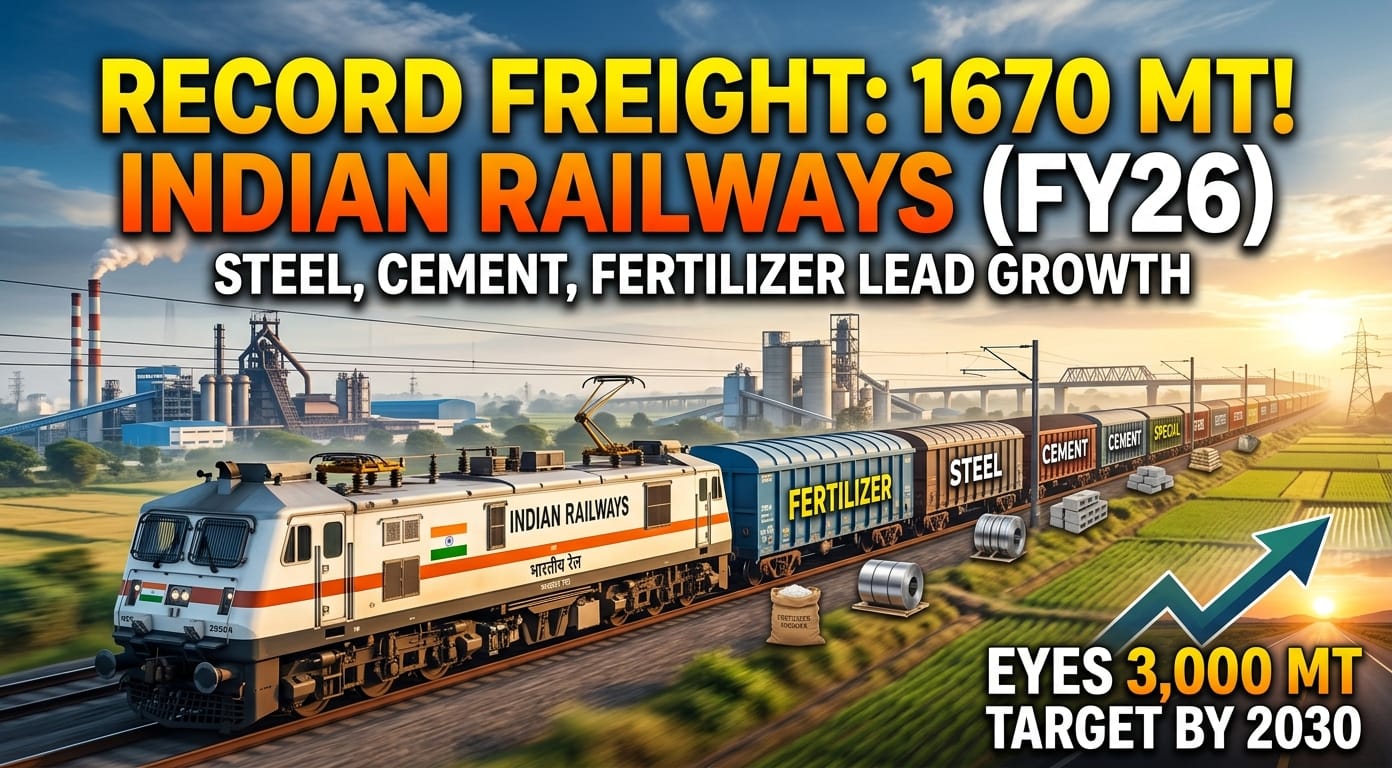
This year the rhythm of trains running all over India told the story of resilience, revival, and record-breaking freight performance. The Indian Railways, which is also called a backbone of the nation’s logistical network, ended the financial year 2025-26 (FY26) on a high note after transporting over 1,670 million tonnes (MT) of freight. This is a 3.25% increase from the 1,617 MT carried in the previous fiscal, reaffirming the railways’ role as a core force behind India’s industrial and infrastructure growth.
What makes this performance is not just the numbers but the sectors that pushed it forward. Fertilizer shipments rose sharply by 13.49 percent while movement of pig iron and steel climbed 13.11 percent, signaling robust activity in the manufacturing and infrastructure space. Iron ore and cement, both take indicators of construction momentum registered 6.74% and 4.74% respectively. Container traffic increased by 5.59% which also indicated a gradual but steady diversification of the freight mix. These gains combined affected the insignificant drop in coal loading, which declined by just 0.51%, and the decline of foodgrain by 2.05% from the previous year.
Railway officials attribute the freight surge to India’s ongoing infrastructure push—industrial corridors, housing projects, and renewed focus on logistics efficiency. “There has been increased movement of cement and iron ore reflecting increased construction activity in the country,” a senior official said, adding that the railways as a logistics partner for major sectors continue to grow. As a matter of fact, as India invests in constructing highways, metros, airports, and renewable energy plants, the railway wheels are turning faster than before to keep up.
Freight remains the financial lifeline of Indian Railways. The freight remains the financial lifeline of Indian Railways. Freight thus remains the financial lifeline of Indian Railways, generating almost 65 per cent of revenues against 30 per cent from passenger operation, (which is heavily-subsidized but socially crucial), according to FY26 performance. The achievement also indicates progress towards the ambitious targets specified in the 2019 National Rail Plan, which aims at a “future-ready railway system” where the freight capacity can be scaled up to 3,000 MT by 2030 and the speed of trains raised to 100 kmph from the current average of 25 kmph.
Zooming at zonal performance, South Western Railway (SWR) comprising Bengaluru, Mysuru, and Hubballi divisions recorded the sharpest rise of 14.89%. The NCR, ECoR, and WCR followed closely, recording 12.62%, 10.42%, and 10.06%, respectively. They have mostly benefited from industrial development, in steel, cement and container cargo. Positive strains were also reported for the Northeast Frontier Railway and North Western Railway, marking the expanding freight reach into India’s rising logistics belts.
Yet, not all zones experienced the same momentum. The freight loading reported a slight downward trend in Central Railway (-3.87%), Konkan Railway (-2.02%), Northern Railway (-6.13%) and South Eastern Railway (-0.92%). These drops may have arisen due to seasonal hitches, lowered coal requirements, and the sparsity of terminal spaces in some areas (Analysts). Nevertheless, the overall upward momentum indicates the positive efficiency of the railways freight and the growing regional spread of freight basing.
Aside from operational figures, policy vision behind the performance is also of great significance. The Standing Committee on Railways, in its December 2025 report, noted the importance of diversification other than the traditional bulk commodities. It urged the railways to tap fast-growing segments such as automobiles, FMCG, and e-commerce – goods currently dominated by road transport. This recommendation falls in line with the Indian shift towards multimodal logistics as well into integrated freight ecosystems that reduce cost as well as carbon footprint.
As the world’s fourth-largest railway network steers into the next decade, the challenge is not merely to transport more cargo but to transform how freight moves—faster, cleaner, and more efficiently. Thereby, Indian Railways is on a strong railway mode towards its 2030 milestone with freight growth exceeding multiple expectations (ibid). It is one thing to set the goal of 3,000 MT but another to achieve it yet FY26 broke several records indicating the goal is on course every loaded wagon speaks volumes about a running economy (ibid).