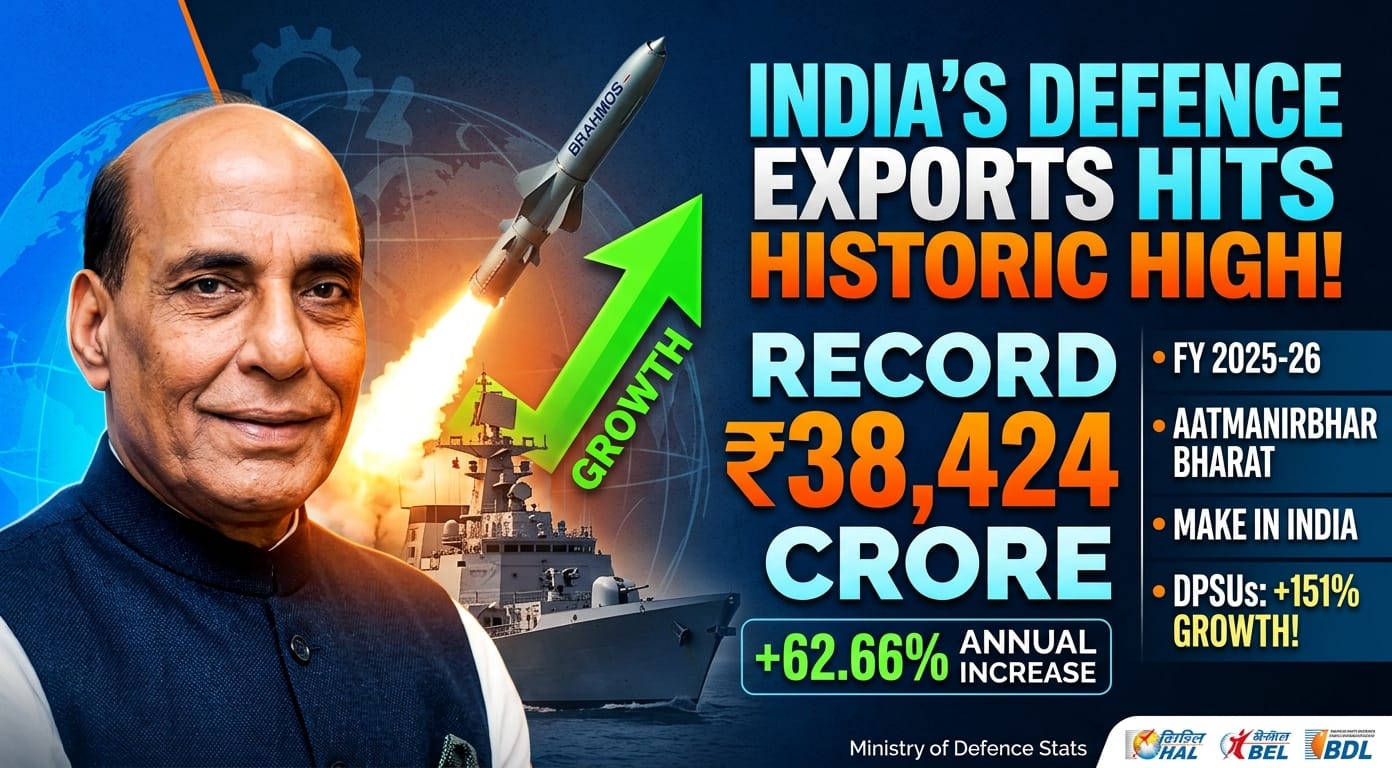
The government has reached a historic high in the quest towards having self-reliance in the world of defence with the defence exports registering a record level of 38,424 crore in the financial year 2025-26. Most recent statistics, which the Ministry of Defence released, represents a radical rise of almost 14,802 crore in comparison to the past financial year’s export of 23,622 acres, amounting to a powerful 62.66 percent annual increase.
This world record performance can be attributed to the stunning change in the defence manufacturing system of India due to the strategic policy change, the increase in the level of participation by the individual, and the rising level of global requirements in the local defence products.
Reporting the success on social media platform X, Defence Minister Rajnath Singh talked of the surge as a roaring success to Aatmanirbhar Bharat and Make in India. He added that the steep increase is a pointer to the increased confidence being placed on the Indians in their home defence production capabilities.
Praising the work of the Department of Defence Production, Defence Public Sector Undertakings (DPSUs), and the private industries, Singh gave the leadership of the prime minister Narendra Modi the credit to transform the nation into a global manufacturing centre of advanced defence systems. Singh says that the success story of FY 2025-26 highlights the emergence of India as a reliable defence exporter with the ability to serve the global market with affordable prices, dependability, and technological innovation.
The process leading to this historic accomplishment can be traced to policy initiatives that have been initiated in the last few years. The government under the Make in India and Aatmanirbhar Bharat programmes simplified its export licensing processes, decreased its regulatory burden and also provided an enabling environment where defense manufacturers, both public and private, can expand across various countries worldwide.
India had advanced the target of reaching 35,000 crore in annual defence exports by 2025-26 (in 2020) which has already been exceeded, and is an indicator of robust institutional delivering and enhanced competitiveness of Indian defence products. The policy ecosystem of the government, together with a greater cooperation between Indian and foreign defence organizations, has simultaneously not only raised production capacity, but diversified the export portfolio, too.
Defence Public Sector Undertakings have formed a large share of this year’s exceptional growth and accounted for 54.84% of the total export. In FY 2025-26, DPSUs have exported defense items valued at 21, 071 crore, which is an exceptional 151 per cent higher than the 8, 389 crore of the past year.
This boost shows the restoration of state-owned defence conglomerates that have updated their business procedures, embraced new technology in manufacturing processes and aggressively sought overseas business opportunities. The main contributors to the growth have been companies like Hindustan Aeronautics Limited (HAL) Bharat Electronics Limited (BEL) and Bharat Dynamics Limited (BDL) with those companies acquiring massive international orders and increasing their customer base beyond conventional clients.
The role of the private sector in enhancing the defence export situation in India has also been critical. There were ₹17,353 crore registered by the private firms of total exports, which was 14% more than the ₹15,233 crore reported in 2024- 25. As the privatized players in the total exports make 45.16% share of the total exports, they have increasingly contributed to the story of export-based growth in India.
Their military flexibility, the use of technology and their increased partnership with foreign defence contractors has seen them compete effectively in the high end global markets. This equitable input of owned and privately owned businesses in India tells a lot regarding the changing Indian defence industrial ecosystem – the one that promotes competition, innovation, and collaboration.
Export of defence products by India is also increasing to more than 80 countries in various regions and it is a sign of increased trust on Indian made systems by other countries. Products that are exported through the export portfolio cover the state of the art equipment like the Brahmos supersonic cruise missile, radar systems, defence electronics and aerospace components.
The landlake 375 million deal with the Philippines of the shore-based BrahMos missile system in the year 2022 is also one of the high points of the expanding global foot bill of India. Moreover, there is overall growth in registered defence exporters in India having 128 to 145, effective diversification and entry of new participants in the manufacturing ecosystem are healthy.
In the last five years, the defence exports of India nearly tripled, signifying a continued upward trend, which is consistent with the vision of the country of making it as a premier global defence exporter. This has not just improved the strategic presence of India in the international defence market, but also contributed in decreasing dependence on imports, which ensures that it is more self-contained in the critical defence technologies.
With the increase in the geopolitical requirements in the area and the change of alliances in the global arena, analysts feel that India, with its vast manufacturing strength, policy-favoured environment and enlarging industrial fabric, will keep on spearheading its emergence as a trusted producer in the international defence value chain.
As a testament to stable policy line, industrial cum industrial cooperation, and technological advancement, the India defence export story is poised to record a new high with FY 2025-26 being the first high in years. The record growth explains why the concerted efforts of both the government and industries through Aatmanirbhar Bharat have seen India become not merely a large importer but an emerging exporter of defence equipment of a world standard. The impetus of this score is bound to make India rank higher in terms of the world armed trade and propel it further on the path of becoming a fully self-reliant defence production powerhouse.