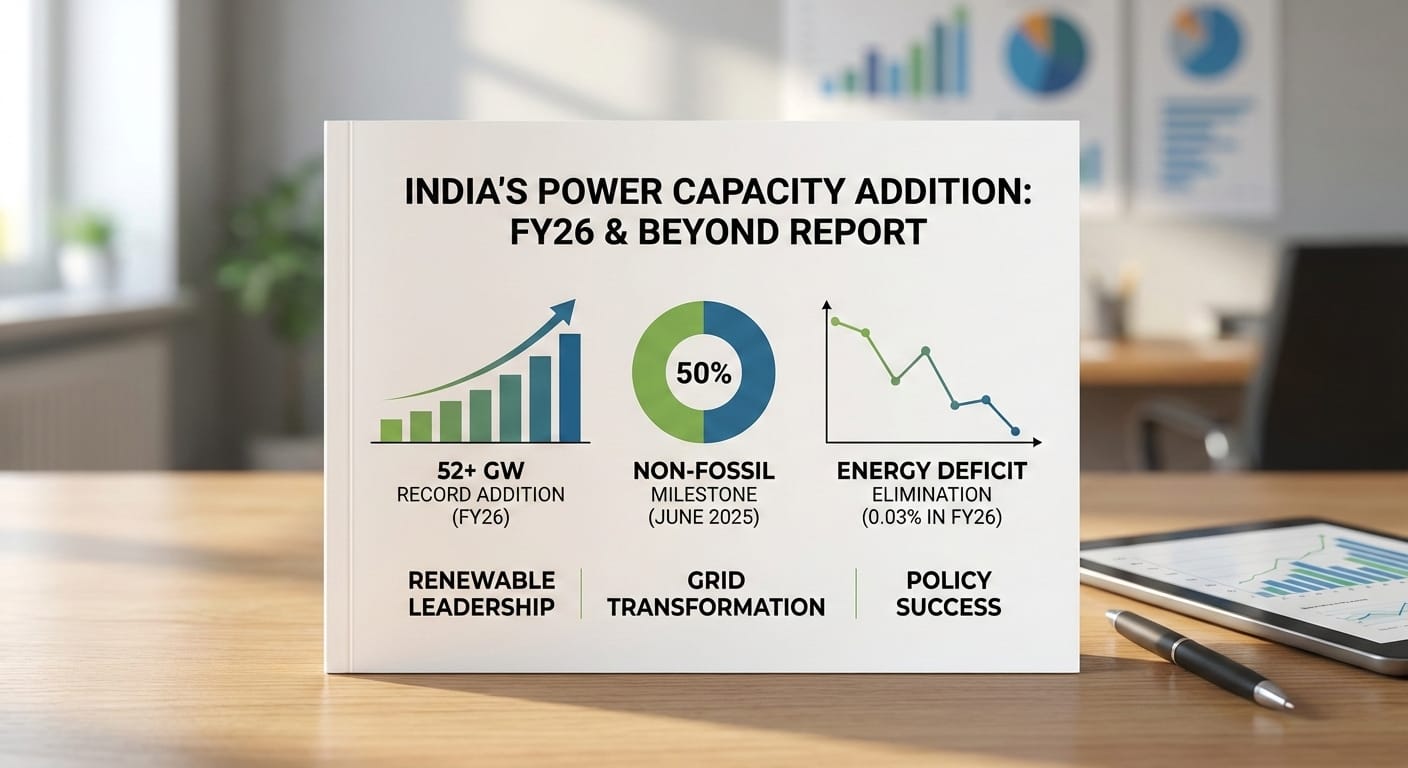
India has made a historic achievement in its power sector by adding generation capacity of over 52 Gigawatts (GW) in the first ten months of the financial year 2025-26. This is the highest capacity addition so far, in one financial year, according to the Ministry of Power. The achievement set a new record for capacity additions in a calendar year, overtaking the previous high of 34,054 megawatts set in the 2025 financial year (FY25), and mirrors the rapid changes in the energy landscape of India. This more than 11 per cent power capacity addition to the nation’s total installed capacity in a year is a sign of policy direction as well as massive infrastructure development happening in India.
Further, a significant portion of FY26’s newly added capacity has been from renewable energy sources, strengthening India’s commitment to clean and sustainable energy. Out of the total 52,537 MW added, 39,657 MW was from renewables. Solar power was at the forefront of this growth with a new capacity of 34,955 MW, and wind power added 4,613 MW. However, to maintain grid stability and sustain rising demand, 8,810 MW of thermal power capacity was added during the same period. Renewable energy additions stood at 48,436 MW during the calendar year 2025 alone, comprising 37,945 MW of solar energy and 6,347 MW of wind power. These figures highlight the acceleration of the energy transition in India, which is largely based on renewable energy sources, albeit in a balanced energy mix.
As of Jan2026 , India’s total installed power generation capacity now stands at 520,510.95 MW or roughly 520 GW. The total installed power generation capacity in India currently stands at 520,510.95 MW, or about 520 GW as of January 2026. Out of the entire current capacity, the fossil fuel-based sources tally 248,541.62 MW, while the non-fossil fuel sources record 271,969.33 MW. Renewable energy exclusively constitutes 263,189.33 MW of the entire capacity, and nuclear power accounts for 8,780 MW. Non-fossil fuel sources have, therefore, become a major contributor to the country’s power generation, signaling India’s gradual shift to cleaner power.
India also achieved a landmark milestone in June 2025, by having 50 percent of installed capacity of electricity from non-fossil fuel sources. This target was initially set under India’s Nationally Determined Contributions to the Paris Agreement and achieving the target more than five years ahead of schedule shows a strong policy implementation and investment in renewable energy infrastructure. Expansion of solar parks, wind farms, and grid modernization has been instrumental in supporting this rapid growth. The focus on renewable energy not only supports environmental goals but also enhances energy security in the long run, besides reducing reliance on imported fuels.
Equally important is the reduction in India’s energy deficit over the past decade. The total energy deficit stood at 8.4 per cent in FY2014, which showed a significant gap between energy demand and supply. The deficit has been reduced to 0.03 percent in FY2026, signifying a 99 percent decline. The gap between the energy supplied and the energy required has narrowed down to 0.5 per cent in FY23 and completely eliminated in the current financial year. Similarly, peak demand not supplied stood at 4 percent in FY23 and has reduced to nearly zero in FY26. These improvements show that power availability in most regions of India is sufficient to meet industrial growth, economic development and actualize improvement of life quality for the citizenry.
Combined with the fact that energy shortages have been almost entirely eliminated, this rapid growth in capacity demonstrates how India’s power sector has transformed over the last decade. The country has built its capacity to cater to increasing power needs of households, industries, and new sectors like electric mobility and digital services, ranging from extending generation capacity to adopting renewable energy and more effective grid management. The record addition of over 52GW in FY26 reflects a significant milestone and demonstrates sustained progress in India’s efforts to create a dependable, eco-friendly, and modern power infrastructure.
The record additions in FY26 build on a strong performance in the previous calendar year where India added a total of 48,436 MW of renewable energy capacity in 2025. Government programs such as PM-KUSUM for solar pumps, PM Surya Ghar for rooftop solar, and the National Wind-Solar Hybrid Policy have been instrumental in driving this surge. These initiatives, combined with a projected investment of over ₹9 lakh crore for infrastructure upgrades under the National Electricity Plan, suggest that India’s record capacity addition is part of a permanent structural shift toward a more resilient power system.