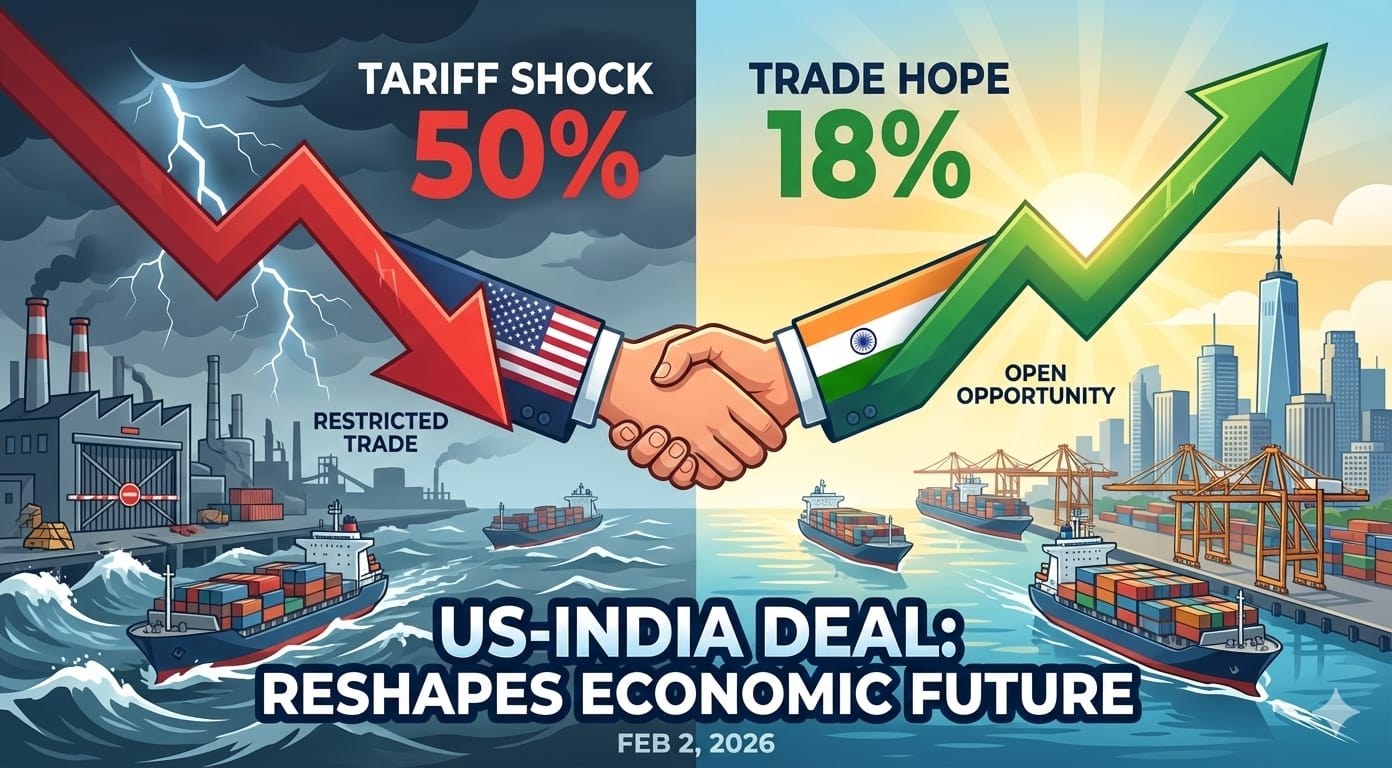
Think of tariffs as heavy chains snapped loose—Indian goods now race freely to US ports. On February 2, 2026, President Donald Trump unveiled a breakthrough trade deal with PM Narendra Modi, dropping US tariffs on Indian products from a crippling 50% (25% standard reciprocal rate plus 25% penalty for Russian oil imports) straight to 18%. This simple move revives our $86.5 billion worth of FY25 exports to the US, a whopping 18% of India’s total shipments, This will aid key areas like textiles, gems and jewellery, seafood, carpets, and auto parts from predicted 70% plunge after the tariffs.
So, what’s the real deal? As per President Trump, India promises to sharply reduce Russian oil purchases and commit to buying $500 billion in American energy, technology, agriculture, and coal over coming years. This has been the claim from the US president. He also claimed that in exchange, our goods face friendlier US borders, making them cheaper and hotter for American shoppers and factories.
But here is where optimism must meet reality. With just two months remaining in the current fiscal year, the economic impact for FY 2025-26 will be limited. The International Monetary Fund projects India’s GDP growth at 7.3% for FY 2025-26, according to recent updates, while the government’s own estimates put real GDP growth at 7.4% as reported by India Briefing. These forecasts were built assuming the punishing American tariffs would persist. The tariff reduction came too late to dramatically alter the FY 2025-26 trajectory, though it prevents further deterioration.
The real transformation begins in FY 2026-27 and beyond. Indian manufacturers now face a crucial test: Can they respond with the speed and scale needed to recapture market share? The 18 percent tariff is not a gift; it is a fighting chance. Companies that lost US contracts to Vietnamese, Mexican, or Bangladeshi competitors during the tariff chaos must now prove they can deliver superior value, quality, and reliability.
Manufacturing competitiveness will determine whether this deal becomes a launchpad or a footnote. India’s manufacturing sector grew 7% in FY 2025-26, according to government data cited by the Press Information Bureau, but faced headwinds from global trade disruptions. The Union Budget 2026-27 responded with targeted measures: Extending the export period for garments and leather products from six months to one year, increasing duty-free import limits for seafood processors from 1% to 3% of export turnover, and allowing special economic zones to sell excess capacity into the domestic market, as reported by Business Standard.
Those Indian goods fallen out of favor—shifted to cheaper rivals like Vietnam or Bangladesh—snap right back into the system. Prices crash 7-32 percentage points effectively, so US giants ditch alternatives and rebook with us. Supply chains realign quick in fast-moving sectors. Manufacturing gets the super boost here, clocking 7% growth in FY26 despite headwinds.
Picture Tirupur looms whirring for US apparel again, Surat polishers crafting gems for New York jewelers, idled lines firing up overnight. Union Budget 2026 sweetens it: Garment/leather export periods stretched to one year from six months, seafood processors’ duty-free imports up to 3% of turnover from 1%, SEZs sell extra to home market. Electronics exploded 39% in November 2025 exports, pharma holds $8.7 billion US sales from 2024, autos and components gear for comeback.
Services? They were never tariff-tied but gained indirect wings—IT, BPO, software exports (54% to US per KPMG) flowed easier with warmer ties, more visas, and tech pacts. FY27 GDP could swell extra 0.3-0.4% or $12 billion in activity, spawning jobs galore. Budget infra like dedicated freight corridors and 20 new waterways cuts logistics costs, speeding everything.
Challenges ahead, sure. Trump’s deal will need US Congress okay, our huge US purchase pledges could pinch imports budget short-term. But opportunity knocks loud— This is no handout, it’s a race to capture the market. Indian makers must nail quality, slash costs, woo buyers back with speed. Win this, and we don’t just recover; we dominate as China+1 hub. Factories pulse with pride, services touch skies, economy roars to $4 trillion plus. The tariff trap broken, India’s story turns epic. Seize the day.