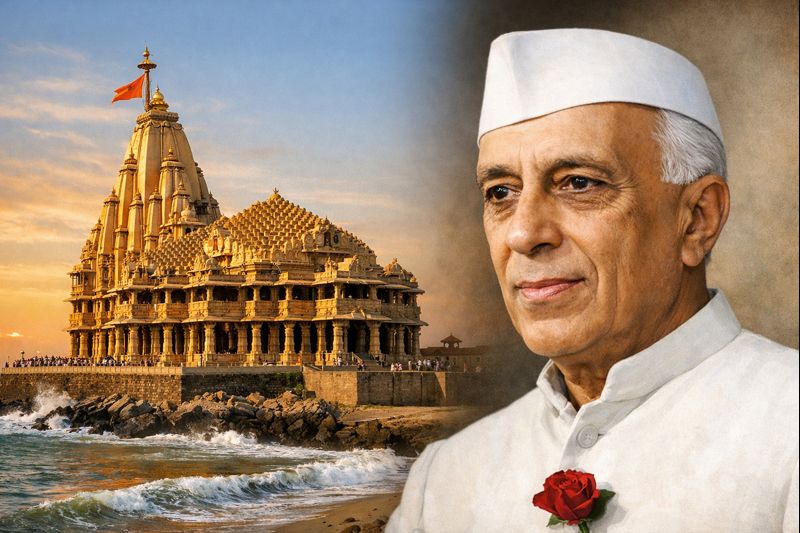
- PM Jawaharlal Nehru wrote more than 17 letters opposing the construction of Somnath Mandir.
- Letters to President and Cabinet Ministers: questioned the need for reconstruction of Somnath Mandir and heavily discouraged them from attending the inauguration.
- Letter to Pakistan Prime Minister Liaquat Ali Khan: Addressed him as “Dear Nawabzada”; downplayed the importance of the reconstruction.
- Instructions to public broadcasters: Directed them to minimise coverage and downplay the significance of the reconstruction of Mandir.
- Letters to Indian Chief Ministers: Wrote twice; termed the reconstruction “revivalist” and “pompous”; complained it harmed India’s image abroad.
- Instructions to Indian embassies: Explicitly prohibited assistance to the Somnath Trust, including requests of waters from river for consecration ceremony.
- Taken together, these letters reveal Jawaharlal Nehru’s sustained opposition and discomfort he felt due to reconstruction of the Somnath Mandir.
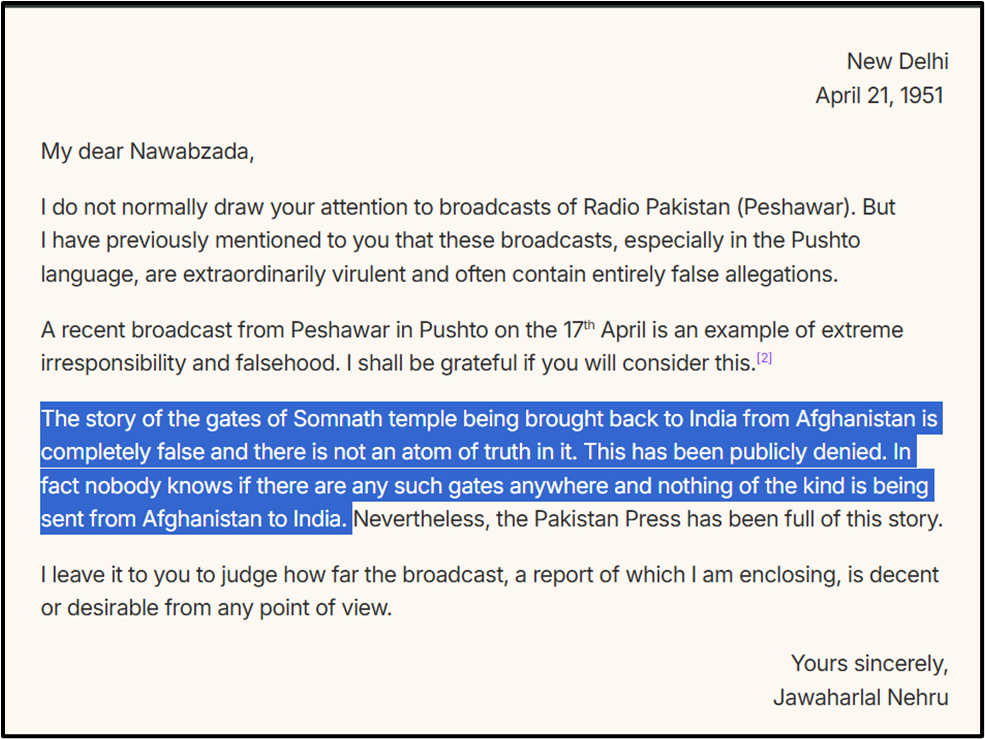
- 21 April 1951 – Letter to Liaquat Ali Khan (Prime Minister of Pakistan)
Jawaharlal Nehru went so far as to write reassuringly to Liaquat Ali Khan, dismissing the Somnath gates narrative as “completely false” and stressing that nothing of the sort was happening.
Instead of confronting Pakistan’s propaganda or defending India’s civilizational memory, he chose to comfort Pakistan by downplaying Hindu historical symbolism, prioritising external appeasement over internal confidence.
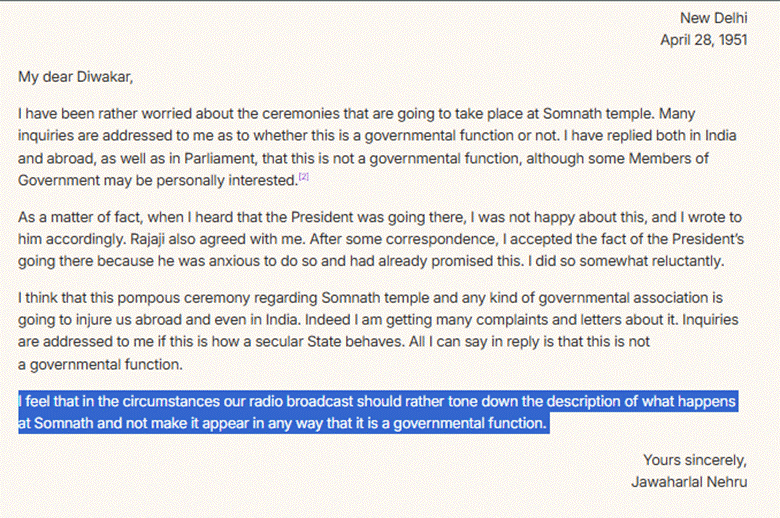
2- 28 April 1951- Letter to R.R. Diwaker Minister of Information and Broadcasting of India
Jawaharlal Nehru asked the Ministry of Information and Broadcasting to tone down coverage of Somnath consecration, described the ceremony as pompous and said that ceremony is injuring India’s image in the world.
He also wrote that Somnath ceremonies worried him a lot and that he is not happy with the President attending the ceremony.
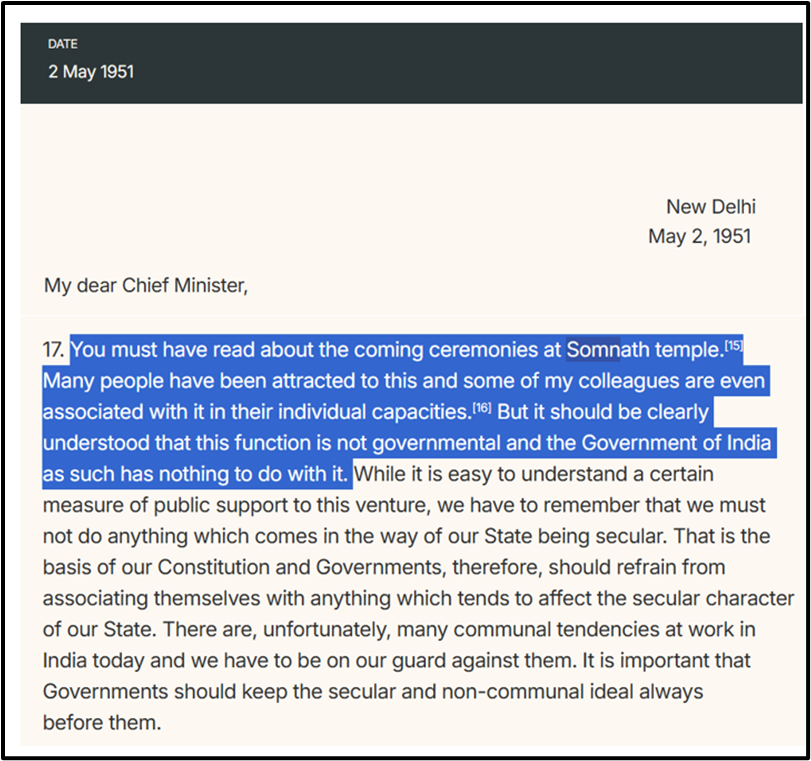
3 – Letter to Chief Minister 2 May 1951
He wrote 2 letters to Chief Ministers on Somnath consecration repeatedly distancing the Government of India from the Somnath ceremonies, despite acknowledging the mass public support and participation of his own colleagues.
By invoking secularism to justify non-association, he effectively portrayed Hindu civilizational restoration as a political risk, reducing a national act of historical correction to a problem of optics and treating popular religious sentiment as something the State needed to restrain rather than respect.[3]
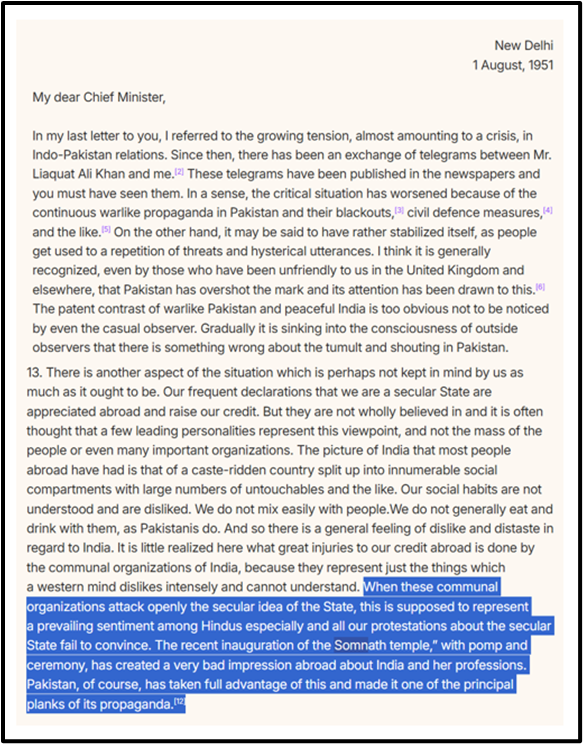
4 – 1st August 1951 Letter to Chief Ministers
In this letter, Jawaharlal Nehru, blamed the “pomp and ceremony” of the Somnath temple inauguration for creating a “very bad impression abroad” and weakening India’s secular image.
Instead of questioning hostile propaganda from Pakistan, he treated Hindu religious assertion itself as the problem, arguing that Somnath’s revival damaged India’s credibility, once again framing civilizational expression as a diplomatic liability rather than defending it against external misuse.
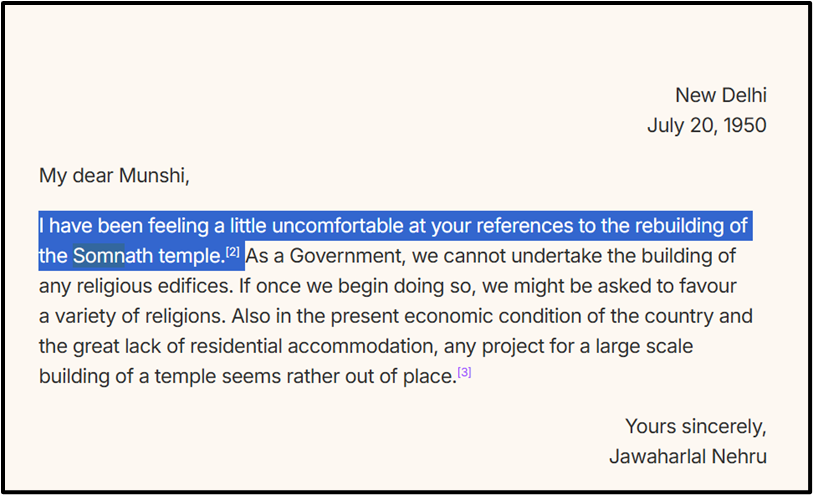
5 – 20 July 1950 letter to K.M. Munshi (Union Minister of Food & Agriculture)
In this letter, he questioned why Somnath temple should be built even as country was facing housing shortages and economic situation was bad.
Nehru reduced a centuries-old symbol of civilizational recovery to a balance-sheet problem, using economic hardship as a pretext to delegitimise Hindu religious revival rather than addressing its historical and emotional importance to the nation.
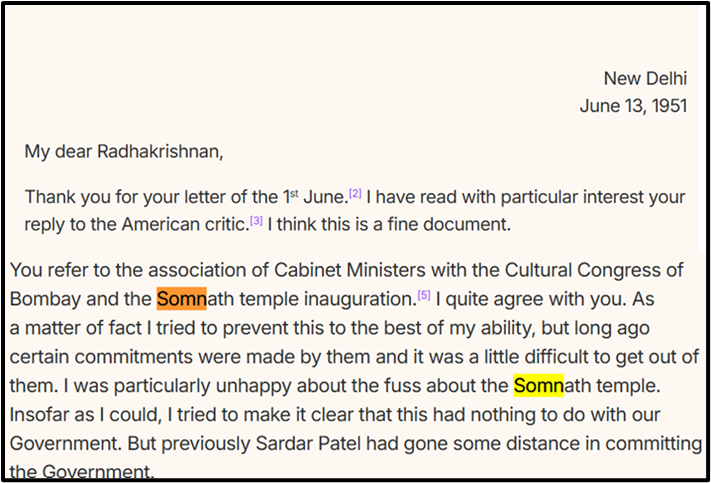
6 – 13 June 1951 letter to Vice President Dr. S. Radhakrishnan
In this letter, he dismissed the Somnath temple inauguration as unnecessary “fuss” and admitted that he had tried to stop Cabinet Ministers from being associated with it.
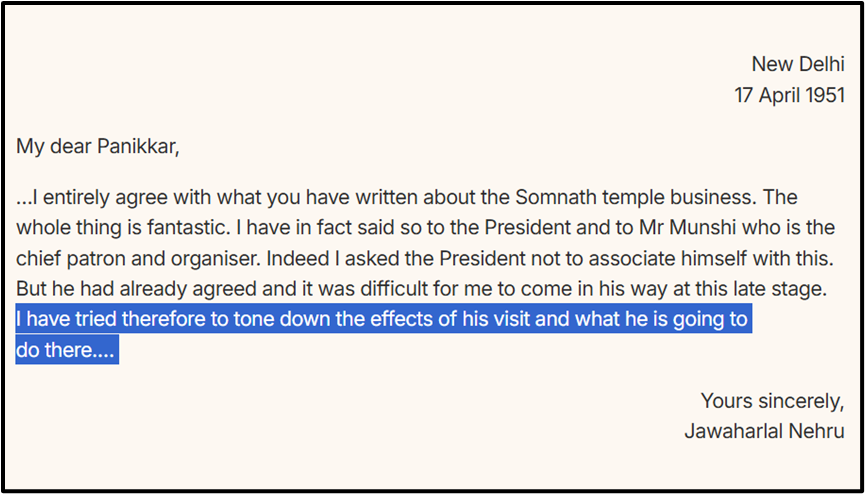
7 – 17 April 1951 letter to K.M. Panikkar (Indian Ambassador to China)
In this letter, Nehru openly admitted that he had “tried to tone down the effects” of the President’s visit to the Somnath temple, clearly acknowledging an active effort to reduce the visibility and significance of the temple’s inauguration rather than merely staying neutral.
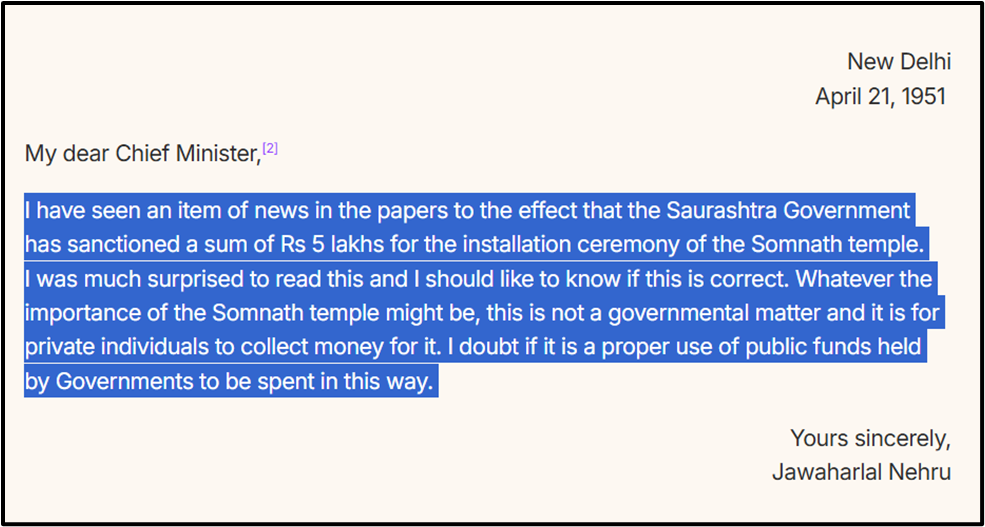
8 – 21 April 1951 letter to U. N. Dhebar (Chief Minister of Saurashtra)
Jawaharlal Nehru in this letter objected to public funds being used for the Somnath ceremony and invoked secular propriety to argue that temples were not a government matter.
The irony is stark: where state support for other religious structures was earlier justified, the moment a Hindu temple symbolising civilizational revival was involved, Nehru discovered fiscal caution and constitutional scruples, revealing selective secularism applied only when Hindu heritage sought public recognition.
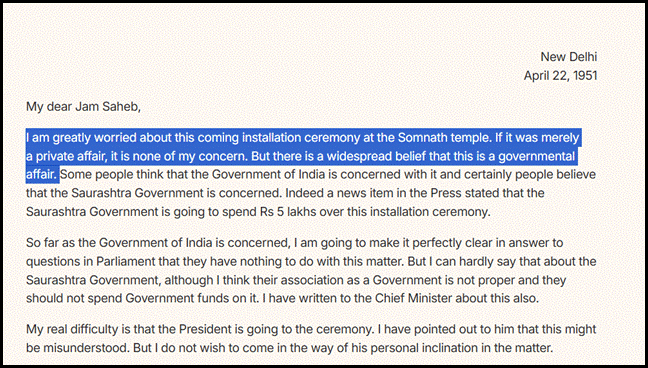
9 – 22 April 1951 – Letter to Digvijaysinghji (Jam Saheb of Nawanagar)
Jawaharlal Nehru reacted with visible anxiety to the Somnath trustees reaching out to foreign missions for sacred river water and soil, arguing that it created a false governmental impression.
He prioritised foreign sensitivities and the fear of Pakistan’s propaganda over India’s own civilizational expression, portraying Hindu religious symbolism as a diplomatic liability rather than a cultural right.
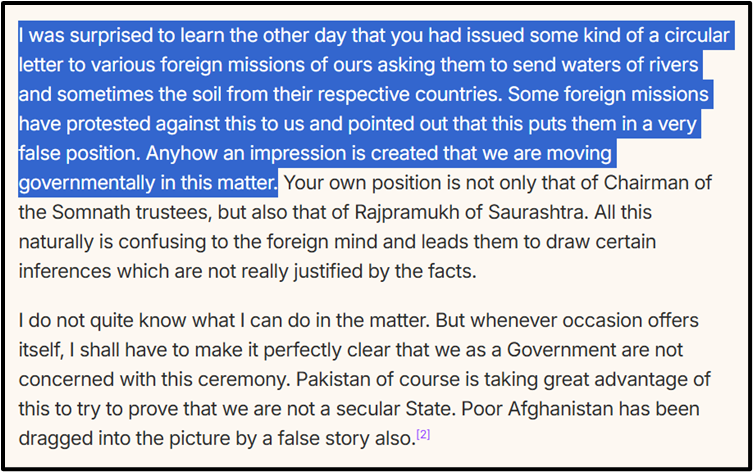
He objected to the ceremony being seen as anything beyond a private affair, distanced the Government of India from it, and criticised even the Saurashtra Government for associating with the event or spending public funds, revealing a consistent discomfort with any visible state association with Hindu religious restoration.
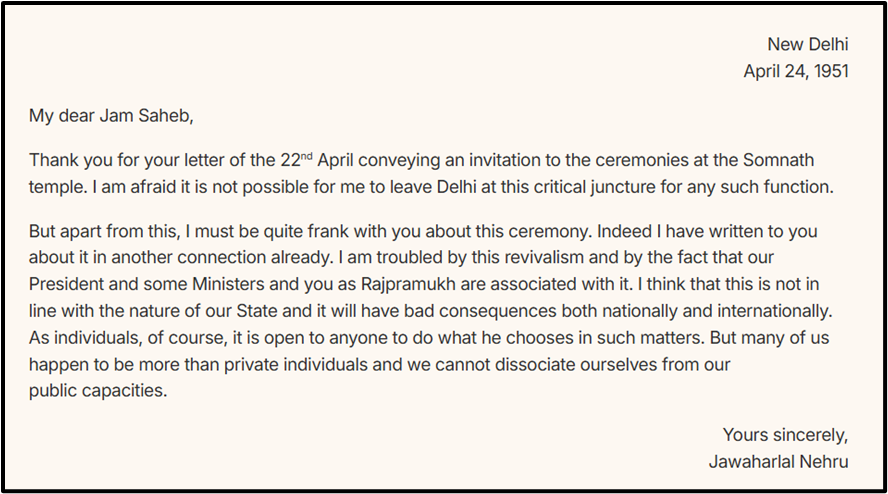
10 – 24 April 1951 letter to Digvijay Singh (Jam Saheb of Nawanagar)
In this letter written 2 days after his first letter to Digvijay Singh, he openly attacked the Somnath inauguration as “revivalism” and warned that the President’s and Ministers’ participation would have “bad consequences nationally and internationally.” Instead of standing with a historic act of Hindu civilizational restoration, he treated it as a threat to the Indian State itself.
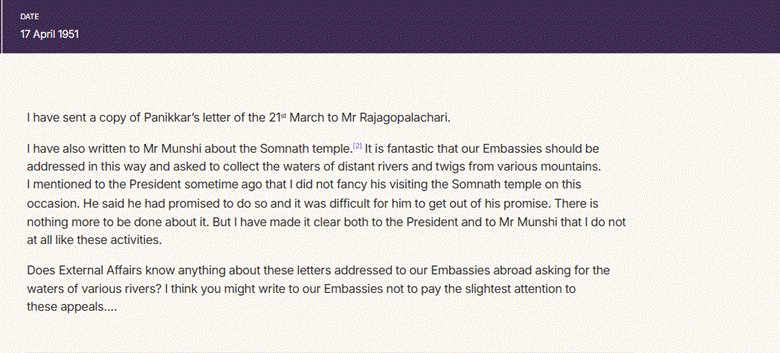
11 – 17 April 1951 – Letter to the Secretary-General and Foreign Secretary, Ministry of External Affairs
In this letter, Jawaharlal Nehru directed that embassies should be instructed not to pay the slightest attention to requests for sacred river water from the Somnath Trust, reflecting clear discomfort even with symbolic expressions of Hindu religious activity.
He acknowledged that he had already conveyed his displeasure to both the President and K. M. Munshi, and further suggested that Indian embassies.
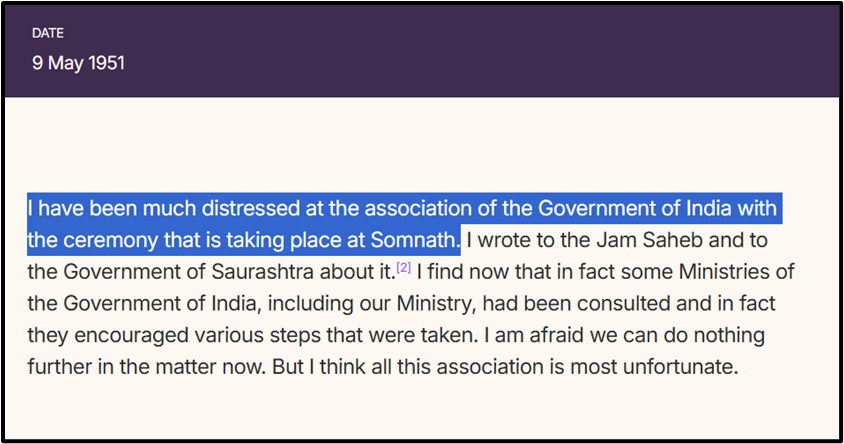
12 – 9 May 1951 – Letter to S. Dutt (Secretary, Ministry of External Affairs)
Just days before the Somnath consecration, Jawaharlal Nehru continued to express clear distress over any association of the Government of India with the ceremony.
Writing to S. Dutt, Secretary in the Ministry of External Affairs, he objected to governmental linkage with Somnath and reiterated that such association was “most unfortunate,” underscoring his persistent unease with state involvement in Hindu civilizational restoration right up to the eve of the inauguration.
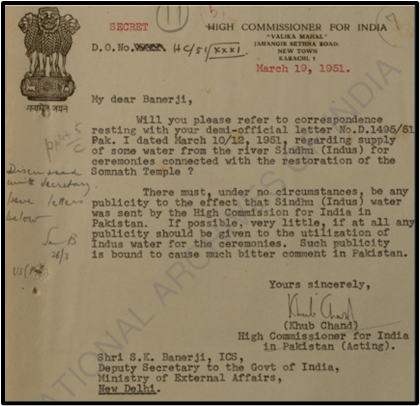
13 – 19th March 1951, Letter to Khub Chand, High Commissioner of India to Pakistan
Jawaharlal Nehru formally disapproved of the use of Indus water for the Somnath consecration, conveyed through the Foreign Secretary that the request did not have his approval, and ordered that any such future requests be cleared in advance, effectively distancing the Indian state from the ceremony and suppressing its symbolic significance.
Jawaharlal Nehru allowed and reinforced a line where Indian officials insisted there be “no publicity under any circumstances” about Indus water being sent for Somnath, prioritising fear of “bitter comment in Pakistan” over openly owning a civilizational act, showing how the government chose silence and concealment instead of defending the restoration against hostile reactions.
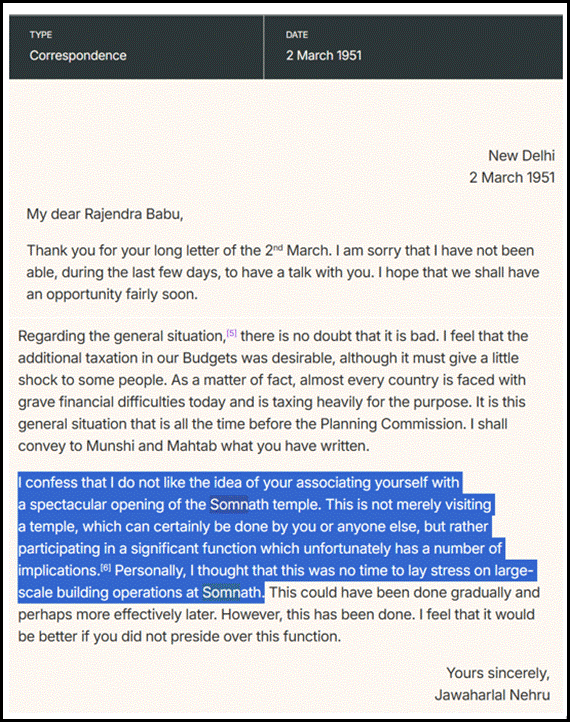
14 – 2 March 1951 to President Rajendra Prasad
Jawaharlal Nehru wrote this letter on bluntly admitting that he “did not like” the President associating with the Somnath inauguration. He went beyond advice to express discomfort with the scale, visibility, and symbolism of the temple’s restoration, suggesting it should have been delayed and even urging the President not to preside over it.
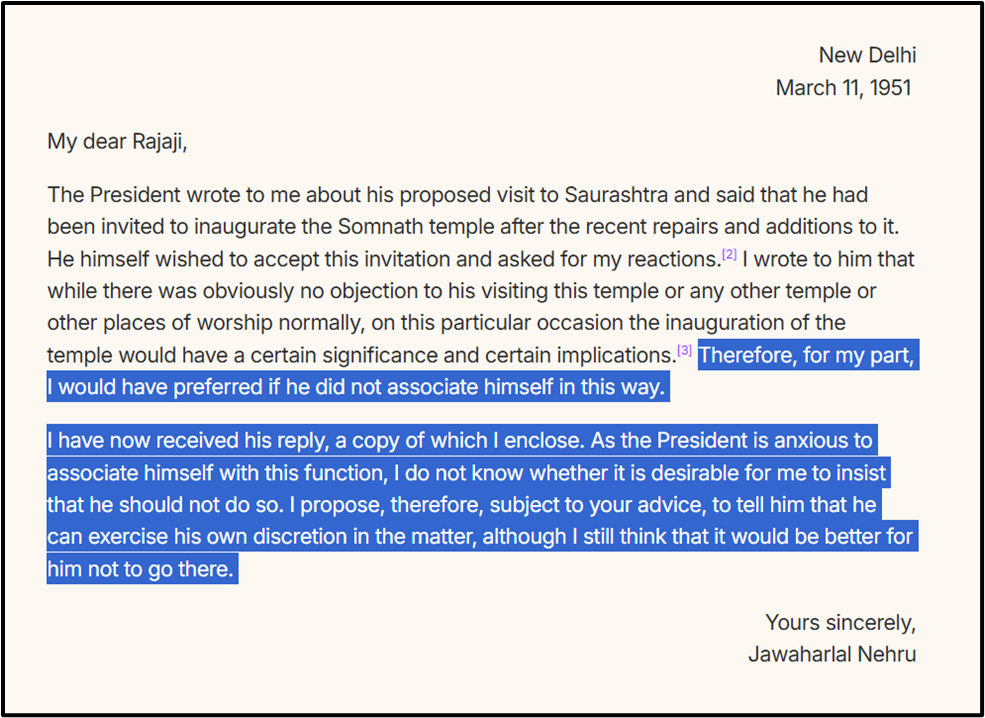
15 – 11 March 1951 to C. Rajagopalachari (Union Home Minister)
Jawaharlal Nehru openly opposed the President’s participation in the Somnath inauguration and stated that he “would have preferred” the President not associate with it, showing an active attempt to keep the Head of State away from a major Hindu civilizational event he considered politically inconvenient.
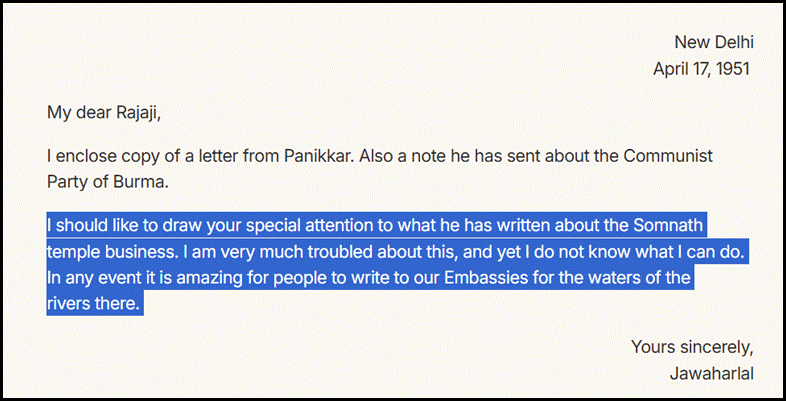
16 – 17 April 1951 to C. Rajagopalachari (Union Home Minister),
In this letter, He admitted that he was “very much troubled” by the Somnath temple.
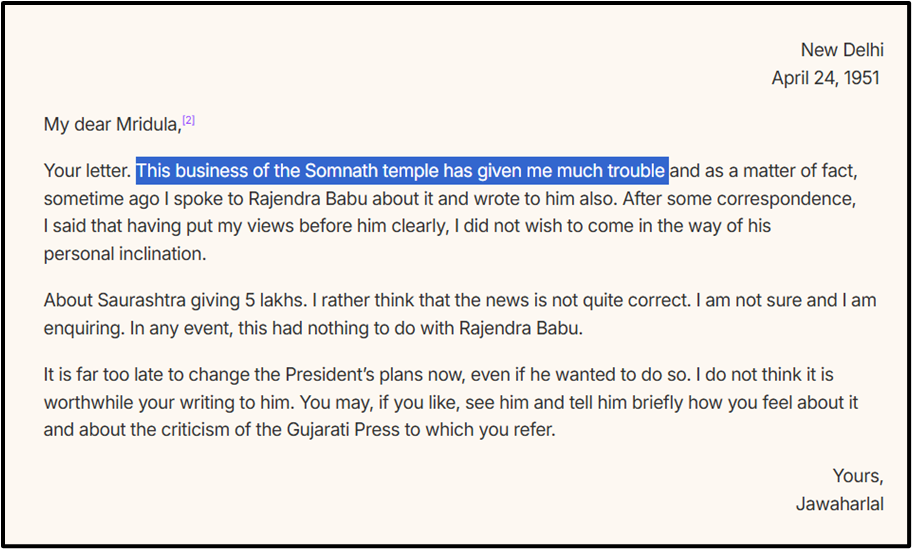
17 –24 April 1951 – Letter to Mridula Sarabhai, Congress Leader
Jawaharlal Nehru repeatedly wrote letters expressing that the Somnath temple issue was “giving him much trouble”, openly admitting discomfort with Hindu civilizational restoration.