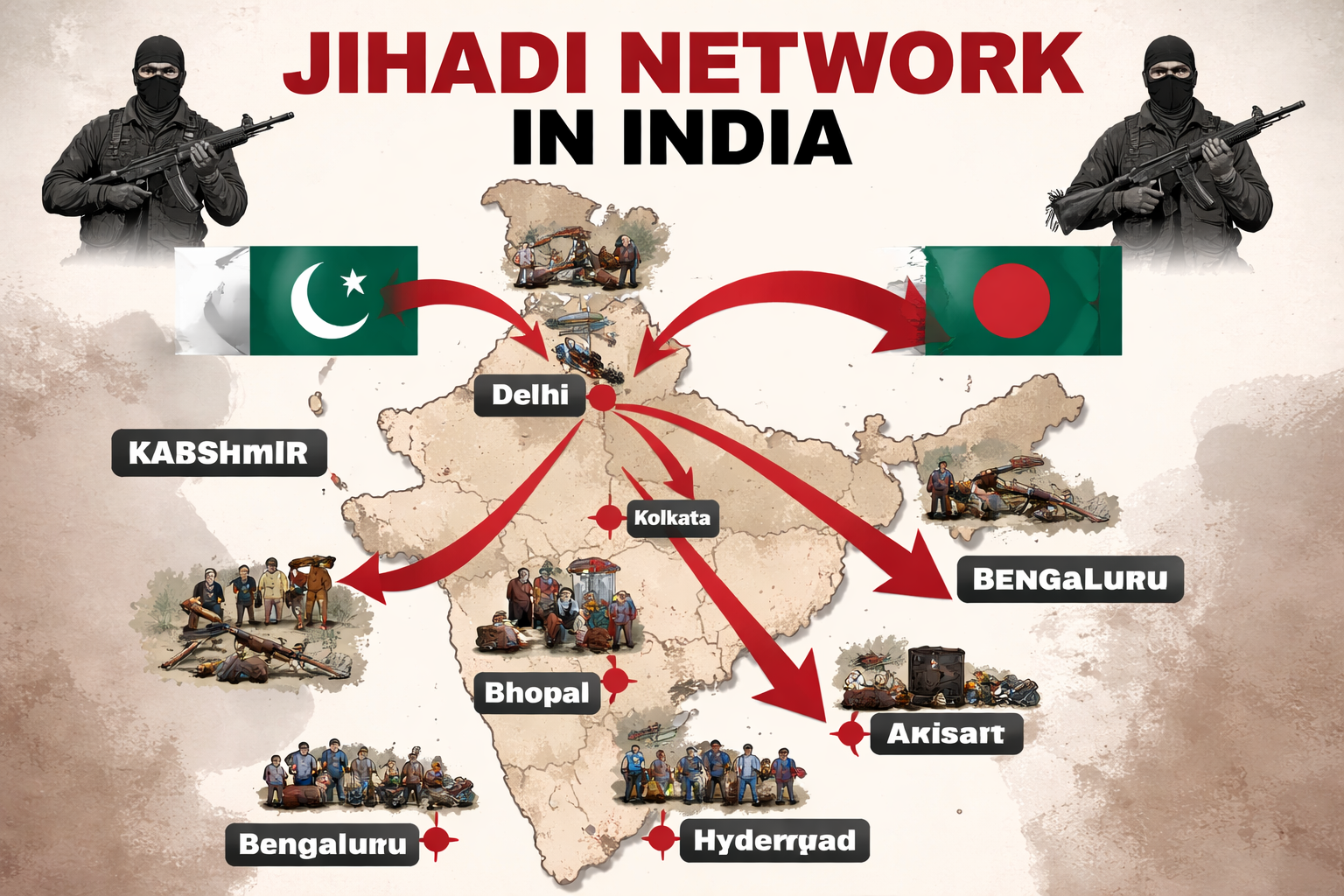
India’s southern and eastern states, once considered relatively insulated from Islamist extremism compared to regions like Kashmir, have emerged as focal points for counter-terrorism operations.
States such as Kerala, Tamil Nadu, and West Bengal have witnessed a series of busts involving groups like the Islamic State (ISIS), Lashkar-e-Taiba (LeT), Jamaat-ul-Mujahideen Bangladesh (JMB), and Ansarullah Bangla Team (ABT). These incidents, spanning from 2014 to 2026, highlight intricate networks fueled by online propaganda, cross-border infiltration, Gulf remittances and socio-economic vulnerabilities. Amid these developments, heated political debates have arisen with critics accusing opposition-ruled governments of “appeasement politics” that create permissive environments for radicalization.
The shift began in the 2010s coinciding with the global rise of ISIS and Al-Qaeda affiliates. National Investigation Agency (NIA) data indicates over 200 pro-ISIS cases nationwide, with a notable share in these regions. Factors like porous borders with Bangladesh in West Bengal, Gulf migration in Kerala and madrasa networks in Tamil Nadu have facilitated this growth.
Tamil Nadu: Madrasa networks and selective secularism
Tamil Nadu, under the Dravida Munnetra Kazhagam (DMK) government since 2021, has seen a string of terror-related incidents linked to southern modules with Bangladesh and LeT ties. The 2018 IS jailbreak plot in Cuddalore, the 2019 Ansarulla module bust involving 16 arrests for ISIS-inspired plans, the 2020 IS recruitment in Ramanathapuram, the 2022 Coimbatore car bomb near a temple (linked to Salafi-Jihadi ideology) and the 2026 LeT-ISI bust in Tiruppur where eight were arrested for plotting attacks. The NIA has highlighted roles of Arabic colleges and white-collar professionals in these networks.
Critics accuse the DMK of “minority appeasement,” citing policies like Ulema pensions introduced in 2026 and alleged inaction on Hindu ritual disputes, such as the 2025 Thiruparankundram lamp controversy. They argue this enables radical elements claiming Tamil Nadu has become a “breeding ground for terrorism” due to lax policing. Opposition figures like AIADMK’s Edappadi Palaniswami have questioned the state’s Anti-Terrorism Squad’s effectiveness, noting central agencies often lead arrests. Experts note that radicalization here stems more from online recruitment and coastal networks than state policies alone, with socio-economic disparities in districts like Ramanathapuram playing a role.
West Bengal: Border vulnerabilities and soft stance allegations
West Bengal’s 2,200 km border with Bangladesh has long been a conduit for groups like JMB and ABT. Incidents include the 2014 Khagragarh blast revealing JMB safe-houses, the 2020 Al-Qaeda module in Murshidabad, 2021 Neo-JMB arrests in Kolkata, 2024 Shahadat module bust, and the 2026 LeT-ISI module involving arrests across Bengal. Demographic shifts, with Muslims comprising about 27% of the population, add layers to the discourse.
The Trinamool Congress (TMC) under Mamata Banerjee’s ‘Muslim appeaser’ government such as imam allowances since 2012 and reluctance toward CAA/NRC implementation. This fosters a “permissive environment,” turning the state into a “breeding factory” for radicals, exacerbated by poverty in Muslim-majority districts like Murshidabad. TMC’s focus on communal propitiation overlooks border lapses and madrasa radicalization.
Kerala: Gulf links and controversial alliances
Kerala, with a 26% Muslim population and strong Gulf ties has been a recruitment hub, with around 100+ joining ISIS which is the highest in India. The 2016 Kasaragod ISIS module where 21 joined ISIS in Afghanistan, 2018 IS-Khorasan recruits, 2019-20 Al-Qaeda arrests and the 2023 ISIS module averting attacks on Hindu worship places and the 2026 IS social media case at the airport. Radicalization often occurs via madrasas and social media.
The Left Democratic Front (LDF) is criticized for “appeasement,” including opposing 2024 Waqf amendments and hosting 2023 Palestine rallies with elements from the banned Popular Front of India (PFI). LDF has strong ties with PFI for votes despite the ban and “soft” stances on islamic extremists. Concerns over “love jihad” and conversions add to Hindu-Christian anxieties in the area.
Across these states, radicalization intertwines external factors like Bangladesh infiltration and online propaganda with internal vulnerabilities. NIA raids reveal inter-state networks, while governments emphasize cooperation amid electoral strategies. The jihadi networks in Kerala, Tamil Nadu and West Bengal underscore a national challenge that balances security with secularism. While it is highlighted that potential permissive environments exist, evidence suggests multifaceted causes such as international jihadist elements and islamist preachers active in the area. State governments must prioritize robust border controls, education reforms and de-radicalization programs without politicization. Ending appeasement debates and embracing unified national security is essential to elevate Bharat above division. Only through facts-driven action, devoid of fear-mongering, can India counter this threat effectively.
Author – Vanita S, Public Policy Professional