The Union Cabinet’s approval of 100 plug-and-play industrial parks under the BHAVYA scheme signals India’s most ambitious push yet to transform its manufacturing landscape — but speed of execution will determine whether the vision becomes reality.
The government has long wrestled with a stubborn paradox — a vast, young workforce eager to participate in manufacturing, and an industrial infrastructure that has historically fallen short of global standards.
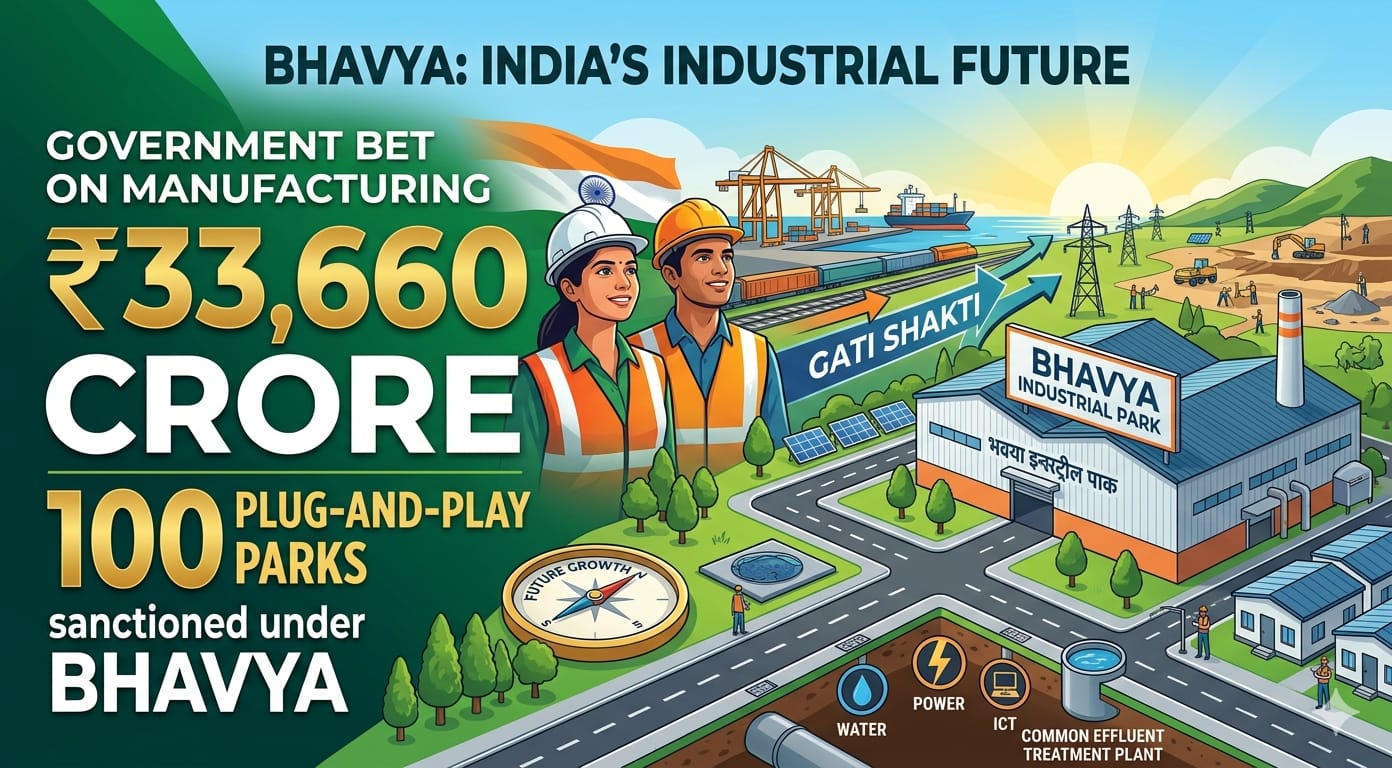
The Union Cabinet’s approval of the Bharat Audyogik Vikas Yojana, widely known as BHAVYA, represents a direct and well-funded answer to that gap. With an outlay of ₹33,660 crore, the government has sanctioned the creation of 100 plug-and-play industrial parks designed to remove every friction point that has traditionally slowed investors from committing to Indian manufacturing. This is not merely an infrastructure project — it is an attempt to rewire how India does industrial business.
The scale and design philosophy of BHAVYA set it apart from previous industrial corridor efforts. Each park will span between 100 and 1,000 acres, with central financial support of up to ₹1 crore per acre, making the economics compelling for state governments and private sector players who will partner in development. Crucially, these will not be empty plots handed over to developers.
The scheme mandates that every park come pre-fitted with internal roads, underground utilities, drainage systems, common effluent treatment plants, ICT-enabled administrative systems, testing laboratories, ready-built factory sheds, built-to-suit units, worker housing, and single-window clearances. The intention is clear: an investor should be able to walk in, plug in, and begin production — hence the phrase that has come to define the scheme’s ambition.
The scheme builds on the proven architecture of the National Industrial Corridor Development Programme, which has already demonstrated results through 20 projects across 13 states. BHAVYA draws directly from the NICDP framework, carrying forward its emphasis on large-scale smart industrial cities while expanding the model to a broader network of parks.
Ashwini Vaishnaw, Minister for Information and Broadcasting, described the vision at a media briefing: these ecosystems would allow industries to move from intent to production with speed and certainty, eliminating the long delays that have historically deterred both domestic and foreign investors from scaling up in India.
What gives BHAVYA additional strategic depth is its alignment with PM Gati Shakti, the government’s integrated infrastructure planning initiative. The parks will be designed not as isolated industrial zones but as nodes within India’s broader multimodal connectivity grid, ensuring seamless integration with road, rail, port, and airport networks.
The government has also committed to extending support for external infrastructure of up to 25 per cent of project cost, addressing a long-standing complaint from industrialists that last-mile connectivity failures routinely undermined otherwise well-planned industrial zones. Projects will be selected through a challenge mode, ensuring that only reform-oriented, investment-ready proposals make it through.
The job creation projections attached to BHAVYA are significant. The government estimates that the scheme will generate approximately 15 lakh direct jobs, a figure that would represent a meaningful contribution toward absorbing India’s growing working-age population into formal manufacturing employment.
Alongside employment, the initiative is explicitly framed as a vehicle for strengthening domestic supply chains — a priority that gained fresh urgency in the aftermath of COVID-19-era supply disruptions and the broader global realignment of manufacturing away from over-dependence on single geographies. India’s window to position itself as a credible alternative hub has never been wider, and BHAVYA is an attempt to ensure that the infrastructure matches the opportunity.
The sustainability dimension of the scheme deserves attention as well. At its core, BHAVYA seeks to improve ease of doing business through streamlined approvals and single-window systems, but the parks are also designed with green energy use and sustainable resource management as operating principles.
This dual focus — efficiency and environmental responsibility — reflects the kind of industrial planning that modern global supply chain partners, particularly in Europe and North America, now expect as a baseline before committing to long-term sourcing relationships. India’s ability to offer not just cost advantages but governance and environmental credibility will determine how deeply it can penetrate high-value manufacturing segments.
Yet, as with every ambitious industrial programme in India, the decisive variable is execution. Approvals and outlays are necessary but not sufficient. The history of Indian industrial policy contains enough well-designed schemes that lost momentum in the gap between announcement and operationalisation. BHAVYA’s partnership model — relying on states and private sector players to co-develop and manage these parks — introduces both an opportunity and a risk.
States that move quickly, offer complementary reforms, and attract anchor investors will likely see transformative outcomes. Others risk falling behind, turning a national scheme into a patchwork of uneven results. If India’s policymakers can hold the line on speed, quality, and accountability, BHAVYA has the genuine potential to become the backbone of the country’s next manufacturing decade.