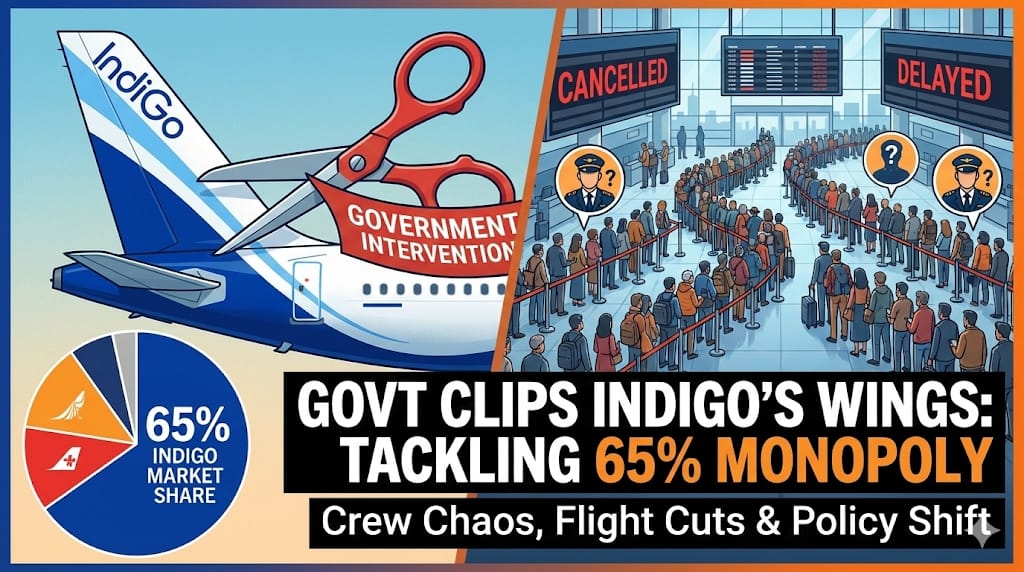
For nearly a week, India’s busiest airports told a story that no airline wants to headline: Serpentine queues, stranded passengers, missing bags, and display boards full of “Cancelled” and “Delayed”.
At the centre of this storm stood IndiGo, the country’s largest airline, with about 65% domestic market share and over 2,300 daily flights. When chaos turned systemic, the aviation regulator DGCA stepped in first. What was the DGCA’s original order to IndiGo? It had directed the airline to curtail about 5% of its schedule – roughly 110–115 flights daily – primarily on high-frequency, high-demand routes, and to submit a revised truncated schedule by 5 pm on December 10. The logic was simple: if the airline could not operate its expanded winter schedule without massive cancellations, it needed to fly less and stabilise.
But the situation had already gone beyond a routine operational blip. The second phase of new Flight Duty Time Limitation (FDTL) rules, effective from November 1, demanded more rest and smarter rostering for pilots, especially around late-night operations, to combat fatigue and improve safety.
The rulebook was not a surprise; airlines had been notified well in advance and implementation was phased from July 1 to November 1. Yet IndiGo, by its own admission to the DGCA, misjudged crew requirements and left “planning gaps” in implementing FDTL Phase II. The result? Over 1,200 flight cancellations in November, of which 755 were due to crew and FDTL-related constraints. When delays compounded with winter schedule changes, weather, congestion and minor technical issues, the network buckled.
So why did the government step in and double the cut to 10% when the DGCA had already ordered 5%? The answer lies in both immediate public anger and longer-term structural questions. Civil Aviation Minister K Rammohan Naidu openly blamed IndiGo’s “internal mismanagement of crew rosters, flight schedules and inadequate communication” and “summoned” CEO Pieter Elbers to the ministry. While IndiGo claimed operations were stabilising, with about 1,800 flights and on-time performance back over 80%, the ministry did not rely solely on the airline’s assurance. It ordered a 10% overall curtailment in IndiGo’s domestic schedule, bringing its daily domestic flights below 1,950, with a clear political and policy message: passenger disruption on this scale will invite tough intervention, even against the biggest player.
An interesting twist is what happens to the flights IndiGo will no longer operate. According to government indications, the freed-up slots may be offered to other carriers that have the capacity to deploy additional aircraft and crew. Does this raise a bigger question – is the government quietly signalling that IndiGo’s effective monopoly on domestic routes needs to be diluted? When one airline controls nearly two-thirds of the domestic market, disruption at that single carrier can “bring India’s aviation ecosystem to its knees”, as seen in early December. In such a scenario, can regulators and the ministry afford to treat IndiGo as just another private company, or does it become a systemically important player like a “too-big-to-fail” bank?
The DGCA’s actions show a dual track: on one side, it granted IndiGo temporary relaxations from some night-operation provisions of FDTL for A320 pilots till February 10, to help the airline stabilise. On the other side, it issued show cause notices to IndiGo’s CEO and COO, launched an inquiry, and made clear that “appropriate action” will follow after examining the airline’s explanations. IndiGo has argued that it is difficult to pinpoint a single cause for the meltdown and cited a combination of minor technical glitches, winter schedule changes, adverse weather, congestion and FDTL implementation. Yet the core allegation from the regulator and ministry is sharper: you had time, you expanded your winter schedule from about 14,158 to 15,014 weekly domestic flights, and you still failed to align crew strength and rostering with the new safety norms.
What does this episode ultimately mean for IndiGo’s dominance? In the short term, the airline will fly fewer domestic routes, see some of its slots temporarily open to rivals, and operate under intense regulatory and political scrutiny. In the medium term, the 10% curtailment is less about punishing one airline and more about sending a signal: India’s aviation policy cannot allow a single private carrier, however efficient in normal times, to become so dominant that its internal mismanagement paralyses the entire system. If this crisis nudges policymakers to encourage more competition, rational slot allocation and a diversified market structure, the message is clear – IndiGo’s 65% share may have been great for its shareholders, but for India’s flyers and regulators, that kind of concentration now looks like an unacceptable risk.