India’s food safety regime is entering a new phase where ease of doing business and stricter oversight are being pursued together rather than in conflict. Building on the recommendations of the High-Level Committee on Non-Financial Regulatory Reforms chaired by Rajiv Gauba, the government has cleared a package of reforms in the Food Safety and Standards Authority of India (FSSAI) licensing framework that fundamentally changes how food businesses are registered, monitored and inspected. For millions of food business operators (FBOs), from packaged food companies to street vendors, this means fewer procedural hurdles but a sharper focus on actual risk and compliance behaviour.
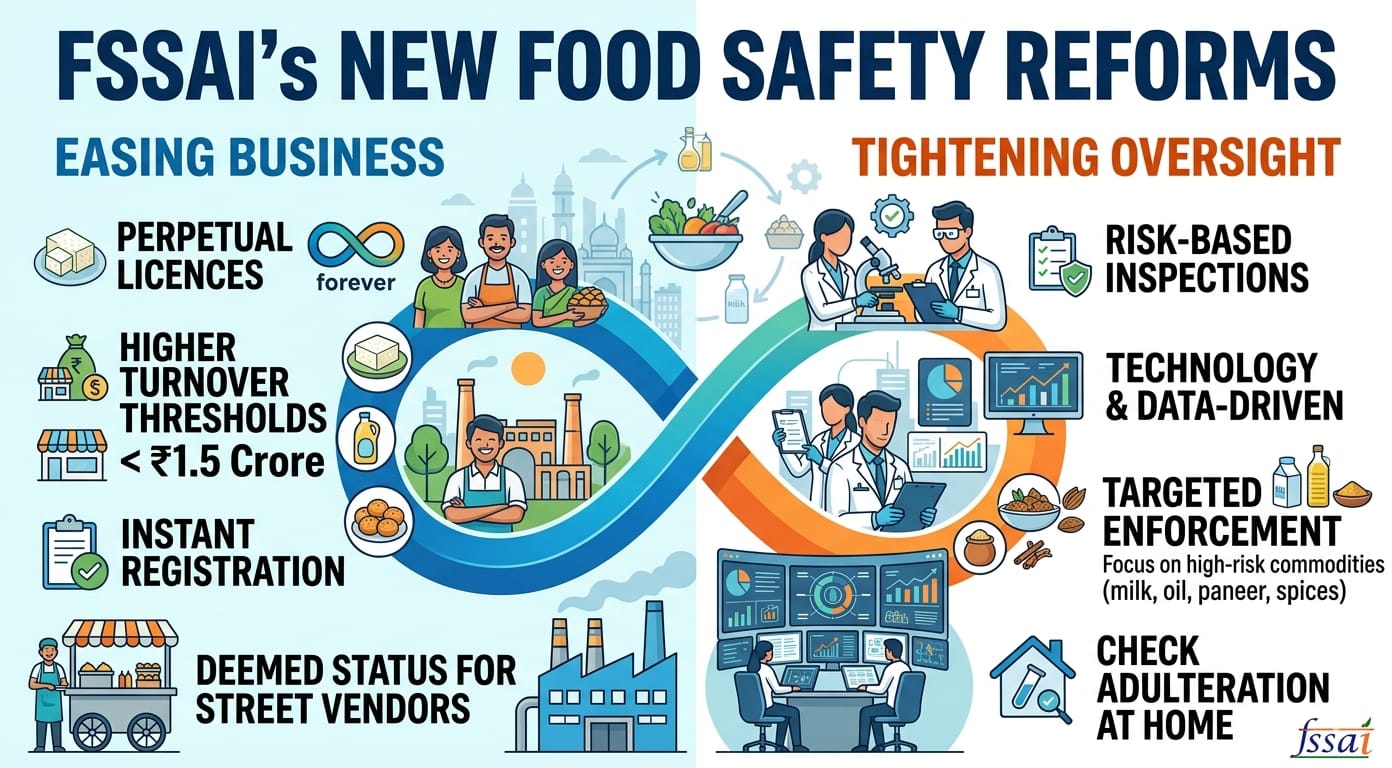
A key pain point for businesses so far was the constant cycle of licence renewals, with FSSAI licences typically valid for one to five years and requiring renewal at least 30 days before expiry. The new framework replaces this with perpetual validity for registrations and licences, eliminating the need for repeated renewals and the associated paperwork and costs. This is expected to substantially cut compliance friction and reduce routine interactions with licensing authorities, while allowing regulators to redirect capacity towards inspections, surveillance and enforcement instead of clerical processing. At the same time, perpetual validity does not mean a free pass: licences can still be suspended or cancelled for violations, and the new risk-based inspection system is designed precisely to catch non-compliance in real time.
The change in turnover thresholds is another structural reform that responds directly to long-standing complaints from small and micro food businesses. Previously, any business with annual turnover above ₹12 lakh had to move beyond basic registration into the more demanding licensing regime. The government has now raised the basic registration threshold sharply to ₹1.5 crore, bringing a far larger universe of small players under a simpler, low-cost registration route. Above that level, businesses with turnover up to ₹50 crore will fall under state licences, while those exceeding ₹50 crore will require a central licence. This rationalised structure not only simplifies categorisation for FBOs but also strengthens the regulatory role of state authorities in supervising the bulk of small and mid-sized enterprises operating within their territories.
At the ground level, the reforms explicitly recognise that India’s food economy is not just made up of large factories and restaurant chains but also of small vendors, home-based kitchens and local units. Small FBOs are set to benefit from instant registration on submission of basic documents, removal of pre-inspection requirements in many low-risk cases, and lower fees and procedural compliances. One of the most impactful steps is deemed FSSAI registration for street vendors who are already registered under the Street Vendors (Protection of Livelihood and Regulation of Street Vending) Act, 2014 or with urban local bodies, eliminating the need for multiple parallel registrations.
Government statements indicate that this could benefit over one million street food vendors, a segment that has often operated in a grey zone despite being central to urban food culture. By formally bringing them into the FSSAI net with low friction, regulators gain visibility and the ability to conduct targeted awareness and enforcement drives where necessary.
Underpinning these ease-of-doing-business measures is a clear shift to a technology-enabled, risk-based inspection framework. Instead of blanket, routine inspections, the frequency and intensity of checks will be determined by factors such as the nature of the food commodity, the past compliance track record of the business, third-party audit performance and intelligence from surveillance and enforcement activities. Compliant businesses can therefore expect fewer but more focused inspections, while repeat offenders, high-risk commodities and suspicious cases will face closer scrutiny. This approach directly addresses industry complaints about arbitrary or excessive inspections, while also responding to citizens’ concerns that serious violators often slipped through gaps in the system.
The push for smarter regulation comes against a backdrop of frequent public outrage over food adulteration, from everyday staples like milk and edible oil to spices, pulses and sweets. FSSAI’s own surveillance campaigns have documented non-compliance and adulteration in a range of commodities, including oils and fats, sweetening agents, foodgrains and their products, pulses, spices, salt, tea and coffee. The regulator also runs a “Check Adulteration at Home” initiative, with simple tests to detect contamination such as water or starch in milk, industrial dyes like metanil yellow in oils and pulses, and non-permitted additives in sweets and besan, underscoring how widespread these risks can be in the unorganised sector. Recent enforcement drives, such as the seizure of over 1.4 tonnes of adulterated paneer made with refined palmolein oil in Surat, highlight the scale at which unsafe products can reach consumers if inspection capacity is weak or misdirected.
Seen together, the current reforms try to strike a balance that previous regimes struggled to achieve. By cutting down on repetitive paperwork and giving licences perpetual validity, the system becomes more predictable and business-friendly, especially for small operators who lack compliance teams. Simultaneously, by using data, technology and risk profiling to decide who gets inspected, when and how often, the government is tightening the screws where it matters most: on high-risk products, habitual offenders and zones with a history of adulteration.
For consumers, the promised outcome is safer food and faster action on complaints; for businesses, it is a regulatory environment that rewards sustained compliance instead of box-ticking. How effectively these reforms are implemented by states and local bodies will determine whether this new FSSAI framework becomes a genuine turning point in India’s fight against food adulteration or just another well-intentioned policy on paper.