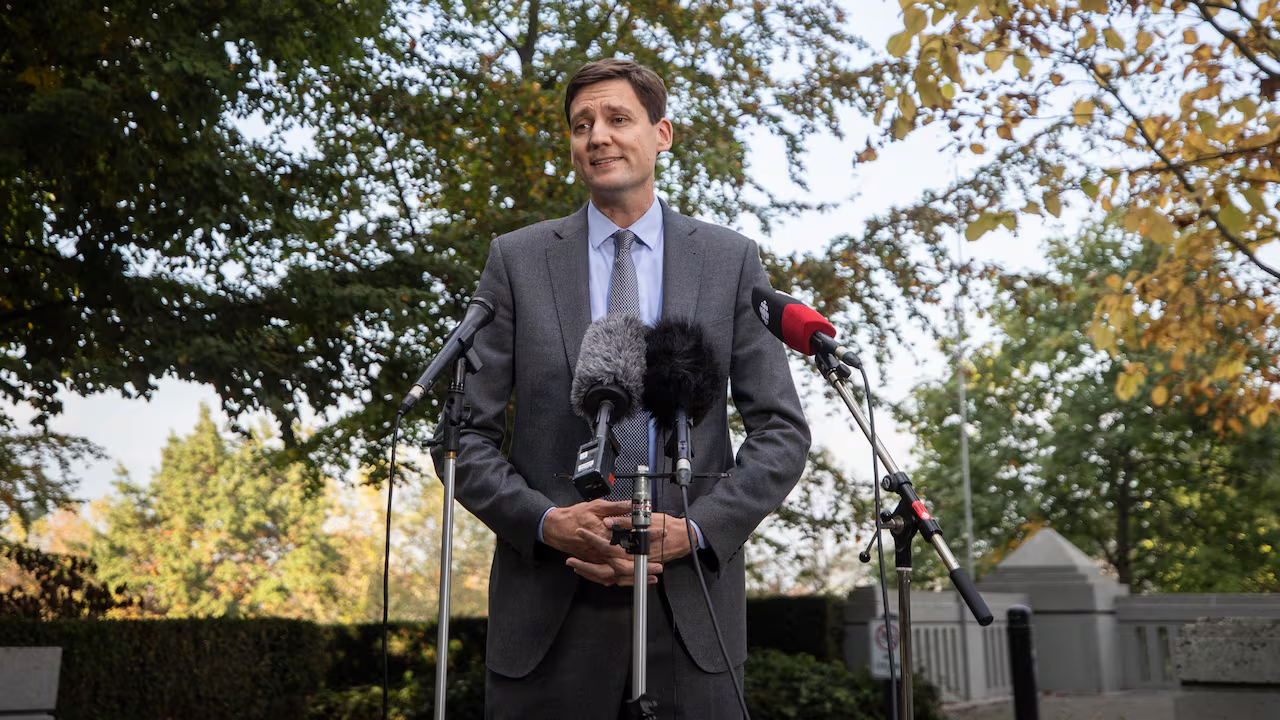
A miniscule but vocal group of pro-Khalistan activists gathered outside the British Columbia Legislative Assembly in Victoria to protest Premier David Eby’s upcoming trade mission to India (January 12–17, 2026). Waving Khalistan flags and holding signs calling for Eby’s resignation, the demonstrators accused him of prioritizing trade deals over justice for the 2023 killing of Sikh leader Hardeep Singh Nijjar in Surrey, B.C. Groups like banned extremist outfit Sikhs for Justice framed the visit as a betrayal, claiming it undermined Sikh rights in favour of economic ties with India under Prime Minister Narendra Modi.
While Eby defended the trip as essential for diversifying trade amid U.S. tariff pressures, focusing on sectors like sustainable forestry, clean energy, and critical minerals, the protest illustrates how imported geopolitical grievances continue to complicate sub-national and national efforts to strengthen Canada-India relations.
The Roots of Imported Issues and “Manufactured” Activism
The Khalistan movement, which seeks an independent Sikh state in India’s Punjab region, originated in the 1980s, went on to become an extremely violent phenomenon resulting in a decade of militancy in Punjab and loss of human lives in thousands. Starting as a ideological driven movement it gradually faltered and became a violent movement dominated by criminal elements. After a decade of anti Militancy operations which also involved some questionable police encountes it was suppressed in India but the movement’s violent fringe has largely been imported to Canada, home to the world’s largest Sikh population outside India (over 770,000 people).
Critics describe much of this activism as “manufactured,” driven by opportunistic elements including criminal networks (e.g., drug trafficking proceeds from Punjabi-Canadian gangs funding rallies), misused charities for donations, and alleged external influences. The Canadian Security Intelligence Service (CSIS) identifies this as “politically motivated violent extremism (PMVE),” with Canada-based Khalistani extremists (CBKEs) forming the primary manifestation since the mid-1980s. Designated terrorist groups like Babbar Khalsa International and the International Sikh Youth Federation are implicated in these networks.Importantly, this fringe does not represent the broader Sikh community. Leaders such as former B.C. Premier Ujjal Dosanjh and the World Sikh Organization of Canada have condemned the politicization of gurdwaras and the stigma it imposes on peaceful Sikhs, who prioritize integration and legitimate advocacy.
Insights from the CSIS 2024 Report: A National Security Concern
The CSIS 2024 annual report (released in mid-2025) explicitly states that a “small group” of CBKEs “continue to use Canada as a base for the promotion, fundraising or planning of violence primarily in India.” While no CBKE-related attacks occurred on Canadian soil in 2024, their ongoing involvement in violent activities abroad “continues to pose a national security threat to Canada and Canadian interests.” The report notes that “real and perceived Khalistani extremism emerging from Canada continues to drive Indian foreign interference activities in Canada,” creating a cycle of espionage and repression. CSIS distinguishes this extremist subset from protected peaceful advocacy under the Charter of Rights and Freedoms, but warns of risks like transnational repression and resource strain on security agencies.
Undermining Canada’s Foreign Policy–Canada’s foreign policy emphasizes pragmatic trade diversification and strong ties with rising powers like India—a key counterweight to China and a growing economic partner. Yet, this activism has repeatedly disrupted progress. India’s long-standing view of Canada as a “safe haven” for anti-India elements led to the 2023–2024 diplomatic crisis following Nijjar’s killing (which India denies involvement in), including mutual diplomat expulsions, frozen talks, and stalled trade.
The recent Eby mission exemplifies the challenge: Amid U.S. tensions, it aims to attract investment and create jobs, but faces backlash from pro-Khalistan groups framing engagement as capitulation. This hampers bilateral trust, delays extraditions, and risks economic losses, complicating Canada’s Indo-Pacific strategy.
Eroding Liberal Canadian Values
Canada’s liberal values—multiculturalism, tolerance, and free expression—are tested when exploited by extremists. Protected speech allows protests, but when it crosses into incitement or violence glorification (echoing the 1985 Air India bombing that killed 329 mostly Canadians), it fosters division. This leads to community clashes (e.g., 2024 temple violence in Brampton), stereotypes against Sikhs, and perceptions of “vote bank politics” in Sikh-heavy ridings.The “manufactured” amplification—blending genuine grievances with criminal funding—undermines equality and integration, turning an open society into a perceived hub for global radicals and eroding public trust.
A Path Forward
Canada must balance enforcement against violent extremism (e.g., financing monitoring and prosecutions) with protections for peaceful expression. Enhanced cooperation with India on shared threats, as signaled under Prime Minister Mark Carney, could rebuild ties without compromising sovereignty.As Premier Eby’s mission continues amid these tensions, the CSIS report serves as a reminder: Allowing a handful of aggressive elements to import and manufacture division threatens not only foreign policy but the core of Canada’s liberal democracy. Reaffirming unity and decisive action is essential to preserve both national security and societal harmony.