When Finance Minister Nirmala Sitharaman stood in Parliament on February 1, 2026, and announced an ambitious plan to launch “Bharat-VISTAAR,” it seemed as just another line in a long list of schemes under her 9th consecutive Union Budget. But Bharat-VISTAAR initiative holds the potential for becoming one of the most transformative initiatives for agriculture in India – a sector that still supports over half the nation’s population.
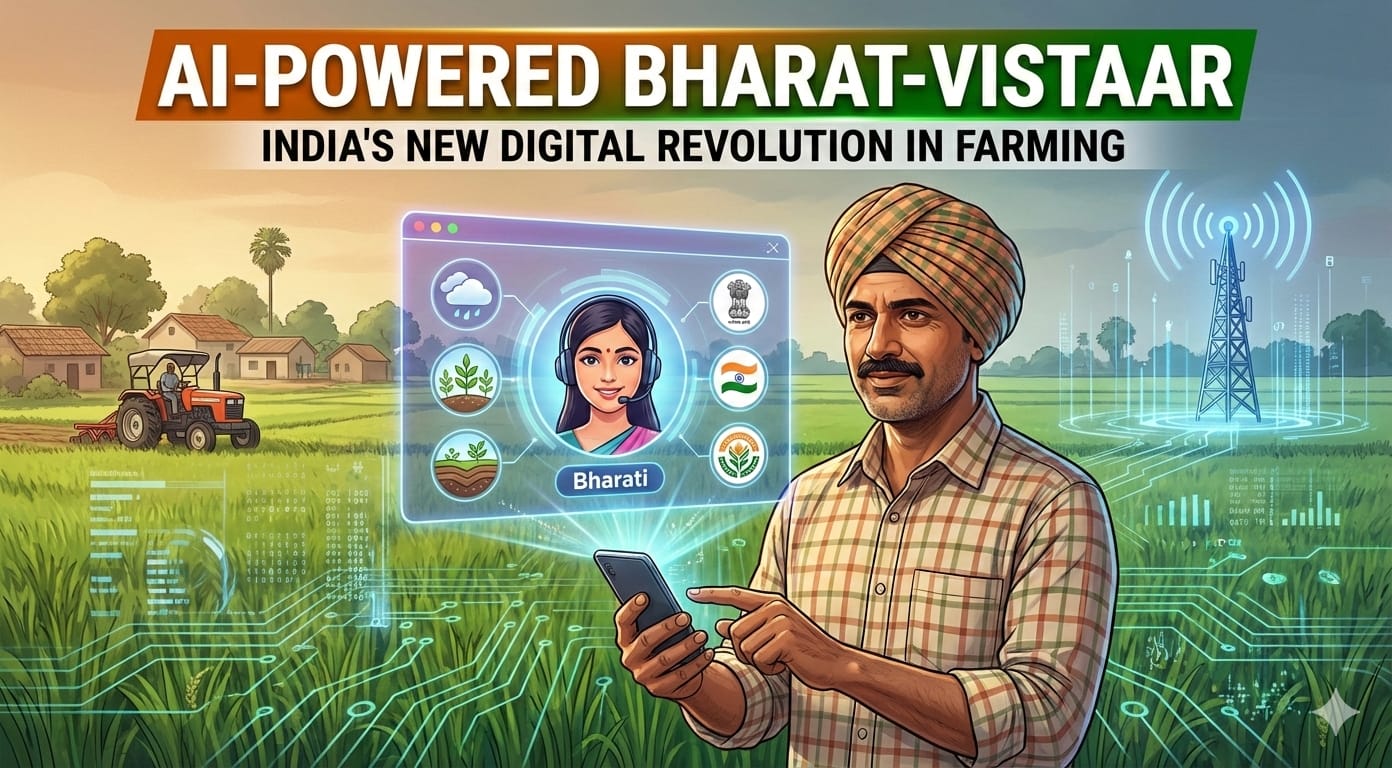
Two weeks later that vision takes shape. Today in Jaipur the Union Agriculture Minister Shivraj Singh Chauhan and the Rajasthan Chief Minister Bhajanlal Sharma are to jointly dedicate Bharat-VISTAAR (Virtually Integrated System to Access Agricultural Resources) – a multilingual AI-powered digital platform developed with the intent to brand India’s first ‘virtual agriculture expert accessible 24×7’ for farmers across the country.
At its core, Bharat-VISTAAR is designed to break down one of rural India’s biggest barriers – access to timely, reliable and easily digestible information relating to agriculture. The already existing AgriStack and ICAR portals provide data on crops, schemes, and techniques, but the innovation in Bharat-VISTAAR comes with the integration of those resources with artificial intelligence and speech recognition.
The idea is simple but path-breaking—farmers can ask their farming queries over a phone call or through a mobile interface in their own language and receive immediate, AI-guided responses. If they are not into smartphones or the Internet, they can simply call *155261*, where an interactive AI, *Bharati*, will talk them through everything from crop planning to dealing with pests.
What makes this launch extremely significant is the scale and inclusivity of it. Bharat-VISTAAR is not just a tool but a national digital framework—an infrastructure allowing the Central and State agricultural data to be merged without compromising the autonomy and uniqueness of each state. The digital architecture of Bharat-VISTAAR is developed in coordination with the India AI Mission, BHASHINI (India’s AI language initiative), and various AI Centres of Excellence. This collaboration guarantees that the platform will not be static. Rather, it will “learn” based on farmer feedback, evolve to accommodate regional concerns and obstacles, and be able to cross-verify the government’s schemes and policies with real-world data.
The tool is also set to provide tailor-made information on ten central flagship schemes, including the PM-KISAN, PM Fasal Bima Yojana, Soil Health Card, Modified Interest Subvention Scheme, Sub-Mission on Agricultural Mechanisation, Per Drop More Crop, PM Krishi Sinchayee Yojana, PM Annadata Aay Sanrakshan Abhiyan, Agriculture Infrastructure Fund, and Kisan Credit Card. In addition to that, the Bharat-VISTAAR tool will also provide real-time information about weather, pest attacks, and market trends which are critical for changing a farmer’s fortune from season to season.
Bharat-VISTAAR will initially be operational in Hindi and English only, but the roadmap has been carefully charted to extend the facilities to a wide array of regional languages such as Bengali, Marathi, Tamil, Telugu, and Punjabi, among others, ensuring that linguistic barriers do not deter the lesser technologically savvy farmers from the envisioned benefits. The entire system revolves around the idea of conversational intelligence, wherein Bharati – the AI advisor – and the farmer engage in natural dialogue, allowing a two way flow of feedback.
This feedback loop will funnel anonymized data back into government systems, enabling policy planners to yield evidence-based inferences on crop performance, pest incidences, and weather pattern changes. This feedback, in the long run, can change the way agricultural research and extension programs receive priorities in India.
The project’s scale also reflects in its financial support. The project’s scale expresses itself even in its financial aspects, with Rs 150 crore allocated for 2026–27, making Bharat-VISTAAR part of a broader national strategy that marries digital transformation and rural empowerment. It fits perfectly into the government vision of doubling farmer income, agricultural productivity, and vulnerability buffer in an unpredictable climate shift era. At its core, Bharat-VISTAAR represents a “Digital India” revolution in rural India, ensuring that information technology reaches even the farthest parts of the agricultural sector.
The AI assistant Bharati is expected to be a familiar name among the millions of farmers, who relied on local agents or passed on knowledge in the villages for guidance. By democratizing access to expert guidance, Bharati offers farmers something invaluable: guidance on demand, in their language, tailored to their soil and crop.
Experts believe that such initiatives, if done in line with best practices, can cut information asymmetry, reduce losses incurred due to pest attacks and improve the adoption rate of government schemes turning digital empowerment into direct economic gains.
As the sun rises over Jaipur today, Bharat-VISTAAR’s official launch may well mark the dawn of a new digital chapter in India’s agri-history. For the farmers dialing *155261*, it’s not just about connecting to a voice on the other end—it’s about connecting to the future of farming in India. A future where innovation speaks their tongue, works 24*7 for the farmers and keeping up with them, season after season, crop after crop.