
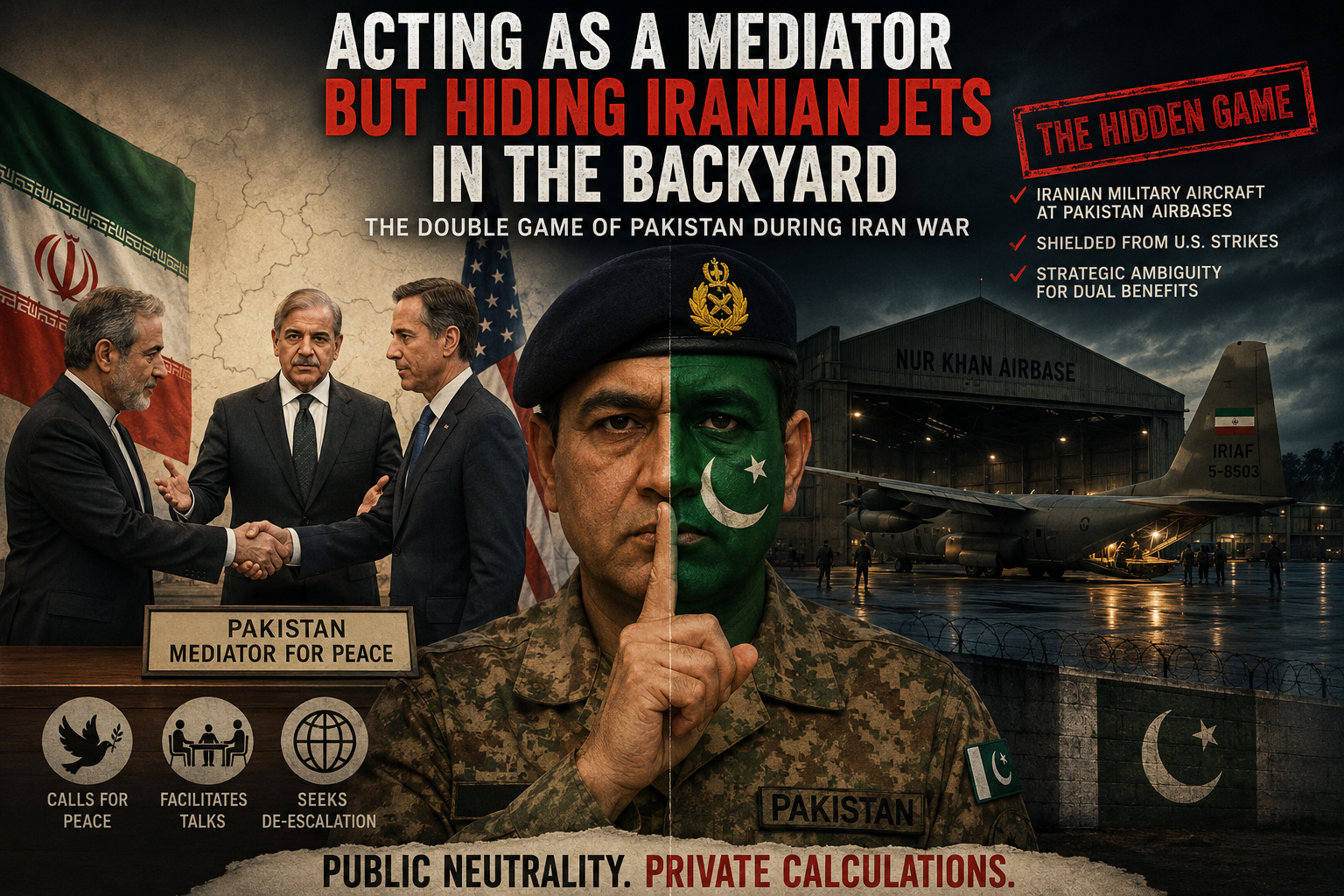
As the Iran war pushed West Asia into one of its most dangerous crises in decades, Pakistan attempted to present itself as a responsible diplomatic bridge between Tehran and Washington. Islamabad projected an image of neutrality, calling for restraint, hosting talks, and publicly advocating de-escalation. But recent revelations have cast serious doubts over that carefully cultivated image.
Multiple international reports now suggest that while Pakistan was publicly acting as a mediator, it may simultaneously have allowed Iranian military aircraft to use Pakistani airbases — potentially shielding them from possible American strikes.
The controversy erupted after a report by CBS News claimed that Iranian military aircraft, including a reconnaissance variant of the RC-130, were flown into Pakistan’s strategically important Nur Khan Airbase near Rawalpindi during the height of tensions. According to U.S. officials quoted in the report, the movement of these aircraft appeared aimed at protecting valuable Iranian aviation assets while the conflict intensified.
Pakistan quickly denied the allegations, calling the reports “misleading” and “sensationalised”. Yet its own foreign ministry stopped short of denying that Iranian aircraft had indeed landed in Pakistan. Instead, Islamabad argued that the aircraft arrived during a ceasefire phase and were linked to diplomatic and logistical coordination.
That distinction has done little to calm suspicion in Washington and elsewhere.
The issue is not merely about aircraft parking rights. It strikes at the heart of Pakistan’s credibility as a mediator. A country genuinely serving as a neutral intermediary is expected to maintain visible distance from the military calculations of both sides. By allegedly offering space to Iranian military aircraft while simultaneously facilitating diplomatic engagement with the United States, Pakistan appears to have been attempting a familiar balancing act — extracting strategic value from both camps without fully committing to either.
This is not unprecedented in Pakistan’s foreign policy history. For decades, Islamabad has mastered the art of strategic ambiguity. During the Cold War, it partnered with the United States while nurturing Islamist networks for regional leverage. During the War on Terror, it received billions in Western aid even as elements within its establishment were repeatedly accused of maintaining links with militant proxies. The Iran war seems to have produced another version of the same playbook.
Pakistan’s motivations are not difficult to understand.
First, Islamabad cannot afford hostility with Iran. The two countries share a sensitive border in Balochistan, where militant activity already threatens regional stability. Pakistan also depends heavily on regional energy arrangements and cannot risk complete estrangement from Tehran.
Second, Pakistan simultaneously needs to preserve working ties with Washington, especially at a time when its economy remains fragile and dependent on international financial institutions influenced by the United States.
Third, China’s growing strategic partnership with both Pakistan and Iran has added another layer to the equation. Beijing has major economic stakes in Iran and views Pakistan as a crucial node in the China-Pakistan Economic Corridor. In many ways, Islamabad’s actions reflect an attempt to align itself with a broader China-backed regional architecture while still avoiding direct confrontation with the West.
The fallout, however, could be significant.
In the United States, lawmakers have already begun questioning Pakistan’s role as mediator. Senator Lindsey Graham openly expressed distrust toward Islamabad after the reports emerged, arguing that a country allegedly helping Iran shield military assets cannot simultaneously claim neutrality.
The episode has also revived comparisons with past Middle Eastern conflicts. Analysts have pointed out similarities with Saddam Hussein’s 1991 decision to move Iraqi aircraft into Iran during the Gulf War to protect them from U.S. bombing campaigns. This time, ironically, Iran may have used Pakistan in a similar fashion.
Pakistan insists it merely provided routine logistical support connected to diplomacy. Yet even if Islamabad’s explanation is accepted at face value, the optics remain deeply problematic. Neutral mediation demands transparency and trust. Secretive military coordination — or even the perception of it — undermines both.
For India, the developments are also strategically revealing. They reinforce New Delhi’s long-standing argument that Pakistan often pursues parallel tracks in diplomacy and security policy. Public moderation and private manoeuvring have repeatedly coexisted in Islamabad’s regional conduct.
Ultimately, the Iran war has exposed the limits of Pakistan’s balancing strategy. In a deeply polarised geopolitical environment, countries attempting to simultaneously reassure Washington, accommodate Tehran, and align with Beijing eventually face scrutiny from all sides.
Pakistan wanted the prestige of being seen as a peacemaker. Instead, it now finds itself accused of playing host to one side’s military assets while speaking the language of neutrality. Whether the allegations are fully proven or not, the perception damage is already done — and in geopolitics, perception often matters as much as reality.

