
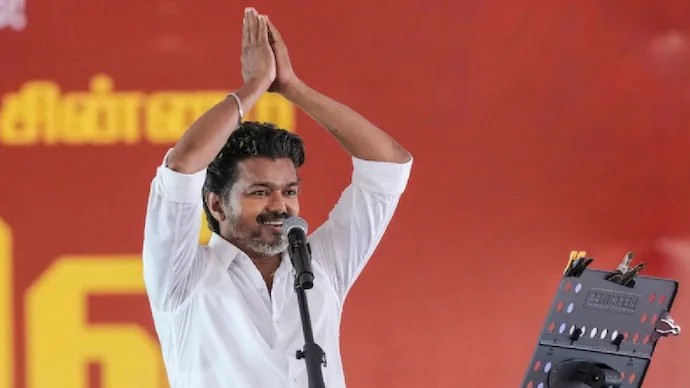
The 2026 Tamil Nadu Assembly election produced one of the most dramatic political stories in recent Indian politics. Actor-turned-politician Vijay and his party Tamilaga Vettri Kazhagam (TVK), a party formed just 2 years back, stormed into the state’s political arena with extraordinary momentum. They won 108 seats out of 234 assembly seats and emerging as the single largest party in the Assembly. During these elections, Vijay upstaged traditional powerhouses of Tamil Nadu politics, DMK and AIADMK. Yet, despite this stunning debut, Vijay still finds himself struggling to form the government.
This reflects the complicated arithmetic of politics, where raw popularity alone does not always translate into power.
For decades, Tamil Nadu politics has been dominated by the two Dravidian giants — the Dravida Munnetra Kazhagam (DMK) and the All India Anna Dravida Munnetra Kazhagam (AIADMK). Several actors entered politics hoping to break this monopoly, from Rajinikanth’s aborted political venture to Kamal Haasan’s limited electoral success. Vijay, however, managed what many believed impossible — he converted cinematic charisma into a mass political movement almost overnight.
TVK’s campaign focused heavily on youth mobilisation, anti-corruption rhetoric, welfare delivery, and Tamil pride. Vijay’s carefully crafted image as a clean outsider resonated strongly with urban voters, first-time voters, women voters, and sections of the middle class frustrated with both the DMK and AIADMK. Massive rallies, aggressive social media outreach, and Vijay’s enormous fan following helped TVK build organisational strength at remarkable speed.
The result was historic. TVK not only crossed the 100-seat mark but also ate into the vote share of both DMK and AIADMK. In many constituencies, Vijay’s candidates defeated veteran politicians with comfortable margins. The election effectively announced the arrival of a third pole in Tamil Nadu politics.
Yet, he can’t take the oath of CM just yet.
Tamil Nadu’s Assembly requires 118 seats for a majority, leaving TVK short by 10 seats. While Vijay won the battle for public imagination, he did not secure the alliances necessary to comfortably cross the majority mark. Smaller regional parties and independents now hold the balance of power, and many of them remain hesitant about backing a first-time political force. Vijay allying with Congress (which has 5 MLAs) hasn’t helped matters much as smaller local parties are reluctant to enter into an alliance with Congress in Tamil Nadu. After all, once Congress ditched its long term ally DMK to join hands with TVK, parties are hesitant to trust them in the state.
Many smaller parties also worry that aligning with TVK could erase their own political identity in the long run. Others are waiting to see whether Vijay’s popularity can survive the transition from opposition politics to governance.
The DMK and AIADMK, despite their setbacks, still possess formidable institutional machinery. Even after losing heavily, both parties retain influence within the bureaucracy, local bodies, and sections of the business community. Their experience in coalition management also gives them an edge in backroom negotiations.
There is another challenge for Vijay: The burden of expectations. During the campaign, TVK projected itself as a transformative force that would redefine governance in Tamil Nadu. But forming a minority or unstable coalition government could quickly expose the party’s administrative inexperience. Political opponents are already portraying TVK as a movement driven more by celebrity appeal than policy depth.
At the same time, Vijay’s near-victory has fundamentally altered Tamil Nadu politics. The election has demonstrated that the state’s electorate is no longer emotionally tied to the old Dravidian binaries in the way previous generations were. A younger voter base appears willing to experiment with new leadership, especially when backed by strong cultural appeal and modern political messaging.
Whether Vijay ultimately forms the government or sits in opposition, TVK’s rise marks the beginning of a new political era in Tamil Nadu. The actor who once dominated the box office has now become the central figure in the state’s political future. But the election has also delivered a harsh lesson: in Indian politics, a smashing victory is not always enough. Sometimes, power still depends on the complicated art of coalition-building.

