
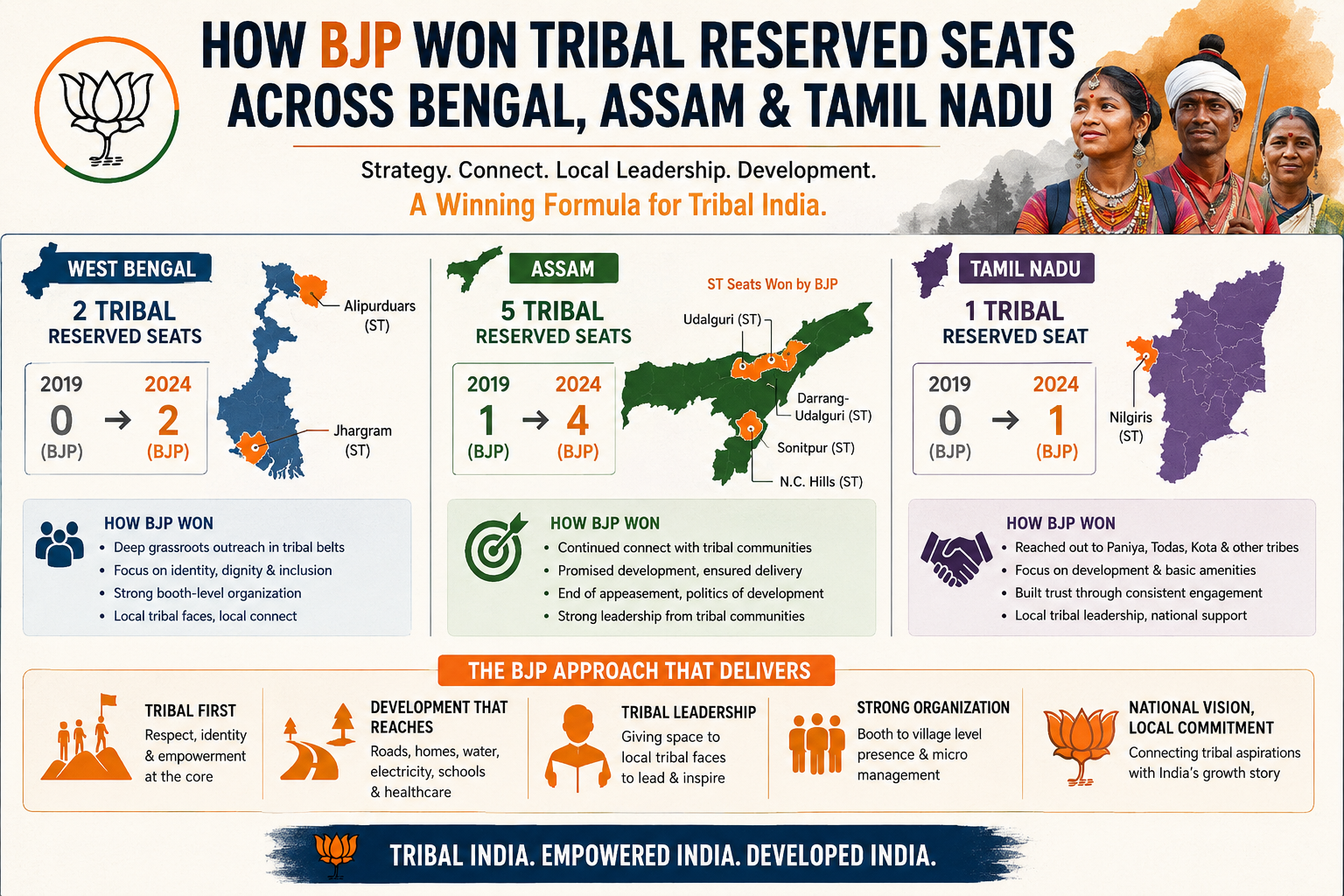
The 2026 assembly elections saw BJP make major gains among Dalit and tribal constituencies across Bengal, Assam, and Tamil Nadu, reshaping India’s SC/ST political landscape.
The 2026 elections may be remembered as the moment India’s reserved constituency politics fundamentally changed. Across West Bengal, Assam, and Tamil Nadu, Dalit and tribal voters moved decisively away from opposition parties that had long treated these communities as permanent vote banks
Three states. Three different opposition parties. Three complete collapses in reserved constituencies.
In West Bengal, Mamata Banerjee’s TMC lost every single tribal seat it held- 0 for 16. In Assam, the Congress was reduced to one solitary SC seat out of nine. In Tamil Nadu, the DMK’s grip on Dalit constituencies loosened for the first time in a generation. Different states, different parties, different political cultures, and yet the same result, playing out with same consistency across the map.
For years, a consensus had hardened in Indian political commentary: BJP could not win Dalit trust, could not penetrate tribal belts, could not break the bonds that opposition parties had spent decades carefully weaving through welfare, identity politics, and the ever-reliable warning that the Constitution itself was under threat. It was treated not as an argument but as a settled fact.
Then came May 2026.
In West Bengal, BJP took 51 of 68 SC-reserved seats, 75%, in a state Mamata Banerjee had held with an iron grip for fifteen years. In Assam, the BJP-led NDA won all 19 ST-reserved seats. In Tamil Nadu, NDA ally AIADMK cracked open 9 of 46 SC seats in territory DMK considered its own. Across 84 reserved constituencies in Bengal alone, BJP and its allies hold 67.
These communities didn’t just shift. They moved in one direction, at the same time, across states that share no language, no geography, and no common political history.
That doesn’t happen by accident. It happens when people have been watching, waiting, and finally decide they’ve seen enough.
The oldest inhabitants, the last in line
There is a word in Sanskrit — Adivasi — that means “original inhabitant.” These are the communities that were here before the colonial cartographers drew their lines across the subcontinent, before modern India was imagined into existence. For most of independent India’s political history, that foundational status meant nothing at the ballot box. Tribal and Dalit communities were managed, not represented. They were vote banks to be mobilised every five years and forgotten in between. Their constituencies were reserved on paper; their agency was not.
2026 changed that.
What happened in Bengal
West Bengal’s tribal belt, Junglemahal in the west, the forests of North Bengal, has long been a contested ground. The TMC held it through a combination of welfare delivery, muscular local politics, and the personal appeal of Mamata Banerjee. That hold is now gone. And the unravelling began not with a policy failure but with an insult.
In early 2026, President Droupadi Murmu, herself from a tribal community, the first vanvasi to hold India’s highest constitutional office, visited Darjeeling for the International Santhal Conference. The Bengal state government, run by TMC, denied permission for the original venue at Phansidewa, citing security concerns, and shifted the event at the last minute to a remote location in Gossainpur on the outskirts of Siliguri. Attendance collapsed. Neither Chief Minister Mamata Banerjee nor a single member of her cabinet showed up to receive the President.
Murmu, visibly moved, addressed the sparse crowd and said quietly: “I don’t know if Mamata Didi is angry with me. Perhaps that is why this happened.”
Junglemahal remembered. The 16-0 scoreline in ST seats is, in part, the answer to that afternoon in Gossainpur.
But the Matua community’s consolidation tells an equally important story on the SC front. The Matuas, a large Hindu refugee community concentrated along Bengal’s border districts, had long been promised citizenship security by TMC and then left in limbo. When that promise repeatedly failed to materialise, and BJP made the Citizenship Amendment Act a tangible assurance, the community moved. The SC seat sweep in border districts reflects that shift with brutal clarity.
What happened in Assam
Assam’s story is structurally different but philosophically identical. Here, the vehicle was not just the BJP alone; it was a coalition built on genuine cultural recognition.
The Bodoland People’s Front, representing the Bodo tribal community of lower Assam, is not a junior partner that was absorbed into a larger machine. It is an alliance built on trust, and that trust was earned over years of political engagement that went beyond elections. Two major Bodo community gatherings were held, one in Delhi, one in Assam, at a scale that signalled national seriousness, not state-level tokenism. Prime Minister Modi personally attended the Delhi event. Chief Minister Himanta Biswa Sarma did not need to fly to the capital to manage the relationship. The centre had already done the work.
This matters because it sent a message the Bodo community had not received before: you are not a regional footnote. You are a national priority.
The leadership that emerged from these communities was also notably young, faces that spoke of their own culture, their own land, their own future, rather than rehearsed grievances handed down from older political patrons. Delimitation had increased ST-reserved seats from 16 to 19. BJP and its allies won all 19. The structural and the emotional aligned perfectly.
The narrative that died
For the better part of a decade, a particular political argument dominated Indian opposition discourse: that BJP was anti-Dalit, anti-tribal, anti-Constitution. The argument had emotional resonance. It had historical texture. And it was repeated with enough conviction that it began to function as received wisdom.
The 2026 results have not merely challenged that narrative. They have dismantled it from within, not through counter-argument, but through the choices of the communities the narrative claimed to represent.
When Dalit voters in Bengal give BJP 75% of SC-reserved seats, they are not making an error. When tribal voters in Assam deliver a clean sweep, they are not confused. When Santhal communities in Junglemahal vote against the party whose government denied their President a proper venue, they are making an entirely rational, entirely sovereign decision.
The Congress party’s constitutional alarm, “the Constitution is in danger” — found no traction in the very constituencies where it should have resonated most. TMC’s model of minority appeasement and welfare dependency produced 17 seats out of 84 reserved constituencies. DMK’s half-century wall of Dravidian dominance now has visible cracks in its foundation.
What this actually means
India’s reserved constituency system was designed to give the most historically marginalised communities a guaranteed seat at the table. For decades, that guarantee was fulfilled in form but hollowed out in substance; the seats existed, but the communities filling them were steered by party machines rather than genuine representation.
What 2026 suggests is that something has shifted in the relationship between these communities and political power. Whether that shift is durable, whether it translates into substantive policy outcomes, whether it survives the inevitable pressures of governance, those are legitimate questions that only time will answer.
But the political fact is undeniable. The communities that were here first, that were pushed to the back of every political queue, that were told their votes were guaranteed and their loyalty was assumed, they have demonstrated that neither is true.
They came first. For too long, they were made to wait last. In 2026, they did not wait at all.

