
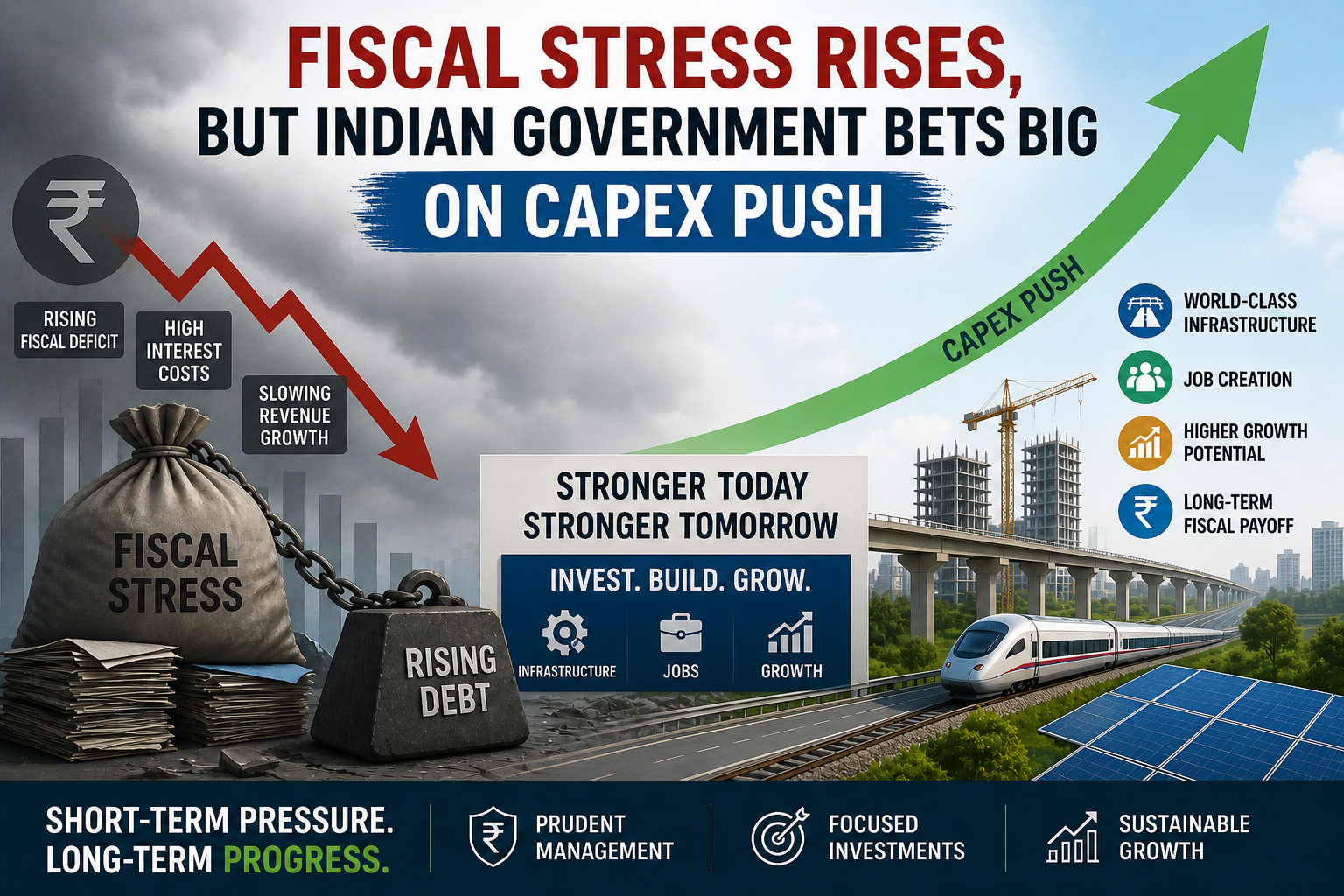
The fiscal situation in India is moving towards a more difficult phase and the government no longer hides from stating this fact. Expenditure Secretary Vumlunmang Vualnam has clearly said that fiscal stress is “very much a reality”, particularly with the ongoing West Asia conflict and interruptions in key energy supply routes being the backdrop. But even as pressures build, one thing is clear from the government, capital expenditure, or capex is not going to be compromised.
The dependence on import of LPG is at the center of the current worry. About 60 per cent of the country’s LPG needs are met through imports, and about 90 per cent of the shipments go through the Strait of Hormuz – a region which is under geopolitical turmoil at present. This makes India to be highly vulnerable to external shocks. Naturally, when supply chains tighten, or prices escalate, the government often intervenes to blunt impacts on citizens, such as by cutting excise duties. However, these measures come at a cost, directly impacting government revenues, and expanding fiscal pressures.
And here comes the balancing act. There is a need to support households and maintain price stability on one side. The other is the problem of managing government finances. Valunam pointed out that although the government has shown some level of proactiveness, there are ‘systemic constraints’ that can never be abolished. This means that certain economic shocks cannot be fully neutralized.
Despite these constraints, the government is doubling down on capital expenditure and keeping the allocation steady at around Rs 12.2 lakh crore. That shows a lot. Capital expenditure (capex), especially in infrastructure, is a key long-term growth driver. Roads, railways, ports, and urban infrastructure help not only in job creation but rallying private investments and improving productivity in the long run. With that, the government is focusing on the future growth instead of short-term fiscal tightening.
Interestingly, Vualnam emphasized that not only do these funds get allocated, but they also get put to good use. That capital is being deployed in sectors like highways, railways, urban development which compounds the multiplier effect of such spending. In the global environment which is slowing down, this is even more vital to keep the domestic growth momentum.
However, concerns over revenue are emerging. One key question raised is around tax buoyancy, which is the extent to which tax collections keep pace with growth in the economy. Tax buoyancy thus becomes uncertain in uncertain economic conditions. This is because fiscal deficits can be worsened by the slowing down of revenues against the backdrop of high expenditures.
Apart from infrastructure, the government is also working to improve the ‘quality’ of expenditure. This means spending not just more but better. Vualnam noted that the central government has over 50 lakh employees, making it among the largest employers in the country. This includes improving the efficiency, productivity and output of this work force. Therefore, what is being sought is better governance outcomes without having to necessarily increase expenditures.
Research and development (R&D) is another critical area which the government seeks to reinforce. Currently, India spends only about 0.6 per cent of its GDP on R&D, which is significantly lower than many developed and emerging economies. This is obviously not enough for a country that wants to be a global manufacturing and innovation hub. The government is no longer looking at merely increasing funds but also at easing processes and eliminating regulatory bottlenecks to boost innovation.
What also is relevant is the shift in narrative. Its also worth noting the shift in a narrative as well. This Goldilocks phase of India is being questioned now. Global uncertainties, supply chain disruptions, and domestic fiscal pressures compound the economic complex.
In this evolving scenario, the government’s strategy is clearly seen as to accept the reality of fiscal stress, manage the immediate risk but without losing sight of long term growth priorities. At the same time, by safeguarding the capex, improving spending efficiency, and obtaining a higher budget share for R&D related projects, the focus remains on the long term priorities to drive growth by building a stronger economic foundation.
The coming months will be the time to see if the balance is maintained properly or not. Much will depend on global developments, energy prices and domestic revenue trend. But the message is clear for now – fiscal pressures India has in, but the country is not budging on growth ambitions.

