
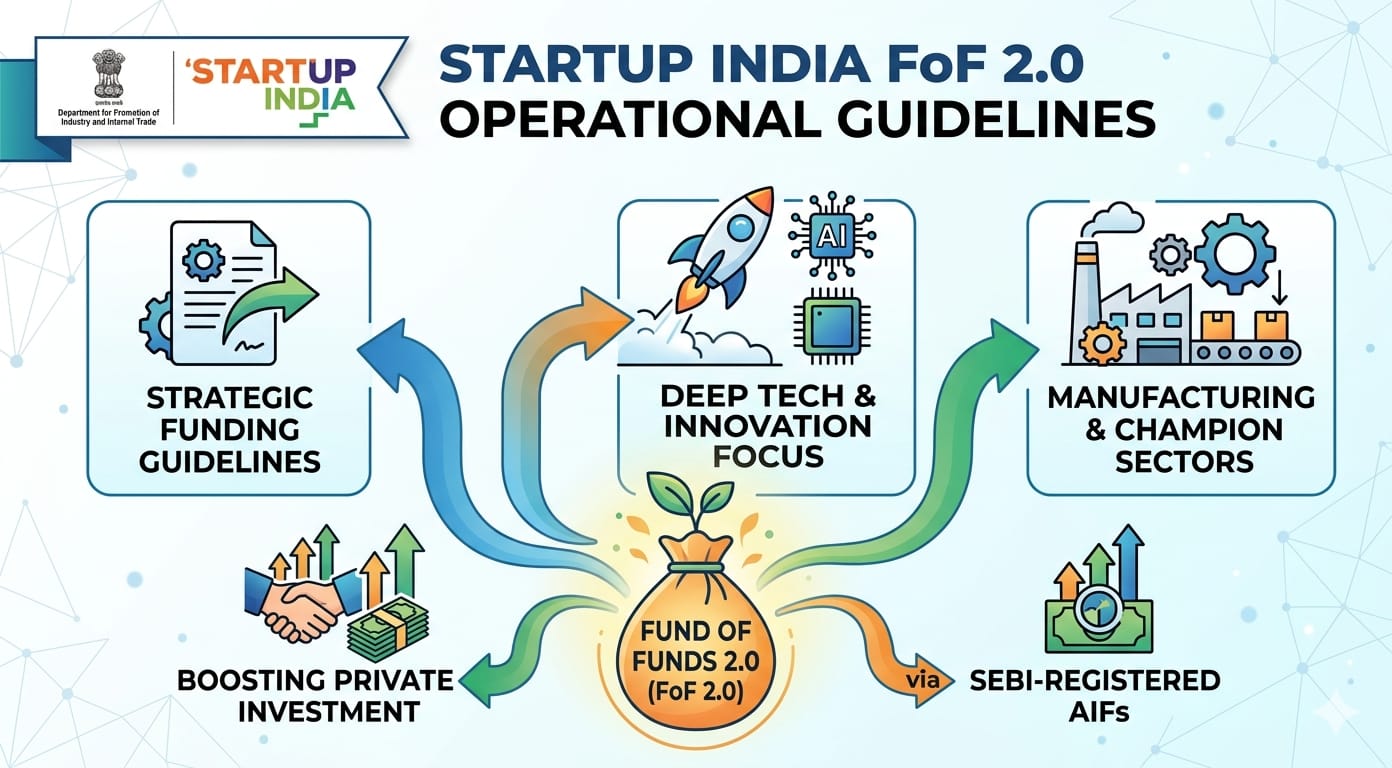
The Department for Promotion of Industry and Internal Trade (DPIIT), under the Ministry of Commerce and Industry, has released comprehensive operational guidelines for the Startup India Fund of Funds 2.0 (FoF 2.0), establishing a robust ₹10,000 crore corpus to enhance capital efficiency in India’s vibrant startup ecosystem.
This initiative, notified in April 2026, does not directly invest in startups but rather through commitments to SEBI-registered Category I and II Alternative Investment funds (AIFs), which are invested in DPIIT-recognized startups through equity, equity-linked, or debt instruments.
The Small Industries Development Bank of India (SIDBI) is the primary Implementation Agency (IA) for selecting AIFs, conducting due diligence, and monitoring, with plans by DPIIT to recruit additional domestic IAs to increase coverage and sector expertise.
To bridge critical funding gaps, the guidelines segment AIFs into four priority categories: deep tech-focused funds with up to 18-year tenures and 40% government contribution caps (max ₹500 crore per fund); micro VCs for early-growth startups (corpus up to ₹400 crore, 30% cap at ₹100 crore); tech-driven manufacturing funds supporting champion sectors (30% cap at ₹200 crore); and sector-agnostic funds (25% cap at ₹180 crore).
Each category is also associated with minimum private capital multipliers—the AIFs must deploy between 1.5X and 2.5X the committed FoF amount into startups, guaranteeing that the scheme is a catalytic lever for market-led investments but not a dominant force.
Aggregate government FoF contributions across ministries is capped at 50% of the corpus of any AIF with a view to instill discipline in allocations, and coupled with AIF advisory boards representation to ensure alignment with scheme objectives.
AIF selection is confined to a rigorous two-stage process of: initial screening and due diligence by the IA, then followed by selection made by the Venture Capital Investment Committee (VCIC) constituted with such ecosystem luminaries capable of evaluating team track records, management capabilities and strategies, and with final sanctions made by the IA’s board sub-committee.
Monitoring includes the annual report on investments, NAVs, and utilisations submitted to DPIIT, half-yearly reviews by an Empowered Committee chairing the DPIIT Secretary, and every five years, third-party evaluations are conducted. Operational expenses for IAs is 0.50% annually of commitments, while up to 5% of returns is set aside for the ecosystem like mentorship, workshops, and shared infrastructure, while the balance reverts to the Consolidated Fund of India.
The framework allows the co-investments from the ministries and institutions in priority areas, credits interest on unutilized funds at the RBI’s repo rate and allows the guidelines to evolve through the Empowered Committee within the Cabinet approved contours.
For Startup India FoF 2.0, by prioritizing non-metro startups, standardizing governance around IP rights and equity dilution, and encouraging private participation, this is bound to deepen domestic venture capital, nurture innovation-led companies, and strengthen India’s leadership in global startups.

