
On April 11, 2026, a 25-year-old Christian woman of Shahkot in Nankana Sahib District of Punjab Province was allegedly raped by a local contractor, Faizan Mehboob Rehmani and his accomplice, in her village.
On March 4, 2026, a 21-year-old Christian farmworker, Marcus Masih, was killed by his Muslim employers, Muhammad Mohsin Kharal and Muhamad Basharat Kharal in the Sargodha District of Punjab.
On March 26, 2026, Police tried to portray the death of Iftikhar Masih, a Christian man, as a suicide, claiming they found his body hanging by a scarf from a ceiling fan in Sadhoki Kahna Nau area of Lahore, the provincial capital of Punjab.
On March 27, 2026, Afzal Javed Masih of Chak No. 648-GB village in Jaranwala, in Punjab Province’s Faisalabad Division, said that his 15-year-old daughter, Sidra Bibi, was kidnapped from their home in the early hours by a Muslim man, Ali Murtaza, and two accomplices.
Based on conditions in 2025, the United States Commission on International Religious Freedom (USCIRF), in its Annual Report released on March 4, 2026, recommended that the U.S. Department of State, redesignate Pakistan, along with 12 other countries, as ‘Countries of Particular Concern’, under the International Religious Freedom Act of 1998 (IRFA). In addition, USCIRF called for targeted sanctions against Pakistani officials and agencies responsible for severe violations of freedom of religion or belief, including asset freezes and visa restrictions.
Christians make up only 1.3 percent of the population of Pakistan and are often among the poorest and most neglected citizens.
According to Open Doors, “World Watch List, 2026”, Pakistan ranks 8th where Christians face the most extreme persecution, with countries like North Korea, Somalia, Syria, Yemen, Sudan, Eretria and Nigeria ahead. The report states:
As a minority in Pakistan, Christians are exposed to many challenges, from everyday discrimination to the threat of deadly violence. Increasingly, Pakistan’s notorious blasphemy laws are used to intimidate Christians and other religious minorities… Most Christians live in Punjab province – where the most persecution takes place. However, the province of Sindh is notorious for being a hotspot for bonded labour, which affects many Christians. There are fewer Christians in Pakistan’s two other provinces, Khyber Pakhtunkhwa and Balochistan, but their isolation means they are more exposed to violence.
Pakistan’s blasphemy laws have increasingly been used to target Christians, along with other minorities. Often, blasphemy laws are misused to include professional rivalry, personal or religious disputes, hostility towards religious minorities, and a calculus of economic gains such, particularly land and property. The major flaw in the practice and implementation of the Blasphemy Law is that on the simple testimony of a complainant, a person charged with blasphemy is immediately placed in detention. Christians have been at particular risk, with neighbourhoods in the cities of Lahore, Gojra, Jaranwala and the capital Islamabad, burned down or attacked following blasphemy allegations in recent years. As reported on May 21, 2025, at least 307 Christians were accused of blasphemy in Pakistan from 1987 to 2024. Moreover, between 1994 and 2024, 26 Christians were killed extra-judicially, following blasphemy allegations.
Christians are also victims of land-grabs. In most cases, property seizures are entwined with blasphemy-related violence, when the property, houses, and places of worship of Christians are attacked, and the ‘accused’ are forced to vacate and leave their properties. For instance, as reported on March 2, 2026, Sarwar Masih and his family had to abandon their property due to blasphemy charges registered by their neighbours. A report titled A Conspiracy to Grab the Land: Exploiting Pakistan’s Blasphemy Laws for Blackmail and Profit, published by Human Rights Watch, on June 9, 2025, documented some such cases. For instance, on August 16, 2023, several hundred people attacked a Christian settlement in the Faisalabad District of Punjab after two members of the community were accused of committing blasphemy. Earlier, in March 2013, a mob of 3,000 people attacked the Joseph Colony, in Badami Bagh in Lahore, following an allegation of blasphemy against Sawan Masih, a Christian resident. More than 100 houses were ransacked, burned, and looted. The entire community abandoned their homes and fled the area.
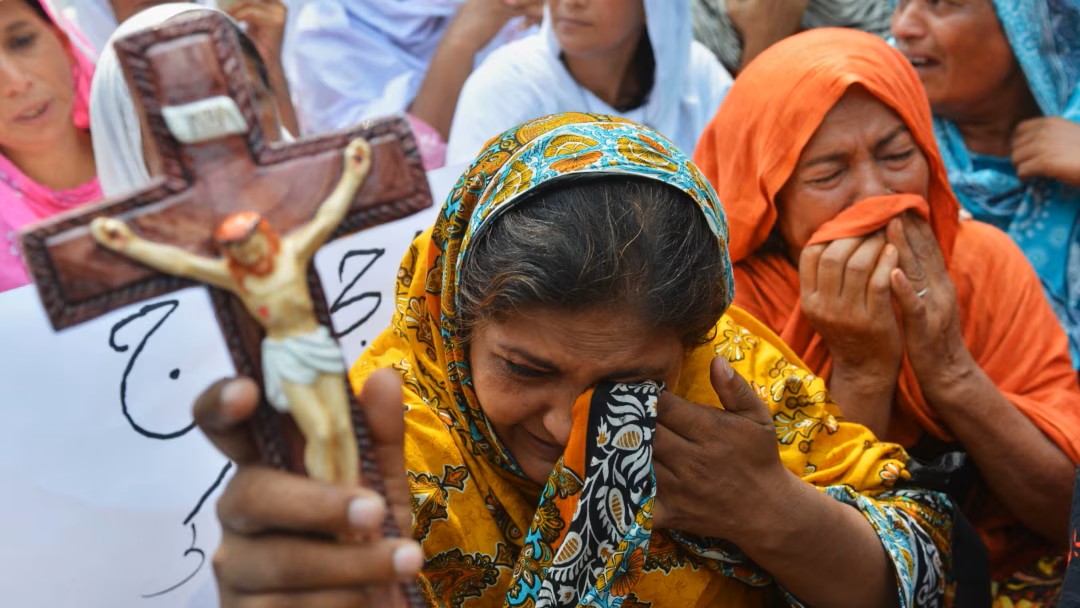
Girls of the Christian community are targeted for forced marriages, which often follow abduction and forced religious conversions. As reported on November 26, 2025, the Center for Social Justice alleged that at least 137 Christian girls were forcibly converted and married between January 2021 and December 2024, in Pakistan. Usually, the girls fall in the range of 12-15 years of age. As reported on April 22, 2026, Christians in Pakistan are protesting a controversial court ruling that upheld the marriage of a 13-year-old Christian girl, Maria Shahbaz, to a 30-year-old Muslim man, a case widely known as the “Maria’s case.” In this case, on March 25, 2026, the Federal Constitutional Court validated the Islamic marriage of Maria Shahbaz. However, Maria’s father had filed a petition in Court stating that his daughter was abducted in July 2025 and forcibly converted to Islam. The ruling has sparked a backlash, with human rights organisations, church leaders and politicians warning that the decision could set a dangerous precedent. Unsurprisingly, according to the Global Gender Gap by Country 2026 report, Pakistan ranks last among 156 countries.
The Christians have been experiencing severe social discrimination and untouchability in Pakistani society, as they are called Isai Chuhra and Chamaar (derogatory caste labels). Practices of ‘purity and pollution’ are harshly imposed on the Christians, with respect to food and water; education; employment, etc. The oppression of Christians in Pakistan remains entrenched, sustained by the persistent misuse of blasphemy laws, rooted societal intolerance, and recurrent mob violence. State responses have largely been reactive and insufficient, with little accountability for offenders.
Author: Sanchita Bhattacharya – Research Fellow, Institute for Conflict Management

