
As the war in West Asia intensifies, agencies have sounded an alert: global terror networks, from Al-Qaeda in the Indian Subcontinent (AQIS) to the Islamic State, have initiated a sophisticated AI-powered propaganda campaign to radicalise India’s Muslims – with the Shia community, historically the most pro-India and anti-jihad segment, as their primary target. For decades, the community has distanced itself from global jihad, maintaining a fundamentally patriotic orientation rooted in India’s syncretic tradition.
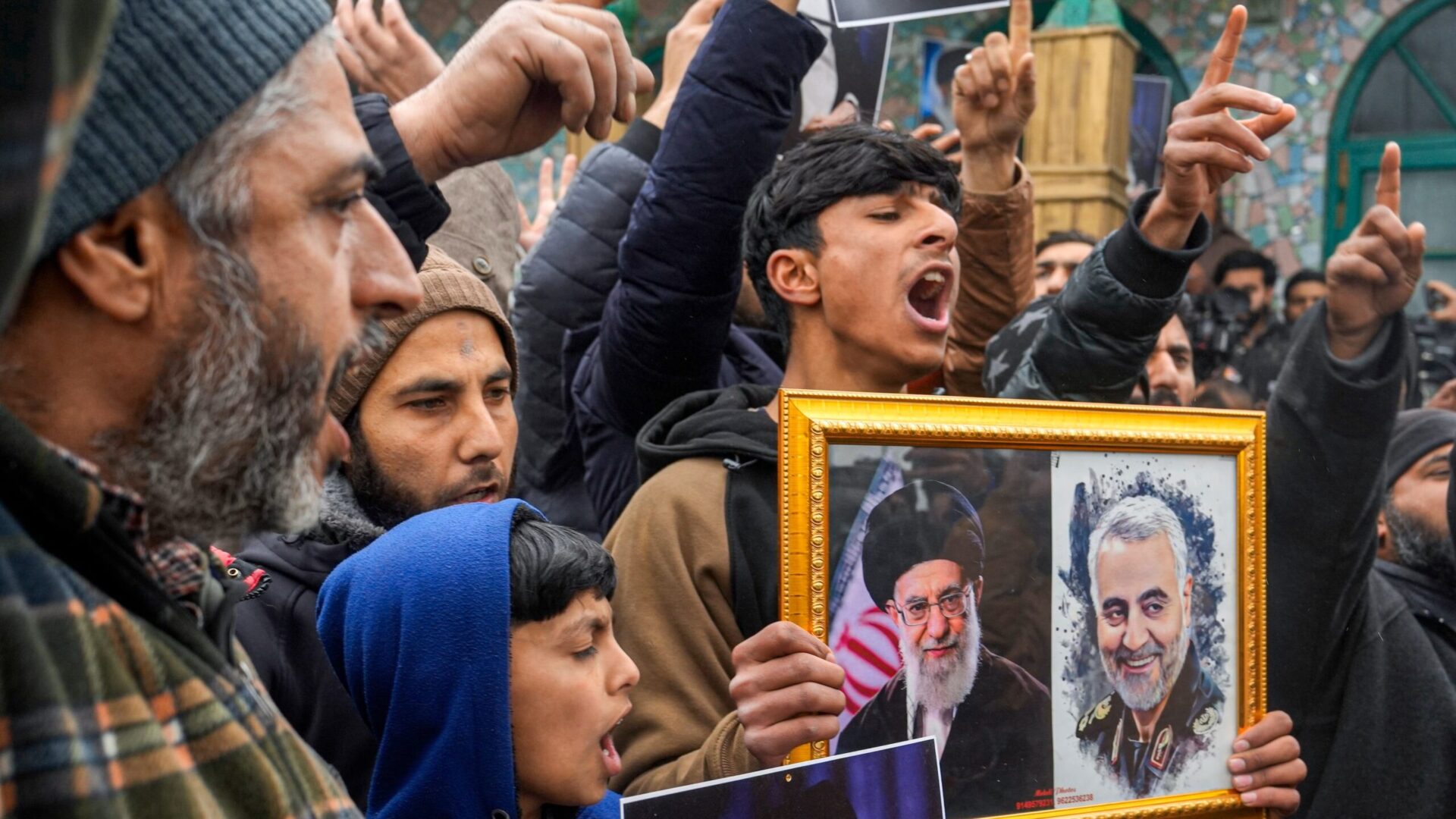
In the days after the assassination of Iran’s Supreme Leader, Ayatollah Ali Khamenei, in US-Israel airstrikes, mourning processions have been held, among others, in Kargil, Srinagar, Hyderabad, Lucknow, Bhopal, Mumbai, Chennai and Delhi.
India’s Shia community – second largest after Iran – turned out in thousands to express its anguish. Even as those processions were being held, intelligence agencies were monitoring attempts to exploit the Shia community’s anguish as AI-generated videos in Kashmiri, Urdu, Hindi, Malayalam and Tamil began circulating on X, WhatsApp, and Telegram – targeting the mourners. The messaging is subtle, calibrated and designed for the long-term. The objective is not to spark immediate violence but to build a large pool of radicals, community by community, language by language, before shifting to a call for violence.
AQIS Propaganda
AQIS has published another edition of its monthly Urdu publication (its primary media for recruitment and propagating Al Qaeda ideology in South Asia). The March 2026 issue has framed the West Asia war as a religious war against Islam; flags of 18 countries (from the U.S. and Israel to India and China) were shown collectively as a single civilisational enemy.
The magazine frames militancy in Kashmir as the main battlefield of Ghazwa-e-Hind (a term often used by radical Islamists to refer to a fictitious ‘holy war’ by Muslim armies to conquer Indian subcontinent). Afghanistan is framed as evidence that superpower militaries can be vanquished; The message to potential recruits is: if it worked in Afghanistan, it can work in Kashmir. The West Asia war’s function as an accelerant is, however, novel. In order to revive its dismal operational capacity in the Sub-Continent, AQIS is now seeking to exploit Shia grief. The objective is its need for a new emotive connect since militant violence in Kashmir is at all-time low after Article 370 was repealed. That connect is the assassination of Khamenei and the consequent anguish among Shias.
But AQIS’s ideological contradiction here is conspicuous. AQIS is a Sunni-Salafi organisation with deep doctrinal hostility toward Shia theology. It considers Shia Islam heretical. Yet it is opportunistically weaponising Shia grief to realise a broader agenda of destabilising India. The Shia community’s mourning is being used as a vector by AQIS that, in other contexts, violently targets Shias.
AI-driven radicalisation
The AI propaganda that has been discerned is not ordinary disinformation. It is precise, targeted content produced on a large scale and designed to each region’s language and culture. There are videos in Kashmiri for Jammu and Kashmir, Malayalam for Kerala, Hindi and Urdu for Uttar Pradesh along with national outreach. The messaging starts with Shia grief over Khamenei and expands the framing as an attack on the entire Muslim Ummah. The objective is to manufacture cross-sectarian anger and widen the potential for radicalization beyond merely the Shias to include Sunnis as well. This is also because Shia and Sunni communities, who often observe religious functions separately, have, in a rare gesture, united in mourning Khamenei’s death, holding joint processions, prayers and tributes.
Platforms have been chosen purposefully. X enables open broadcast to large audiences. With WhatsApp’s encrypted design, group-level distribution is difficult to intercept at large scale. Telegram is in the middle: large channels with plausible deniability. Religious and cultural influencers are being monitored by agencies for what is assessed to be content that is legitimately framed but has incitement embedded.
Even the Islamic State, ideologically committed to the Takfiri view of Shias as apostates, is seeking to exploit the opportunity by pursuing their own jihadist agenda in the guise of community solidarity. The fact that ideologically opposed radical Islamist groups are converging on the same Shia community, at the same time, is a measure of the opportunity they perceive.
Why India and why now?
The assassination of Khamenei has created an emotive vulnerability in the global Shia community. For radical and terror organisations, this geopolitical catalyst is an opportunity of unprecedented scale. India offers a setting that has unparalleled allure for such groups. It has 40 to 50 million Shia Muslims, the second largest population after Iran. Unlike Shia communities elsewhere in the global diaspora, India’s Shia population has traditionally kept a distance from the political theology of Wilayat-e-Faqih (doctrine to justify clerical rule over state). They have avoided global jihad and have, in large measure, opted for India.
The Ministry of Home Affairs has, since its February 28 advisory, increased vigilance and enhanced security around diplomatic missions and sensitive sites. Beyond monitoring, the Government will look to scale up its counter-narrative: the ability to contest ideological framing being deployed online, at the speed at which AI-generated content moves, and in the languages in which it is being consumed. There is also a need to engage with the mujtahids, marajis and leaders of Shia seminaries, who have a theological and social rationale to oppose weaponization of the community’s grief by groups that consider Shia Islam to be heretical.
Prognosis
India is facing a significant threat scenario wherein Sunni-Salafi outfits are trying to exploit Shia emotions, AI-based propaganda is being disseminated in various languages and global jihadist groups are using conflicts in foreign countries to target a section of the Muslim population that has been considered a bulwark against extremism.
There are no current indicators that Shia Muslims in India are on the cusp of radicalisation. The historical evidence is strongly to the contrary. The seminaries of Lucknow, Imambaras of the south, and Shia intellectual and political traditions in north India have long been resistant to the allure of revolutionary Khomeinism, even when it was at the height of its popularity.
If radical Islamist networks are successful in disrupting even a small part of the historical orientation of Shia community – by turning legitimate grief into enduring anger, anger into a propensity for violence – they achieve something that kinetic counter-terrorism will find difficult to reverse. They will have transformed a stabilising element within the Indian Muslim society into a source of fragmentation, with security consequences extending beyond the Shia community.
– Kanchan Lakshman is a Delhi-based national security analyst.

