
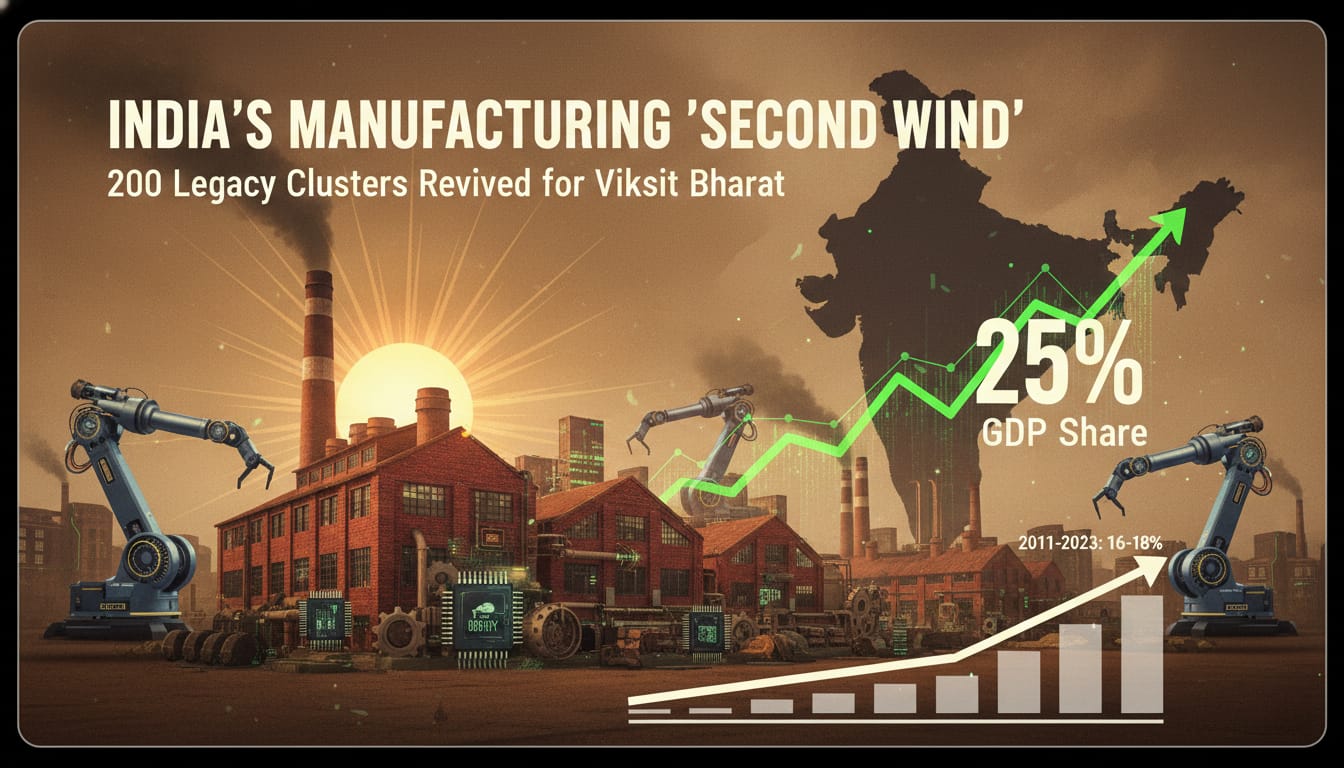
India’s manufacturing dreams are being rewritten in Parliament, with Finance Minister Nirmala Sitharaman’s Budget 2026 announcement to revive 200 legacy industrial clusters emerging as the latest chapter in the quest for a “Viksit Bharat” by 2047.
This move is not just about fixing old factories; it is a direct response to the harsh reality that, over the past decade, manufacturing’s share in GDP and GVA has largely hovered in the 15–17% band, even as East Asian powerhouses like China and South Korea historically ran manufacturing at around 25–30% of GDP during their peak industrial decades, as highlighted by NITI Aayog’s “Reimagining Manufacturing” roadmap.
When Finance Minister Nirmala Sitharaman stood before Parliament and announced a scheme to revive 200 legacy industrial clusters, she was acknowledging an uncomfortable truth that has haunted India’s economic planners for years: the nation’s manufacturing sector has been punching well below its weight, and the window to fix it is narrower than ever.
The announcement comes at a moment when global supply chains are reshuffling themselves like a deck of cards, and India finds itself in a high‑stakes contest for manufacturing investment and jobs against the industrial behemoths of East Asia, particularly China and South Korea, which used manufacturing‑led growth to accelerate their climb into higher‑income status.
The Budget 2026 proposal is structured around a new scheme to revive 200 legacy industrial clusters “to improve their cost competitiveness and efficiency through infrastructure and technology upgradation,” paired with a fresh ₹3,000 crore allocation for plug‑and‑play industrial parks that promise ready infrastructure and regulatory support for investors.
This cluster revival initiative is being layered on top of other targeted schemes, including the Textile Expansion and Employment Scheme to modernise traditional textile clusters with capital support for machinery, technology upgradation, and common testing and certification centres, as well as earlier efforts to build sector‑specific clusters in electronics, textiles and software.
The design is clear: use legacy clusters as strategic multipliers, upgrading their infrastructure and technology so they can plug into global value chains rather than remain under‑utilised relics of an older industrial era.
Behind this policy push lies a data story that is both sobering and galvanising. NITI Aayog’s advanced‑manufacturing roadmap underlines that India’s manufacturing share has been typically sat around 15–17% of GDP, far below the 25–30% benchmarks achieved by East Asian “miracle” economies during their decisive industrialisation phases, and warns that continuing on the current trajectory could leave India with a GDP shortfall of about USD 5.1 trillion by 2047 compared with the desired point of arrival.
Complementing this, NITI Aayog’s services‑sector GVA study and its media coverage show how, between 2011–12 and 2023–24, the manufacturing segment’s share of GVA remained stuck in a narrow 17–18.5% band, ending at 17.5% in 2023–24 versus 17.4% in 2011–12—effectively no structural change in more than a decade, even as the services sector’s share climbed to a dominant 54.5% of GVA.
A Lok Sabha reply using the official MoSPI series reinforces this picture: manufacturing’s share of GVA at constant 2011–12 prices was 17.2% in 2013–14 and 17.3% in 2023–24 (provisional), while absolute manufacturing GVA rose from ₹15.6 lakh crore to ₹27.5 lakh crore over the same period, indicating robust growth in level terms but near‑stagnation as a percentage of the economy.
This stagnation is a red flag for policymakers because it signals that India has not yet achieved the kind of “industrial take‑off” that typically lifts entire economies and labour markets, as East Asian countries did when they expanded manufacturing from a low base to roughly 25–30% of GDP.
NITI Aayog’s “Reimagining Manufacturing” report frames the challenge as a national mission rather than a technocratic adjustment: India must push manufacturing’s share towards 25% of GDP by 2035–2047, create over 100 million quality jobs, and transform from a largely cost‑competitive producer into one of the world’s top three hubs for advanced, high‑value manufacturing.
The report emphasises that incremental tweaks will not be enough; without a decisive leap in capabilities and scale, India risks premature de‑industrialisation, where the economy shifts away from manufacturing at much lower income levels than those at which advanced economies did so.
To close this gap, NITI Aayog calls for a step change in design, engineering and frontier technology adoption, particularly in clusters dominated by MSMEs and sectors like auto components, where firms often lack in‑house design capabilities and operate in fragmented supply chains with infrastructure deficits.
It argues for embedding advanced technologies—AI and machine learning, robotics, digital twins, and new materials—into India’s industrial DNA so that clusters move up the value chain from low‑cost suppliers to high‑value innovators.The 200‑cluster revival scheme fits squarely into this vision: by upgrading common infrastructure, providing capital support for technology upgradation and shared testing and certification facilities, and integrating clusters into better logistics networks, the scheme aims to tackle exactly the bottlenecks NITI Aayog has identified as holding back Indian manufacturing from scaling.
Budget 2026 does not stop at cluster rehabilitation; it embeds this initiative within a broader ecosystem push that includes increased capital expenditure—₹12.2 lakh crore for FY27, with a significant share aimed at infrastructure in Tier‑2 and Tier‑3 cities where many of these legacy clusters sit—and new instruments to support MSMEs and high‑tech sectors.
The NITI Aayog, echoing this direction, has long argued for a coordinated national manufacturing mission anchored in seamless collaboration between central and state governments, industry and research institutions so that technology adoption moves from scattered pilots to a coherent, economy‑wide transformation.
In this context, the 200‑cluster revival is less a standalone expenditure line and more a strategic force‑multiplier: if executed well, targeted infrastructure and technology investments could unlock higher productivity, attract additional domestic and foreign investment and, over time, nudge manufacturing’s share in GDP from its long‑entrenched 15–17% range towards the 25% benchmark that the Viksit Bharat vision demands.
NITI Aayog’s analysis is clear that India’s moment is now—a decade that offers an unprecedented window to reshape not just factories, but the structure of jobs and incomes, and to position the country as an undisputed leader in advanced manufacturing.
The decision to revive 200 legacy clusters signals that India is no longer content to wait for this window to reward it by default; instead, it is attempting to build the physical infrastructure, institutional capacity and technological muscle needed to walk through it deliberately, turning the long‑stalled aspiration of a manufacturing‑led Viksit Bharat into a measurable, data‑driven journey.

