
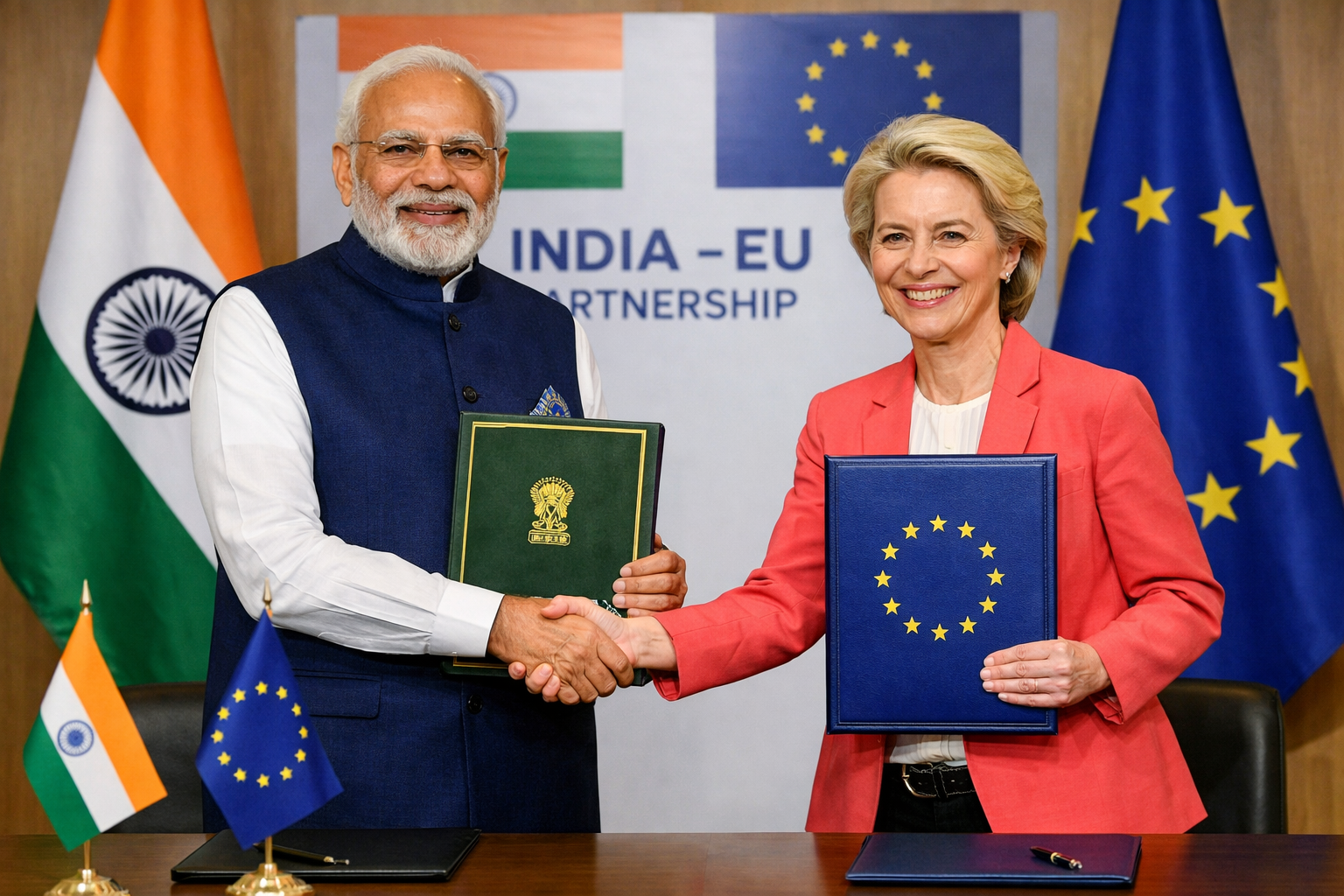
When European Commission President Ursula von der Leyen described India as a ‘trusted partner’ and a central pillar of Europe’s long-term economic strategy, it reflected a clear shift in how India is viewed in global power centres.
That political signal took concrete form on 27 January 2026, when India and the European Union formally signed their long-awaited Free Trade Agreement. After eighteen years of negotiations, the deal marks a decisive moment in India’s economic journey, placing it firmly at the centre of a rapidly changing global order.
Why now? The timing matters
The agreement brings together the world’s second- and fourth-largest economies, covering over two billion people and close to one-quarter of global GDP. Its timing could not be more critical. Global supply chains are under stress, trade rules are becoming unpredictable, and protectionism is again shaping economic decisions. In this uncertain environment, the India – EU FTA offers stability, predictability and long-term confidence for businesses and governments alike.
The economic core of this agreement
At the heart of the agreement is the removal of 9,425 tariff lines, allowing 99 per cent of Indian exports to enter the European Union without customs duties. This opens nearly $75 billion in preferential market access and makes the pact one of the most comprehensive trade agreements India has ever concluded. For Indian manufacturers and exporters, it means secure entry into one of the world’s richest consumer markets, governed by clear and enforceable rules.
Gains of a common Indian
For the common Indian citizen, the benefits will be felt gradually but clearly. Lower duties on medical devices, electronics, industrial machinery and chemicals will reduce production costs and improve product quality, helping to keep prices in check. Even premium goods become more affordable, with car import duties falling from 110 per cent to 40 per cent and wine tariffs reduced to 20 per cent, expanding choice without undermining domestic industry.
India protected its dairy and farmers
Just as important is what India chose to protect. Dairy and sensitive agricultural products remain outside the agreement, safeguarding the livelihoods of over 100 million farmers. This careful balance shows that India’s opening to global markets is guided by national priorities, not blind liberalisation.
The gift for Indian textile sector
For India’s textile and apparel sector, the agreement is particularly transformative. Indian textile exports to the EU earlier faced tariffs ranging from 10 to 17 per cent, putting them at a disadvantage compared to competitors such as Vietnam and Bangladesh that already enjoyed preferential access. With tariffs now eliminated, Indian garments, home textiles and technical textiles gain immediate price competitiveness in a market worth over €250 billion annually. This is expected to boost orders, expand factory utilisation and support millions of jobs, especially for women workers in states like Tamil Nadu, Gujarat, Maharashtra and West Bengal.
The ripple effects extend beyond exports. Lower duties on European textile machinery, dyes and specialty fibres will modernise India’s textile industry, improve quality standards and help Indian firms move up the value chain, from basic garments to high-end fashion and sustainable textiles demanded by European consumers. For a sector employing over 45 million people, the FTA offers not just market access but long-term industrial renewal.
New opportunities for our professionals and youth
One of the most meaningful changes brought by the FTA lies in opportunities for India’s youth and professionals. The agreement guarantees predictable access to 144 European service sectors, including IT, healthcare and education. Each year, 35,000 Indian students will receive post-study work opportunities, ensuring that overseas education leads to real employment and global exposure.
The recognition of Indian traditional medicine practitioners under domestic qualifications adds a powerful cultural dimension. It signals growing international respect for India’s knowledge systems and strengthens the country’s soft power presence in Europe. Together, these measures shift India from being a source of informal labour migration to a hub of globally certified talent.
A Boost to Indian businesses
Indian businesses, particularly micro, small and medium enterprises, stand to gain substantially. Alongside textiles, other labour-intensive sectors such as leather and footwear; previously burdened by tariffs of 10 to 17 per cent, will now enjoy zero-duty access to European markets. This levels the playing field with regional competitors and strengthens India’s export-led employment base.
The agreement also opens doors to Europe’s $2 trillion engineering market, supporting India’s goal of reaching $300 billion in engineering exports. Mutual recognition of standards will reduce compliance costs by nearly 30 per cent, while a dedicated SME portal and a €500 million green transition fund will help Indian firms, including textile units, meet Europe’s strict environmental and carbon standards.
A strategic shield in uncertain world
From a strategic perspective, the FTA acts as a shield against global trade shocks. With the United States accounting for nearly 18 per cent of India’s exports, sudden tariff changes can disrupt entire sectors. The EU agreement offers a stable, rules-based alternative market, allowing exporters, from garment manufacturers to engineering firms, to shift focus without harming production or employment.
India’s rise as a Global rule maker
On the global stage, the deal reflects India’s growing confidence as a rule-maker. By securing flexibility under Europe’s carbon taxation regime while protecting agriculture, India has shown that it can negotiate high-standard trade agreements without compromising sovereignty. This strengthens India’s position as the preferred ‘China-plus-one’ destination for European companies seeking resilient and diversified supply chains, particularly in textiles and apparel where supply-chain reliability is critical.
The India-EU Free Trade Agreement is about more than trade figures. It supports India’s ambition of becoming a developed nation by 2047 and moving towards a $30 trillion economy. As the geopolitical thinker Robert Gilpin argued, economic strength forms the foundation of national power in the international system. By securing markets, rebuilding labour-intensive sectors like textiles, exporting skills instead of vulnerability, and shaping global trade rules, the agreement reflects a confident India, ready not just to participate in the global economy, but to help define its future direction.
Author Maitreyaei Upadhyay (@MaitreyaeiU) is a Public policy and International Relations consultant, closely tracking India’s strategic, economic, and civilisational debates, with a sharp focus on governance, national interest, and contemporary politics.

