
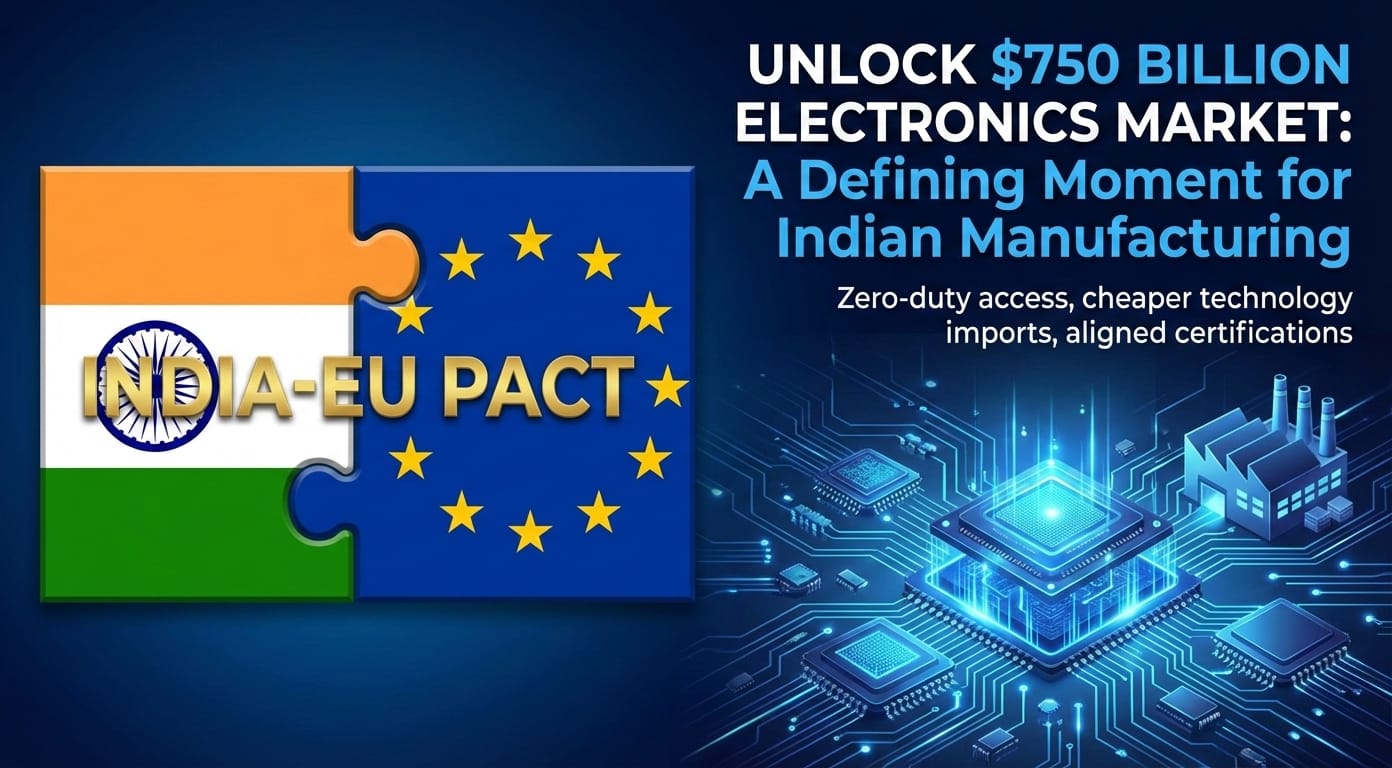
When India and the European Union sealed their long-negotiated free trade agreement earlier this month, industry leaders described it as a “turning point for modern manufacturing.” For India’s fast-growing electronics sector, the deal doesn’t just open new markets—it resets the country’s global position. With access to Europe’s $750 billion electronics market and sharply reduced trade barriers, Indian manufacturers now see a decade-long window to move from contract production to global dominance.
The agreement grants Indian exporters preferential access to one of the most advanced and profitable consumer and industrial electronics ecosystems in the world. According to early estimates by the India Cellular and Electronics Association (ICEA), India’s electronics exports to the EU could surge from the current $18 billion to $50 billion by 2031, and potentially cross $100 billion by 2035. The deal eliminates tariffs on over 99 percent of India’s exports by value, ensuring near-total duty-free entry into the 27-member bloc’s massive market.
Another key feature of the pact is mutual recognition of technical certifications—a move that will help Indian products meet EU quality and safety benchmarks without having to undergo repeated testing cycles. Industry executives say this single provision could shorten export lead times by months while boosting investor confidence in India’s reliability as a manufacturing base.
The biggest gains will be seen in segments like LED televisions, lighting equipment, and home appliances. These categories previously carried duties as high as 14 percent; that is now being brought down to zero. Sunil Vachani, Chairman and Managing Director of Dixon Technologies, called the development “a gateway to scale.” Indian manufacturers—many of whom previously had limited exposure to EU markets—are now building export teams, establishing logistics ties, and preparing to leverage European distribution networks.
For high-value categories such as smartphones, tablets, and IT hardware, where duties were already low, the deal offers something more significant: easier regulatory access and smoother customs procedures. This is particularly critical for companies operating global supply chains, enabling faster shipments, reduced compliance overhead, and larger-scale sourcing partnerships with European brands.
The wider impact of this deal extends beyond electronics exports. It opens a strategic corridor for industrial collaboration in semiconductors—a field central to India’s ambition to become a global tech manufacturing hub. The India Electronics and Semiconductor Association (IESA) highlighted that import duties on critical capital goods—such as lithography systems, wafer slicing machines, and automated testing tools—will now fall from 40–44 percent to zero. According to IESA President Ashok Chandak, this shift will significantly cut project costs for semiconductor fabs and OSAT (Outsourced Semiconductor Assembly and Test) units, making India more competitive in a sector where setup costs have traditionally been among the highest globally.
Chandak also noted the alignment this creates with Europe’s industrial backbone. As companies like Bosch, Continental, and Schneider Electric deepen their sustainability and digitization efforts across Europe, the need for reliable component makers has grown. Indian firms could now play a larger role as suppliers of advanced printed circuit boards, connectors, and industrial modules—key links in Europe’s green and smart manufacturing transitions.
The ICEA expects that with strong follow-through on policy implementation and infrastructure readiness, India could integrate more deeply into the EU’s high-tech value chains than ever before. This would not only expand export volumes but also drive local innovation, as European technology partners and investors anchor new production units in India.
For India, the timing could not be better. As global electronics demand rebounds and manufacturing supply chains realign away from China, this trade deal gives India the foothold it needs to claim a larger share of the world’s production map. Reduced tariffs, synchronized standards, and cheaper high-end machinery set the stage for India to elevate from being a global assembly base to a technology-driven manufacturing leader.
The India-EU partnership, long in the making, now stands as a strategic milestone—blending trade, technology, and trust. For Indian electronics, it signals the beginning of a new industrial story, one that could redefine the country’s place in the 21st-century global economy.

