
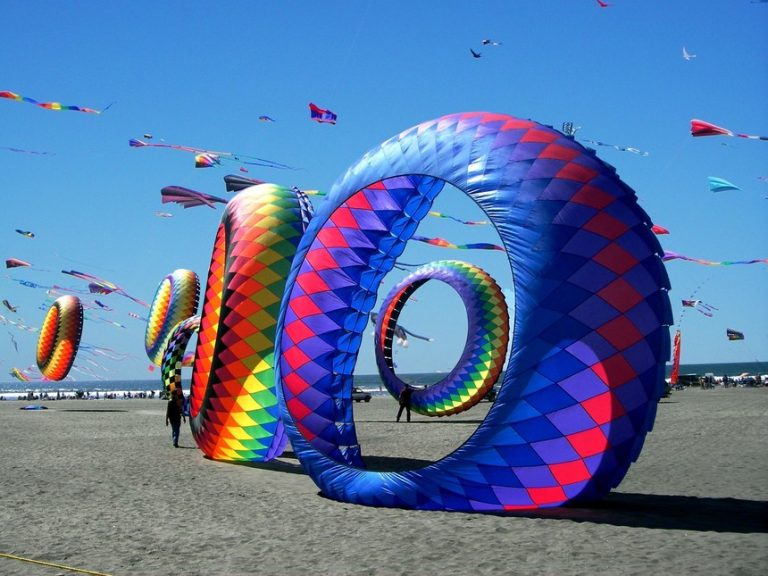
As I write on Uttarayan 2026, my physical self is far from the vibrant Gujarati terrace, yet my soul is unmistakably there. The image is indelible: The sky above the white sands of Kutch, India’s largest district, transformed into a fluttering mosaic of colour. Each kite dancing against the winter sun carries the festival’s quiet philosophy- to let go of what has been and rise toward what awaits.
My childhood was shaped by the rituals of this day. The festival began long before the 14th of January, in kitchens scented with til ke ladoo, chikki, and namkeens. We children sat together, carefully making the kaani( the first fold and thread of a new kite) , sorting spools of manja with grave seriousness, grading them from fiercely sharp, glass-coated competition strings to softer ones meant for smaller hands. At dawn, often as early as five in the morning, we rushed to our chhajja( terraces), the air already crackling with anticipation. What followed was a day-long symphony of friendly warfare: the triumphant cry of “Ae Kaattta!”, the urgent chorus of “Dheel de!” during mid-air tangles, and a playful battle of sound systems blaring Bollywood songs across rooftops.
By afternoon came the grounding comfort of ekdam garam garam Undhiyu, shared with family. As the sun softened, kites returned to the sky, now accompanied by laughter and spontaneous garba steps. There were no declared winners. The day concluded gently, as lanterns were lit and the night sky glowed like a shared dream, an unspoken collective aspiration toward light. Having witnessed this same spirit in Ahmedabad, Vadodara, Rajkot, and Kutch, I realised that the true festival lies not in place, but in this unwavering, shared joy.
This spirit mirrors a truly national celebration. Known across India as Makar Sankranti, the festival marks the Sun’s northward journey: Uttarāyana, signalling renewal after winter. One celestial moment unfolds into many regional expressions: Lohri glows with bonfires and bhangra in Punjab; Thai Pongal in Tamil Nadu thanks the Sun and earth through a rice ritual of abundance; Magh Bihu in Assam celebrates harvest through community feasts; and in Maharashtra and Karnataka, til-gul is exchanged with wishes of sweetness. From Uttarayan in Gujarat to Khichdi Parv, Makara Chaula, Poush Sankranti, and Shishur Saenkraat, the names change—but the Sun, the harvest, and the spirit remain one.
Long before calendars and clocks, India looked to the sky for guidance. Uttarayan stands as quiet proof of how deeply this civilization understood time, nature, and itself. The Rigveda, among humanity’s oldest texts, offers hymns to Surya, the life-giver, and Ushas, the dawn that dispels darkness thus capturing the very essence of Sankranti. The Matsya Purana, studied by historian V. R. Ramachandra Dikshitar, also carries this symbolism into civilizational memory. It recounts how Vaivasvata Manu, survivor of the great deluge, established Ayodhya, laying the foundations of social order. His sons, Ikshvaku and Ila, became ancestors of the Solar and Lunar dynasties, linking Uttarayan to the very origins of kingship and governance in India.
The Mahabharata elevates Uttarayan from a celestial marker to a sacred passage. Upon a bed of arrows, Bhishma waits for fifty-eight days, holding life in suspension until the Sun begins its northward turn. Only then does he release his breath, transforming Uttarayan into a luminous gateway for the soul’s final journey.
This synthesis of meaning extends into science. Makar Sankranti reflects India’s ancient cosmological precision. Astronomically, it aligns with the Sun’s northward movement following the winter solstice. Astrologically, it marks the Sun’s entry into Capricorn (Makara Rashi) in the sidereal zodiac. Around 370 CE, these moments coincided perfectly. Their gradual separation today is due to the Earth’s slow axial wobble, a 26,000-year cycle of precession. That ancient observers identified and calculated such imperceptible cosmic rhythms speaks volumes of their understanding of time and the universe.
The festival’s philosophy has an element of a very profound culinary experience as Sankranti’s cuisine is a living manuscript of agrarian wisdom, ecological balance, and civilizational unity. Sesame, jaggery, and rice form its unified sacred core: warming the body in winter chills of January, celebrating sweetness in life, and honouring the Earth’s bounty. From Pongal in the South, where rice is ceremonially allowed to boil over in gratitude to the Sun, to khichdi in the North, Undhiyu in the West, and pithas in the East, each dish reflects local ecology while speaking a shared civilizational language. Every bite reenacts an ancient conversation between soil, season, and sky.
Today, what began as a rooftop ritual has grown into a global cultural dialogue. Since 1989, the Government of Gujarat has hosted the International Kite Festival, transforming cities and the Rann of Kutch into open skies of cultural exchange. On 12 January 2026, the festival gained renewed global resonance when Prime Minister Narendra Modi inaugurated IKF 2026 at the Sabarmati Riverfront, with German Chancellor Friedrich Merz attending as Chief Guest. The moment signalled a deeper shift: Indian festivals are no longer viewed merely as spectacles, but as living expressions of civilisation i.e. rooted, confident, and open to the world.
Across cultures, kite flying exists as sport and heritage, from Japan’s rokkaku battles to festivals in China, Brazil, and Afghanistan. What sets India apart is timing and meaning. In Uttarayan, kite flying is synchronised with the Sun’s movement, the harvest cycle, and the cosmic calendar. Elsewhere the kite is an object; here, it becomes a moment where play, prayer, season, and sky converge.
Indian festivals like Uttarayan are thus living systems of memory. Through shared rituals like flying kites, eating seasonal food, and aligning life with the Sun, they weave ecology, ethics, astronomy, and spirituality into everyday experience, placing human life within cosmic order (ṛta). And to preserve Uttarayan is not to resist modernity, but to anchor progress in meaning. In an age of speed and disconnection, such festivals remind us that continuity itself is a form of advancement. As the Ṛg Veda proclaims:
“उदु त्यं जातवेदसं देवं वहन्ति केतवः”
The rays bear aloft the divine Sun, the knower of all births.
Thus, the Sun stands as the silent source and witness of all life. Uttarayan honours this presence and when a kite rises into the sky, it carries a civilizational instinct: to look upward, remain grounded, and move forward with light.
Written by Aditi Nanda

