
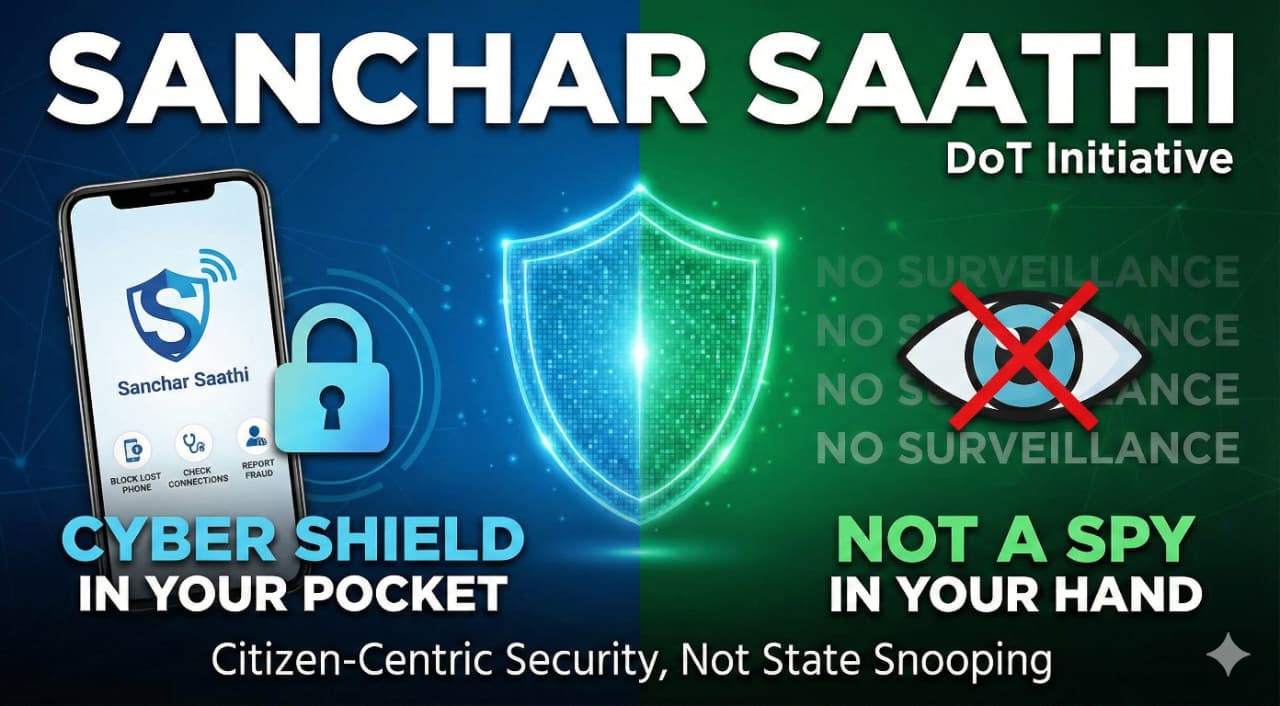
Sanchar Saathi, which will now come pre-installed in your phone, is a citizen-centric cybersecurity platform of the Department of Telecommunications (DoT) that helps mobile users block lost or stolen phones. It helps check how many mobile connections are running in their name, and report fraud calls, messages and phishing links through its Chakshu feature.
The government has now asked smartphone makers to preinstall this app so that every user, whether tech-savvy or not, has an inbuilt shield against rising cyber frauds and telecom scams.
At its core, Sanchar Saathi answers a simple question: What happens when your phone is stolen, your SIM is misused, or you start getting suspicious calls claiming to be from a bank, DoT or the police? The app and portal allow you to immediately block your device anywhere in India using its IMEI – that 15-digit identity number which tells every network “this is that particular handset” – and generate traceability whenever someone tries to reuse it.
Alongside this, Chakshu gives you a dedicated channel to flag suspected fraud communications related to fake KYC, bogus investment schemes, impersonation of government officials, or malicious links circulating over SMS, WhatsApp, Telegram and other platforms. With that, these numbers and patterns can be acted upon at the system level.
Why has the government moved from “optional download” to “default presence” on all smartphones? Officials describe this as part of a broader strategy to harden India’s digital ecosystem, which also includes SIM-binding directives for apps like WhatsApp and Signal so that accounts cannot be freely floated across devices without the original SIM.
The logic is straightforward: In a country with more than 1.2 billion mobile subscribers and extremely uneven digital literacy, leaving a core security tool to voluntary discovery on app stores means the very users who most need protection – rural, low-income and elderly users – are the least likely to install it. By insisting that manufacturers preinstall Sanchar Saathi and push it via software updates, the state wants to make sure the safety net is not a luxury for the aware, but a default for everyone.
Here the question naturally arises: Is this only about lost phones, or is there a bigger war against fraud underway? Data shared by Communications Minister Jyotiraditya Scindia in Parliament and through official briefings shows that Sanchar Saathi has already helped disconnect tens of lakhs of fake and fraudulent mobile connections. It has also helped block several lakh stolen handsets, and even get lakhs of spoofed or fraudulent WhatsApp accounts and bulk SMS senders knocked off the network.
In some reports, the initiative is credited with blocking more than 1.3 crore suspect mobile connections and preventing huge financial losses linked to cyber frauds estimated at over ₹10,000 crore a year. In other words, every fraud link you report and every suspicious call you flag is not just your personal grievance, it becomes a data point in a national anti-fraud intelligence grid.
But if the objective is consumer protection, where did the “spy app” controversy come from? As soon as the preinstallation order surfaced, a wave of posts and videos claimed that Sanchar Saathi would read every message, listen to calls, and turn every Indian smartphone into an always-on state surveillance device.
Digital rights groups flagged the fact that on Android the app seeks “dangerous” permissions like access to call logs, SMS logs and camera, and that its privacy policy is vague on how long data is stored and what exact user rights exist over deletion or correction of their information. This technical critique quickly mixed with political messaging, spawning the narrative that the government wanted a backdoor into everyone’s phone under the garb of cybersecurity.
Jyotiraditya Scindia has publicly pushed back against this, calling such claims misleading, politically motivated and, in many cases, outright fake news. He has emphasized two key points: first, that Sanchar Saathi is not designed as a snooping or surveillance tool, but as a fraud-prevention and consumer-protection platform that runs on citizen participation and telecom data already regulated under law;. Second, that users will retain control over the app, with the government clarifying that it remains optional and can be deleted like any other application despite earlier reports suggesting it would be undeletable. In his words, it is meant to be “a portal which ensures the safety of each user” and a step towards “jan-bhagidari” against cybercrime, not a digital handcuff on citizens’ devices.
This still leaves an important, uncomfortable question: If permissions are broad and the state enjoys exemptions under India’s data protection law, should users simply trust that Sanchar Saathi will never be misused? Civil society voices argue that any state-backed app with system-level presence must be bound by strict transparency, independent audits and clearer privacy guarantees, including explicit timelines for data retention and easy mechanisms to erase personal data.
The government clarified that it is the scale and speed of cyber fraud – from phishing links and fake KYC calls to deepfake “digital arrest” and remote-access scams – that now demand embedded tools that can work in real time and across networks, which is impossible if security is treated as a purely opt-in accessory. Behind the technical debate lies a policy choice: Should India err on the side of frictionless privacy, or on the side of action against fraud?
Now place the ordinary phone user at the centre of this conflict. Consider an elderly pensioner in a tier-2 city who uses a smartphone mainly for calls, WhatsApp and the occasional UPI payment. Does this person regularly read privacy policies or evaluate app permissions, or do they simply tap “allow” because they fear their bank account will freeze if they don’t respond to a message? Surveys and police data show that senior citizens are among the fastest-growing victims of online fraud, with steep jumps in phishing, fake investment offers and impersonation of authority figures precisely because they are dependent on digital channels but not fully comfortable navigating them.
For such users, the government wants Sanchar Saathi to function as a ready-made emergency toolkit. They need that one place where they, or a family member helping them, can check if an unknown number is misusing their identity, block a stolen phone, or flag a threatening “KYC suspension” call without hunting through menus or downloading new apps.
So what does an ordinary user actually gain if this app quietly appears on every new phone? At a practical level, the benefits are concrete: Instant IMEI-based blocking and tracing of lost or stolen devices anywhere in the country. It also provides visibility into all mobile connections linked to your ID so that SIMs you never applied for can be disconnected, and a direct, structured channel for reporting spam and fraud attempts instead of just blocking numbers in isolation.
At a systematic level, mass adoption of such reporting tools gives telecom operators and regulators the data they need to identify fraud patterns, shut down bulk scam operations, and pressure platforms to clean up fake or abusive accounts linked to Indian numbers. In effect, each “small” action by an individual user feeds into a larger defensive wall around the entire telecom and digital payments ecosystem.
The real test for Sanchar Saathi will not just be its technical features, but whether it can balance three expectations at once. First, be simple enough for the least tech-literate citizen to use in a crisis, then be powerful enough to meaningfully cut fraud and identity misuse at scale, and finally be transparent enough to convince skeptical users that it is their ally, not an intruder, on their phones.
For now, the government’s message through Scindia is clear – this is meant to be a shield placed in every citizen’s hand – while critics continue to demand stronger legal and technical guardrails so that a shield never silently turns into a surveillance sword.

