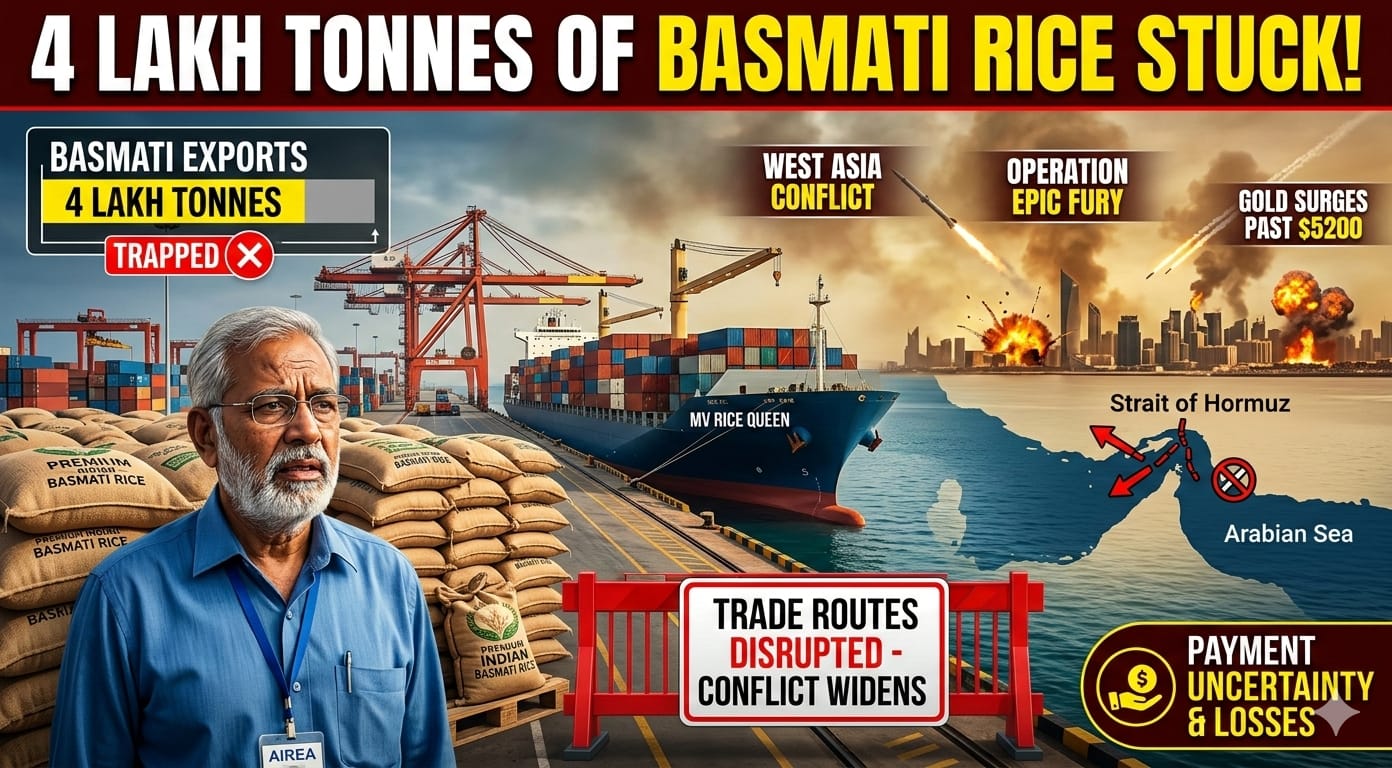
India’s basmati rice trade is facing a serious disruption as the conflict in West Asia continues to grow. According to the All India Rice Exporters’ Association (AIREA), nearly 4 lakh metric tonnes (mt) of basmati rice is either stuck at Indian ports or currently in transit, with no clear timeline for when normal trade can resume.
AIREA president Satish Goel told the press that about 2 lakh tonnes are held at Indian ports, while a similar quantity is somewhere at sea — some near destination ports, others still mid-voyage.
The scale of the problem becomes clearer when you look at the numbers. India exports roughly 60 lakh tonnes of basmati rice every year, and nearly 40 lakh tonnes of that goes to the Gulf region alone, according to Goel. The five biggest basmati buyers — Saudi Arabia, Iran, Iraq, UAE, and Yemen — are all located in West Asia, making them the most directly affected by the current situation. Together, they account for about half of all basmati exports from India.
The Indian Rice Exporters’ Federation (IREF) has issued a formal advisory to its members, warning of sharp price volatility in the days ahead. Wholesale basmati prices had already risen 10 to 15 percent over the past month before the latest escalation, IREF noted. The federation has advised its members to avoid new cost, insurance, and freight (CIF) commitments for Gulf destinations and to shift toward free on board (FOB) sales wherever possible — a move that transfers the freight and insurance risk to the international buyer rather than the Indian exporter.
IREF also flagged the risk of rising shipping fuel prices, known as bunker prices, and a potential shortage of container and bulk vessels if the conflict pushes oil prices higher. Freight costs could spike sharply at short notice, it said, putting exporters who have already agreed to fixed delivered-price contracts in danger of booking losses. Insurance premiums on shipments to the region are also expected to climb.
During the April to December 2025 period, India’s rice exports to the Middle East totalled 3.90 million metric tonnes and to Africa 7.16 million metric tonnes, according to data shared by IREF — showing just how much is at stake.
On the government side, Commerce and Industry Minister Piyush Goyal confirmed that a consultation meeting was held with all stakeholder ministries along with key logistics and trade partners to review the situation. The government has since set up an Inter-Ministerial Group (IMG) for Supply Chain Resilience, bringing together the Department of Financial Services, the Ministry of External Affairs, the Ministry of Shipping, Ports and Waterways, the Ministry of Petroleum and Natural Gas, and the Central Board of Indirect Taxes and Customs.
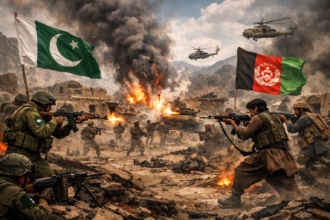
Goel of AIREA said the Commerce Ministry has reassured exporters of full support and is currently in touch with shipping lines to assess the ground situation. The broader geopolitical backdrop makes a quick resolution unlikely. The West Asian conflict has entered its fourth day of large-scale combat operations.
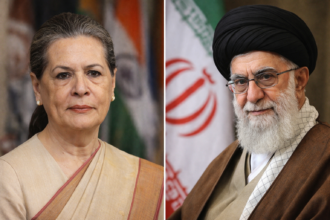
Following the reported death of Iranian Supreme Leader Ali Khamenei, Israeli and US forces have reportedly intensified what has been called “Operation Epic Fury”, striking over 1,250 targets inside Iran. US President Donald Trump said on Tuesday that Tehran had sought talks, but that it was “too late.” Tehran, for its part, has threatened retaliation in the Strait of Hormuz — a critical chokepoint for global energy and shipping. Gold prices have surged past $5,200 as markets respond to the uncertainty. For Indian rice exporters operating on thin margins in a commodity trade, the crisis is unfolding at the worst possible time.